No eBay Sales? Diagnose the Weakest Listing Step

If you have no eBay sales, do not change every listing field at once. Start with the weakest step in the traffic funnel: impressions, page views, or conversion. That tells you whether buyers are failing to find the listing, choosing not to open it, or opening it without buying.
Use at least a seven-day comparison window for fixed-price listings unless there is an obvious error. One quiet day is not enough evidence, and eBay notes that fixed-price page-view counts use a rolling 30-day window once a listing is older than 30 days.
First, read the traffic funnel
Open Seller Hub and review traffic for the same listing and time period. eBay defines a page view as a visit to the listing page; an appearance in search results is not a page view. Its traffic reporting documentation describes listing impressions as appearances of the seller’s listings on an eBay page or flow. Keep those stages separate.
| Pattern | What it suggests | Check first | Change to test |
|---|---|---|---|
| Very few impressions | The listing may not match enough relevant searches, or the offer may be in the wrong category or missing important specifics. | Status, category, title terms, item specifics and eligible shipping destinations | Correct one relevance or eligibility issue |
| Impressions but few page views | Buyers see the result but do not choose it often. | Main photo, visible title, total price, shipping promise and condition | Improve the search-result promise |
| Page views but no sales | The listing earns attention but the offer does not close the decision. | Comparable sold offers, condition proof, return terms, delivery cost and missing buyer answers | Fix the largest trust or value gap |
| Traffic fell across many listings | The issue may be broader than one listing. | Account notices, seller standards, inventory changes and the same date range | Resolve verified account or inventory causes before rewriting |
This table is a diagnosis aid, not proof of how eBay ranks listings. It helps you choose the next test without guessing at a hidden algorithm.
If impressions are weak, check relevance and eligibility
Confirm that the listing is active and available to the buyer you expect. Then inspect the category, title and item specifics. A camera strap placed in a camera-body category may attract the wrong comparison set even if the title contains popular words. Use the eBay category checklist to classify the item by what is actually included.
Next, map buyer language to verifiable product facts. A useful title usually identifies the item, brand or compatible model, defining attribute and condition only when those facts are true. The goal is not to repeat a keyword. It is to make the listing eligible and relevant for the right query. The eBay keyword research workflow shows how to move from search language to listing fields without keyword stuffing.
- Remove terms that describe an accessory, size or model you do not include.
- Complete item specifics that buyers use to filter results.
- Check that handling time and shipping destinations do not exclude the intended buyer.
- Do not end and recreate a listing merely to reset activity; first document the actual defect you are testing.
If buyers see the result but do not open it, fix the search-result promise
The buyer is comparing a compact result: main photo, title, price, delivery information, condition and seller signals. These elements should tell the same story.

Make the first photo the clearest full-item image. It should not conceal the included quantity or make a used product look new. Review the full set against the eBay photo checklist, then compare your visible price and shipping cost with genuinely similar offers. A low item price paired with high delivery cost is still a high total price.
Do not change the title, photo, price and shipping at the same time. If traffic improves, you will not know which change mattered.
If page views arrive but sales do not, close the decision gap
Page views mean buyers reached the listing, not that the offer is competitive. Compare like with like: exact model, included accessories, tested condition, cosmetic wear, fulfillment promise and return terms. A sold comp that includes a charger and original box is not a clean price reference for a bare device.

Record truly comparable sold offers in a worksheet, including condition, accessories and delivery costs. Then test the economics with the Maxmerce eBay Profit Calculator. It is a scenario tool, not a final payout statement or a profit guarantee.
Look for one answer the buyer still lacks:
- Does the item work, and how was that verified?
- Which exact parts, accessories or quantity are included?
- Where is the wear, defect or limitation shown?
- Will it fit the model or use case named in the title?
- What will the buyer pay in total, and when should it arrive?
Run a seven-day single-change test
- Choose one listing with enough time to observe.
- Record the date range, impressions, page views, sales and the current offer.
- Name the first weak funnel stage.
- Make one material change tied to that stage.
- Leave unrelated fields unchanged.
- Review the same metrics after seven days, allowing for demand and seasonality.
| Field | Before | After seven days |
|---|---|---|
| Date range | _____ | _____ |
| Impressions / page views / sales | _____ | _____ |
| One change | _____ | Kept / reverted / retest |
| What you learned | Hypothesis: _____ | Evidence: _____ |
Do not treat a small sample as a guarantee. A niche item may have excellent listing quality and still need more time because buyer demand is limited.

Rebuild a review-ready listing when the facts are scattered
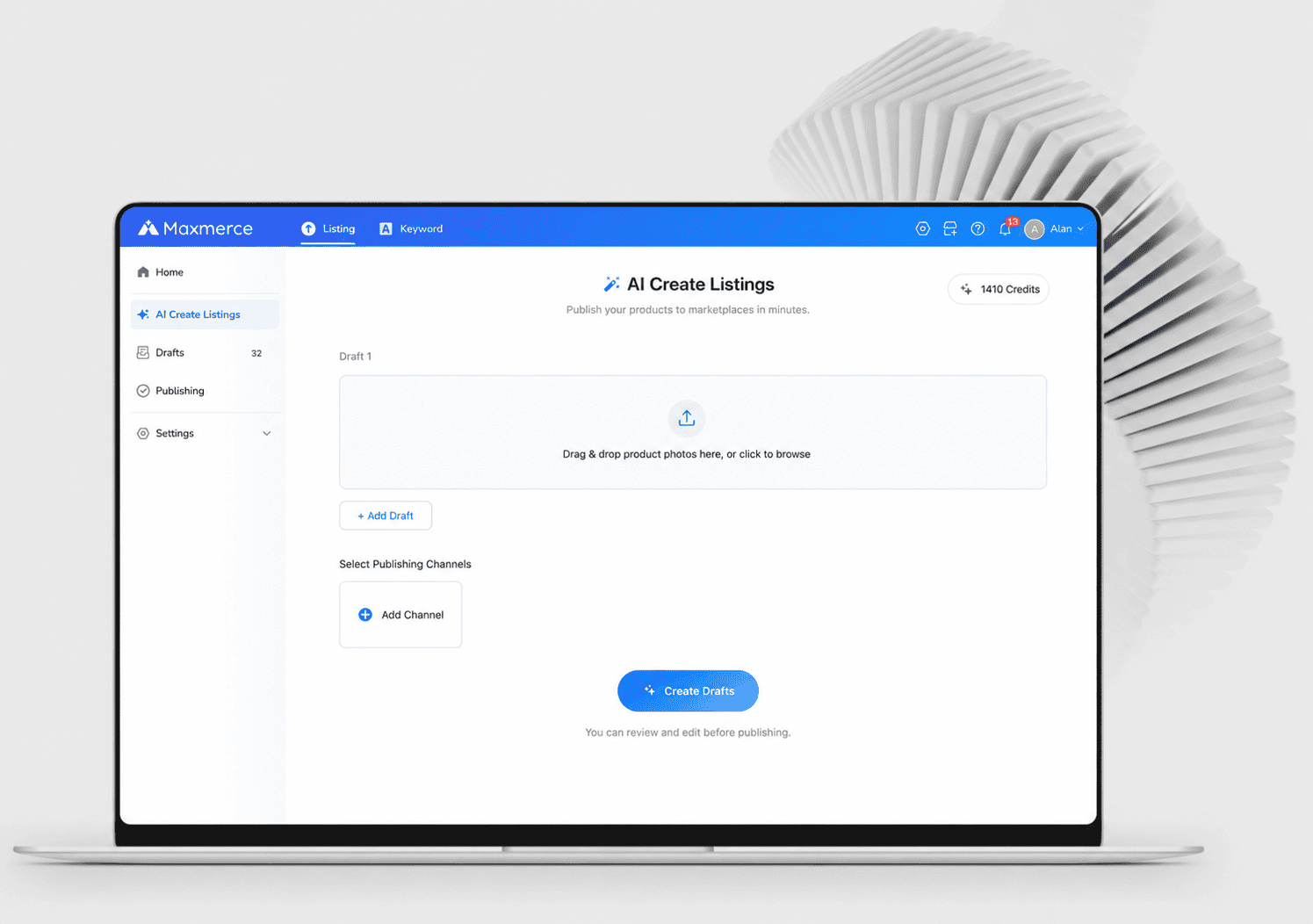
If the diagnosis shows that the title, category, item specifics and description no longer agree, rebuild the draft from verified product facts instead of patching isolated phrases. Maxmerce can generate a review-ready eBay listing draft from product photos and verified product details. You remain responsible for checking the suggested category and every field against the physical item before publishing.
Frequently asked questions
Why do my eBay listings get views but no sales?
Views show that buyers opened the listing. No sale may point to a price, condition, trust, delivery or product-demand gap. Compare the exact offer with truly similar sold items and fix the largest verified gap first.
Why did my eBay page views decrease?
For fixed-price listings older than 30 days, eBay says the displayed count uses a rolling 30-day window. Older days drop out, and bot filtering can also remove views. Use the listing traffic history rather than treating the visible count as a lifetime total.
Should I promote a listing that has no sales?
Promotion may add exposure, but it does not repair a misleading photo, weak offer or missing product facts. Diagnose organic impressions, page views and conversion first; then test advertising separately if the listing and economics are sound.
How long should I wait before changing an eBay listing?
There is no universal period for every item. For an active fixed-price listing without a clear error, a seven-day single-change test is a practical starting point. Slow-demand or seasonal products may require a longer comparison window.
Bottom line: no eBay sales is not one problem. Find the first weak stage, make one evidence-based change and keep a record. That is more useful than repeatedly rewriting the entire listing and hoping the next version works.