Multi-Channel Order Management 2025: Automate Amazon, eBay, Walmart Operations

Multi-channel sellers processing orders across Amazon, eBay, and Walmart manually lose 15-25 hours weekly to repetitive tasks while risking 3-5% order errors that damage seller metrics and customer satisfaction. With order volumes increasing 40% annually and marketplace performance standards tightening, automated order management has evolved from convenience to competitive necessity for sustainable e-commerce growth.
Quick Answer: Multi-Channel Order Management Essentials
Effective multi-channel order management requires centralized order aggregation, automated inventory synchronization, unified shipping workflows, and real-time performance monitoring. Leading platforms like Sellbrite, Linnworks, or ChannelAdvisor reduce processing time by 60-80% while eliminating errors. ROI typically exceeds 300% within 90 days for sellers processing 100+ monthly orders across multiple channels.
Key Takeaways
- Multi-channel automation reduces order processing time by 60-80%
- Centralized systems eliminate 95% of inventory synchronization errors
- Automated workflows improve shipping accuracy to 99.5%+
- Unified analytics provide comprehensive performance insights
- ROI typically reaches 300-500% within first quarter for active sellers
The Multi-Channel Order Management Challenge
Managing orders across multiple marketplaces creates exponential complexity that overwhelms manual processes. Each platform has unique order formats, shipping requirements, tracking protocols, and performance metrics that must be managed consistently for business success.
Order Volume Complexity increases geometrically with each added marketplace. Inventory Synchronization becomes critical to prevent overselling across channels. Shipping Coordination requires platform-specific labels and tracking integration. Performance Monitoring demands unified metrics across diverse platforms.
Cost of Manual Order Management
Manual order processing costs escalate rapidly as businesses grow. Average processing time per order ranges 8-12 minutes manually versus 1-2 minutes with automation. Error rates reach 3-5% manually compared to <0.5% with automated systems.
Hidden costs include opportunity cost of time spent on repetitive tasks, customer service overhead from shipping errors, potential account suspensions from poor performance metrics, and scaling limitations that constrain business growth.
Essential Components of Automated Order Management
Comprehensive order management automation requires integrated systems handling every aspect of the order lifecycle from initial receipt through customer delivery and feedback collection.
Centralized Order Aggregation
Centralized systems collect orders from all marketplaces into unified dashboards enabling efficient processing and oversight. Real-time order synchronization ensures immediate visibility of new orders regardless of source platform.
Order normalization converts platform-specific formats into standardized data structures enabling consistent processing workflows. Priority routing directs orders to appropriate fulfillment channels based on predefined business rules.
Automated Inventory Synchronization
Real-time inventory updates prevent overselling by adjusting available quantities across all channels within 15-60 seconds of any change. Safety stock buffers account for synchronization delays during high-traffic periods.
Intelligent allocation rules distribute inventory based on channel profitability, velocity, and strategic priorities. Automated reorder notifications trigger supplier purchase orders when inventory reaches predetermined thresholds.
Platform-Specific Integration Requirements
Each marketplace requires specialized integration approaches accounting for unique API limitations, data formats, and operational requirements.
Amazon Integration Considerations
Amazon’s Marketplace Web Service (MWS) and Selling Partner API provide comprehensive order management capabilities. FBA integration requires coordination between seller-fulfilled and Amazon-fulfilled inventory. Multi-location inventory management coordinates domestic and international fulfillment centers.
eBay Integration Specifics
eBay’s Trading API handles both auction and Buy It Now formats requiring flexible order processing workflows. Unpaid item management automates communication and case resolution. Global Shipping Program integration streamlines international order fulfillment.
Walmart Marketplace Integration
Walmart’s Partner API emphasizes performance compliance and customer service standards. WFS integration coordinates Walmart-fulfilled versus merchant-fulfilled orders. Real-time acknowledgment requirements demand immediate order processing capability.
Shipping and Fulfillment Automation
Automated shipping workflows eliminate manual label generation while optimizing carrier selection and service levels for cost efficiency and customer satisfaction.
Carrier Selection Optimization
Intelligent carrier selection algorithms evaluate shipping costs, delivery times, and service reliability for optimal selection. Rate shopping APIs compare real-time pricing across USPS, UPS, FedEx, and regional carriers.
Service level mapping ensures marketplace delivery commitments are met while minimizing shipping costs. Automated tracking uploads provide real-time shipment visibility across all platforms.
- Order Receipt: Centralized system aggregates orders from all marketplaces in real-time
- Inventory Check: Automated verification ensures product availability across all channels
- Order Routing: Intelligent routing directs orders to optimal fulfillment locations
- Shipping Selection: Algorithm chooses best carrier/service for cost and speed requirements
- Label Generation: Automated printing with proper marketplace formatting
- Tracking Upload: Real-time tracking numbers uploaded to all relevant platforms
- Customer Notification: Automated shipping confirmations with tracking information
Performance Monitoring and Analytics
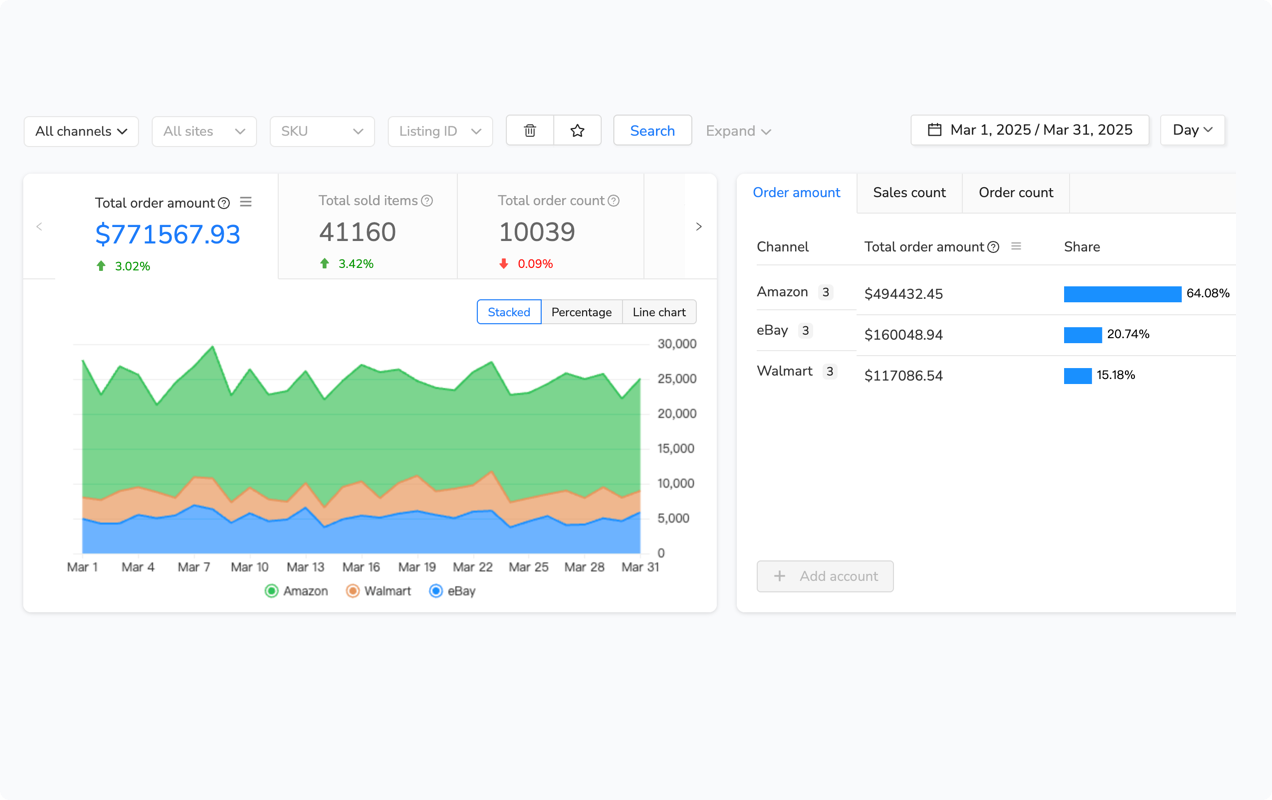
Unified analytics provide comprehensive insights into multi-channel performance enabling data-driven optimization decisions and proactive issue resolution.
Key Performance Indicators
Track metrics that impact both operational efficiency and marketplace performance: order processing speed, shipping accuracy rates, on-time delivery percentages, customer service response times, and inventory turnover rates.
Platform-specific metrics require monitoring: Amazon’s Perfect Order Percentage, eBay’s Top Rated Seller standards, and Walmart’s Pro Seller requirements. Unified dashboards correlate cross-platform performance trends.
Automated Alerting Systems
Real-time alerts notify managers of performance issues requiring immediate attention: inventory stockouts, shipping delays, customer service escalations, and marketplace policy violations. Predictive analytics identify potential problems before they impact performance metrics.
ROI Analysis and Cost Justification
Multi-channel order management automation delivers measurable returns through time savings, error reduction, and operational scaling capabilities that justify technology investments.
Typical ROI calculation includes labor cost savings (15-25 hours weekly × hourly rate), error reduction benefits (3-5% of revenue saved), opportunity costs of freed management time, and revenue growth from improved performance metrics.
Break-even points typically occur within 60-90 days for sellers processing 100+ monthly orders across multiple channels. Advanced sellers report 300-500% annual ROI through operational efficiency and growth acceleration.
Implementation Strategy and Best Practices
Successful multi-channel order management implementation requires systematic planning, gradual rollout, and continuous optimization based on performance data and business growth requirements.
Begin with platform integration for your highest-volume marketplace, then expand to secondary channels once workflows are optimized. Maintain backup manual processes during initial implementation periods to ensure business continuity.
For comprehensive multi-channel management, consider platforms like Maxmerce’s unified management system that can help coordinate orders, inventory, and performance across Amazon, eBay, and Walmart simultaneously. These integrated solutions are designed to help streamline operations while maintaining the flexibility needed for marketplace-specific requirements.
Focus on automation that enhances rather than replaces human oversight. Use technology to eliminate repetitive tasks while preserving human judgment for complex decisions requiring business context and customer relationship considerations.
Success in multi-channel order management comes from systematic automation that scales with business growth while maintaining the operational excellence required for marketplace success across all channels.
No credit card required • Start Your Free Trial with Maxmerce Today →