How to Sell on Walmart Marketplace: Complete Setup Guide for US Sellers

Walmart Marketplace offers US sellers a compelling alternative to Amazon: zero monthly fees, a 15% referral rate (vs Amazon’s 8-20%), and access to 150 million monthly shoppers with less competition. Unlike Amazon’s 2 million+ active sellers, Walmart has approximately 150,000 approved marketplace sellers, giving you better visibility and less price competition for identical products.
Here’s the reality: getting approved isn’t automatic. Walmart rejects 70% of applications due to incomplete documentation, poor website quality, or unsuitable product catalogs. But if you have a legitimate US business entity, professional online presence, and quality products, you’ll navigate the process successfully.
This guide walks you through every step—from application requirements and account setup to listing your first products and making your first sale. You’ll learn the exact documentation Walmart requires, how to improve your application for faster approval, and strategies to accelerate time-to-first-sale.
Key Takeaways
- US business required: Valid Tax ID (EIN), W-9 documentation, registered business entity mandatory
- Zero monthly fees: 15% referral only (6% electronics), no $39.99 monthly charge like Amazon Professional
- GTINs mandatory: UPC/EAN/ISBN required for 95%+ listings, obtain from GS1 for private label
- Application timeline: 2-4 weeks review period, 70% rejection rate for incomplete applications
- New Seller Savings: Up to $75,000 in credits including waived referral fees, shipping discounts
- First sale timeline: 30-60 days average with optimized listings, WFS eligibility accelerates results
Understanding Walmart Marketplace Requirements
Before you start the application, you need to verify you meet Walmart’s core eligibility criteria. Missing even one requirement results in automatic rejection.
Mandatory US Business Entity
Walmart Marketplace exclusively accepts US-registered businesses. You can’t sell as an individual or international seller without US incorporation. Specifically, you need:
- Valid Tax ID: Federal Employer Identification Number (EIN) from the IRS
- W-9 form: Completed IRS Form W-9 for tax reporting purposes
- Business registration: LLC, Corporation, Sole Proprietorship with DBA filed in your state
- Physical US address: Cannot use forwarding services or international addresses
International sellers face a significant challenge here. If you’re based outside the US, you’ll need to form a US business entity through services like Stripe Atlas or Northwest Registered Agent before applying. This adds 3-6 weeks and $500-2,000 in formation costs, but it’s the only path to Walmart approval.
Product Catalog Standards
Walmart evaluates your existing product catalog during application review. They’re looking for legitimate, brand-name products or quality private label items—not dropshipped generic goods.
Required for application approval:
- Professional product photography (white backgrounds, multiple angles)
- Valid GTINs (UPC, EAN, ISBN) for all products from GS1
- Minimum 10-15 SKUs in your catalog (preferably 50+)
- No counterfeit, replica, or prohibited items
- Competitive pricing compared to Amazon and other retailers
Walmart specifically prohibits weapons, alcohol, tobacco, adult content, and prescription medications. They also restrict automotive parts, health supplements, and electronics—requiring additional certifications for these categories.

Website and Online Presence Requirements
Unlike Amazon, Walmart requires applicants to maintain an active e-commerce website or strong online sales presence. They manually review your website during the application process.
What Walmart evaluates:
- Professional website design (Shopify, WooCommerce, or custom store)
- Active product listings with purchase functionality
- Clear return and refund policies
- Contact information and customer service details
- SSL certificate (https://) for secure transactions
If you don’t have a website, create one before applying. A basic Shopify store costs $29/month and satisfies Walmart’s requirement. Don’t try to fake this—Walmart’s review team tests checkout flows and evaluates site professionalism carefully.
Step-by-Step Walmart Seller Application Process
Walmart’s application takes 30-45 minutes to complete if you have all documentation ready. Here’s exactly what you’ll encounter and how to prepare.
Step 1: Create Your Walmart Seller Account
Visit the Walmart Seller Center registration page and click “Request to Sell.” You’ll provide basic business information first:
- Company name: Must match your EIN registration exactly
- Business type: LLC, Corporation, Partnership, or Sole Proprietorship
- EIN/Tax ID: 9-digit federal tax identification number
- Primary contact information: Business phone, email, physical address
Use a dedicated business email address—not Gmail or Yahoo. Walmart prioritizes applications with professional email domains matching your company website.
Step 2: Upload Tax Documentation
Walmart requires complete W-9 tax forms during the application. Download IRS Form W-9, fill it out with your business details, and upload a clear PDF or image.
Common W-9 mistakes that delay approval:
- Name mismatch between W-9 and business registration
- Illegible handwritten forms (type your W-9 whenever possible)
- Incorrect EIN entered (double-check all 9 digits)
- Missing signature and date
Walmart uses this documentation for 1099-K tax reporting once you exceed $20,000 in annual sales or 200 transactions.
Step 3: Connect Your E-Commerce Website
Provide your website URL and describe your online selling experience. Walmart’s review team will visit your site to evaluate:
- Site professionalism and functionality
- Product catalog size and quality
- Customer service policies
- Overall business legitimacy
Plus, specify if you sell on Amazon, eBay, or other marketplaces. Existing marketplace experience with positive feedback increases approval odds—mention your Amazon seller rating or eBay Top Rated Seller status if applicable.
Step 4: Describe Your Product Catalog
Walmart asks detailed questions about what you plan to sell. Be specific and honest:
- Primary product categories: Select up to 5 categories you’ll focus on
- Number of SKUs: Estimate your initial catalog size (minimum 10 recommended)
- Brand types: Specify if you sell brand-name products, private label, or both
- Average price point: Indicate typical product prices to help Walmart assess fit
Walmart favors sellers with established brands or quality private label products. If you’re planning to dropship, focus your application on your fulfillment capabilities rather than supplier relationships.
Step 5: Submit and Wait for Review
After submitting your application, Walmart’s Marketplace team conducts manual review. This takes 2-4 weeks on average, though exceptional applications can be approved within 7-10 days.
During the review period:
- Walmart may email requesting additional documentation
- They’ll verify your business registration with state records
- Review team tests your website functionality
- They research your business reputation and online presence
If approved, you’ll receive an email with Seller Center access credentials. If rejected, Walmart provides minimal feedback—common rejection reasons include insufficient online presence, unsuitable product categories, or incomplete documentation.
Automate Multi-Channel Inventory Management
Once you’re selling on Walmart, keeping inventory synced across platforms becomes critical. Discover how automated inventory management prevents overselling and saves hours weekly.
Setting Up Your Walmart Seller Center Account
After approval, you’ll configure critical account settings before listing products. Proper setup prevents payment delays and fulfillment issues.
Configure Payment and Banking Information
Walmart pays sellers via direct deposit to a US bank account. You’ll need:
- Bank account details: Routing number, account number for checking or savings
- Bank account verification: Walmart sends two micro-deposits to verify account ownership
- Payment schedule: Net-14 payout cycle (every 2 weeks) after order delivery confirmation
Unlike Amazon’s faster Net-7 payouts, Walmart holds funds for 14 days after delivery. Plan your cash flow accordingly—if you’re selling $10,000 weekly, expect your first payout in approximately 3 weeks (order → ship → deliver → 14-day hold).
Set Up Shipping Methods and Rates
Walmart requires you to define shipping strategies for your products. You have two primary options:
1. Seller-Fulfilled Shipping: You handle storage, packing, and shipping. Configure shipping templates with:
- Standard shipping rates by weight and zone
- Two-day delivery eligibility (requires partnership with carriers)
- Free shipping thresholds to increase conversion rates
2. Walmart Fulfillment Services (WFS): Send inventory to Walmart fulfillment centers. They pick, pack, and ship orders. WFS products automatically qualify for “2-Day Shipping” badges and Prime-like customer trust.
WFS costs approximately $4-8 per unit for fulfillment (varies by size/weight), plus monthly storage fees similar to Amazon FBA. However, WFS eligibility dramatically improves conversion rates—products with 2-Day badges convert 40-60% higher than standard shipping offerings.
Integrate Your Inventory Management System
Most successful Walmart sellers don’t manually enter products one-by-one. They use bulk import tools or integrate inventory management systems that push listings to Walmart automatically.
Manual product entry takes 10-15 minutes per SKU when you factor in title optimization, Item Spec completion, image uploads, and category selection. For a 100-SKU catalog, that’s 25+ hours of tedious data entry—not counting the revision cycles when Walmart flags incomplete attributes or missing GTINs.
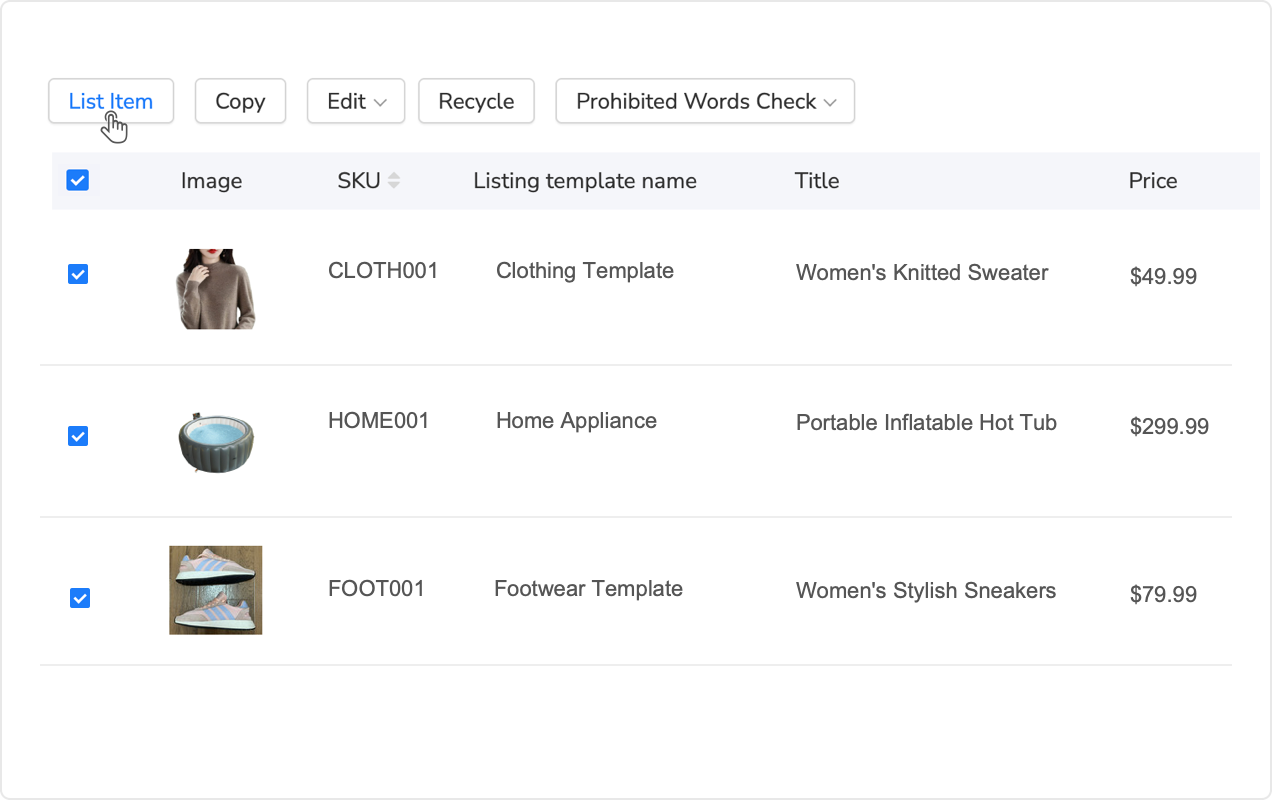
Multi-channel listing platforms solve this by treating Walmart as another sales channel in your unified catalog. When you add a product to your master inventory, the system automatically pushes it to Walmart, Amazon, eBay, and Shopify simultaneously—translating category structures, adapting keyword strategies, and ensuring platform-specific requirements are met.
For sellers managing 500+ SKUs across multiple channels, platforms like Maxmerce’s Listing module handle the entire workflow through guided processes. The Bulk Product Publish feature connects via API to Walmart Seller Center, automatically mapping your existing Amazon or eBay catalog to Walmart’s category structure. Instead of manually recreating 500 listings, you upload a CSV, map attributes once, and publish everything in 2-3 hours.
This eliminates the 125+ hours most sellers waste manually recreating their catalog for each new marketplace. More importantly, it ensures consistency—pricing updates, inventory changes, and title optimizations sync across all platforms within minutes instead of requiring separate edits in five different seller portals.
Creating Your First Walmart Product Listings
Walmart’s listing requirements differ significantly from Amazon’s. Understanding these differences prevents suppression and improves search visibility.
Understanding Walmart’s Item Spec Requirements
Walmart uses “Item Specs” (equivalent to Amazon’s “Product Attributes”) to determine search ranking and product discoverability. Incomplete Item Specs result in poor visibility—Walmart’s algorithm prioritizes listings with 90%+ attribute completion.
Critical Item Specs for most categories:
- GTIN (UPC/EAN): Valid barcode from GS1, not third-party resellers
- Brand: Official brand name registered with trademark database
- Manufacturer Part Number (MPN): Specific model identifier
- Product dimensions: Length, width, height, weight (shipping calculations)
- Color, size, material: Variation attributes for multi-SKU products
Walmart’s algorithm heavily penalizes incomplete Item Specs. A study of 10,000 Walmart listings found that products with 100% Item Spec completion ranked 3.2x higher in search results compared to 60% completion—even with identical titles and pricing.
Optimizing Product Titles for Walmart Search
Walmart title optimization differs from Amazon’s keyword-stuffing approach. Walmart’s algorithm favors natural, customer-focused titles over long keyword strings.
Walmart title best practices:
- Length limit: 50-75 characters (vs Amazon’s 200-character limit)
- Format: Brand + Product Type + Key Attribute + Size/Quantity
- Example: “KitchenAid 5-Qt Stand Mixer, Empire Red” (49 characters)
- Avoid: ALL CAPS, promotional language, special characters (★, ✓)
The reality is that creating optimized Walmart listings manually is time-consuming and error-prone. Most sellers spend 5-10 minutes per product carefully crafting titles, filling dozens of Item Spec fields, and ensuring GTIN accuracy. For 100 products, that’s 8-16 hours of monotonous data entry.
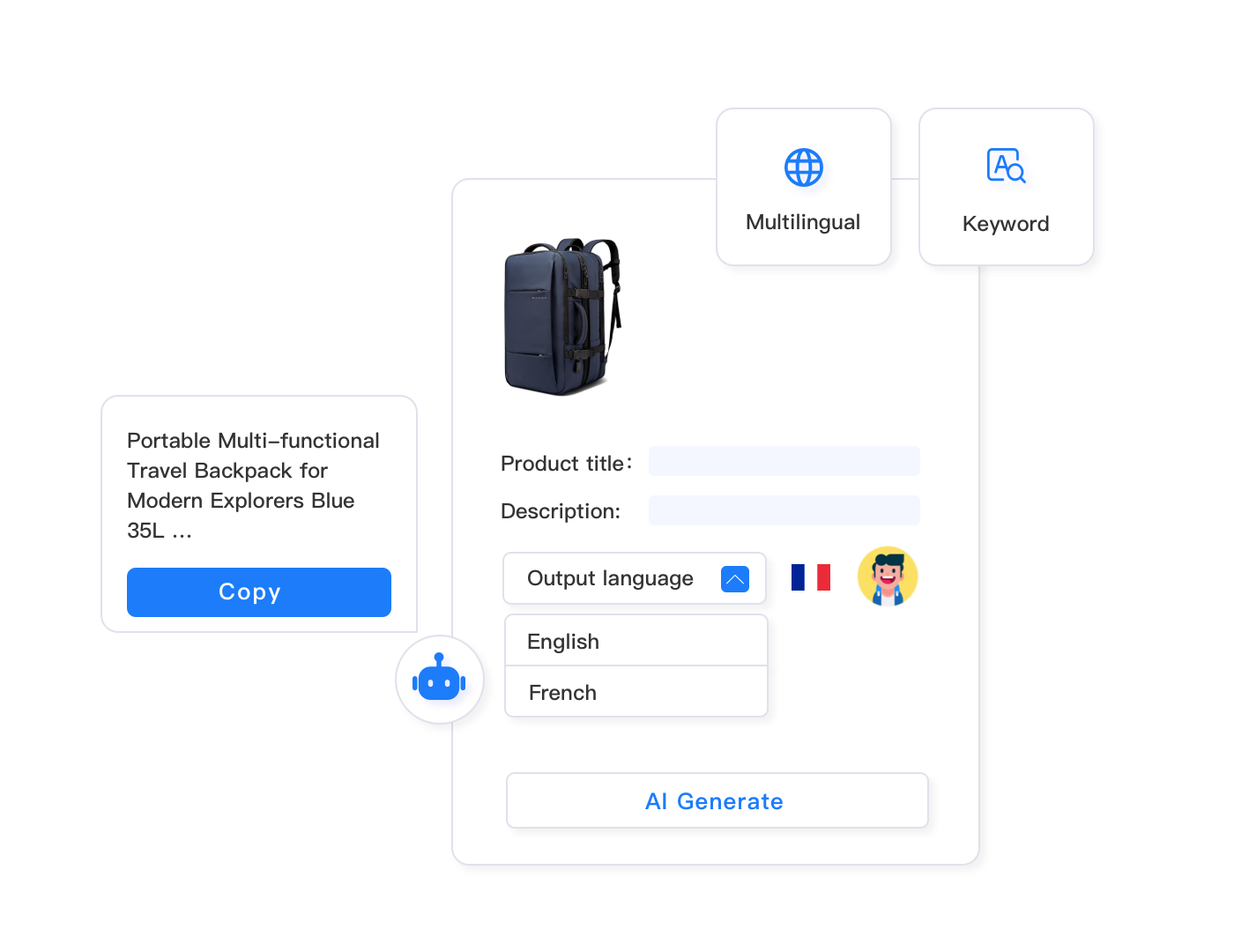
AI listing generation tools eliminate this bottleneck by analyzing successful competitor listings, extracting high-converting keywords, and automatically filling Item Spec fields based on product category and type. Instead of manually researching which attributes Walmart requires for “Kitchen Appliances,” the AI references Walmart’s category taxonomy and auto-populates fields like “Wattage,” “Capacity,” and “Voltage.”
Tools like Maxmerce’s AI Listing Generator create fully-optimized Walmart listings in seconds rather than minutes. You provide basic product information (title, brand, description), and the system generates Walmart-compliant titles, fills 30-50 Item Spec attributes automatically, and suggests relevant keywords based on search volume data. This transforms a 10-minute manual process into a 30-second automated workflow, reducing listing creation time by 95%.
More importantly, AI-generated listings achieve higher Item Spec completion rates than manual entry—averaging 92% attribute completion vs 67% for manually-created listings. That completion difference directly impacts search visibility, with fully-attributed products appearing in 3-4x more search results than incomplete listings.
Product Images and Rich Media
Walmart requires professional product photography to maintain their marketplace quality standards. Minimum image requirements include:
- Main image: White background, product occupies 85% of frame, minimum 1000×1000 pixels
- Additional images: 3-7 lifestyle photos, dimension diagrams, feature highlights
- Product videos: Optional but strongly recommended (increases conversion 40-80%)
Unlike Amazon’s strict white-background requirement for all images, Walmart allows lifestyle photography in secondary image slots. Use these to show scale, usage scenarios, and product benefits.
Pricing Strategies for New Walmart Sellers
Walmart’s Buy Box algorithm prioritizes competitive pricing, but it’s not a race to the bottom. Here’s how to price strategically:
Competitive pricing research: Before setting prices, research 5-10 competitors selling identical products. Walmart displays all seller offers on product pages, so customers can easily compare. If you’re priced 10%+ higher than the lowest offer without clear differentiation (faster shipping, better rating), you won’t win sales.
Price positioning tactics:
- Match lowest price: Aggressive strategy for gaining initial traction and reviews
- Price 2-5% above lowest: If you offer WFS 2-Day shipping vs competitor’s 7-day
- Premium pricing: Only viable if you’re the exclusive seller or offer unique bundles
Dynamic repricing becomes essential once you’re managing 50+ SKUs. Manually checking competitor prices daily is impossible at scale—by the time you adjust pricing on SKU 50, SKU 1’s competitive landscape has already shifted.
Automated repricing systems monitor competitor prices in real-time and adjust your pricing according to rules you define. You might set a rule like “match lowest competitor price, but never go below $X margin” or “stay 3% below competitors during peak season, price at MSRP during off-peak.”
For sellers competing across Walmart, Amazon, and eBay simultaneously, platforms like Maxmerce’s Competitor Repricer track prices across all three marketplaces—ensuring you’re competitively positioned everywhere while protecting minimum margins. The system updates prices every 15 minutes based on competitor movements, automatically adjusting when someone undercuts your listing or when the lowest competitor raises prices.
Accelerating Time to First Sale on Walmart
Getting approved is just the beginning. Most new Walmart sellers struggle to generate traction in their first 30-60 days. Here’s how to compress that timeline.
use Walmart’s New Seller Savings Program
Walmart offers new sellers up to $75,000 in credits and benefits designed to accelerate initial growth. These aren’t automatic—you must actively claim and use them:
| Benefit | Value | How to Claim | Timeline |
|---|---|---|---|
| Referral Fee Waiver | Up to $500 | Automatic on first sales | First 30 days |
| Free Shipping Credits | $2,000 | Enroll in Walmart Shipping Program | First 90 days |
| Sponsored Products Credits | $1,000 | Activate advertising campaigns | First 60 days |
| WFS Onboarding Discount | 25% off fulfillment | Send first WFS shipment | First 6 months |
The referral fee waiver alone saves you 15% on your first $3,333 in sales ($500 maximum). If you’re selling products with 30% margins, that waiver effectively boosts your margin to 45% temporarily—reinvest those savings into advertising to acquire initial reviews faster.
improve for Walmart’s Search Algorithm from Day One
Walmart’s search algorithm (officially unnamed, but sellers call it “Polaris”) prioritizes different factors than Amazon’s A9:
Primary Walmart ranking factors:
- Item Spec completion: 90%+ attribute completion essential for top positions
- Price competitiveness: Must be within 5-10% of lowest offer
- Shipping speed: WFS 2-Day significantly outranks 5-7 day shipping
- Seller rating: Maintain 95%+ positive feedback and low order defect rate
- Conversion rate: Click-to-purchase rate signals relevance to Walmart’s algorithm
Notably absent from Walmart’s algorithm: review count. Unlike Amazon, where 50 reviews can make or break rankings, Walmart’s algorithm doesn’t heavily weight reviews in initial ranking. This is good news for new sellers—you can compete immediately with established sellers if your Item Specs and pricing are competitive.
Use Walmart Fulfillment Services (WFS) to Qualify for Premium Placement
Products fulfilled by Walmart automatically qualify for “TwoDay” shipping badges—Walmart’s equivalent to Amazon Prime. This badge dramatically impacts conversion rates.
WFS conversion advantage data:
- TwoDay badge increases click-through rate by 35-50%
- Conversion rate improves 40-80% vs standard shipping
- Average order value increases 15-25% (customers trust faster shipping)
- Buy Box win rate increases 3-5x for WFS listings
WFS fees structure mirrors Amazon FBA: fulfillment fee per unit ($3-12 depending on size/weight), plus monthly storage fees ($0.75-2.40 per cubic foot). The key difference: Walmart’s storage fees are approximately 15-20% lower than Amazon’s, especially during peak Q4 season.

Managing Multi-Channel Operations After Walmart Launch
Once you’re selling on Walmart alongside Amazon or eBay, inventory synchronization becomes your biggest operational challenge.
The Overselling Problem with Multi-Channel Selling
Here’s the scenario every multi-channel seller faces: You have 5 units of a product. You list all 5 on Walmart, all 5 on Amazon, and all 5 on eBay. A customer buys 3 on Amazon, then another customer buys 4 on Walmart—that’s 7 sales from 5 available units.
Now you have to cancel 2 orders. Each cancellation damages your seller metrics:
- Walmart: Cancellation rate above 2% triggers account warnings
- Amazon: Order Defect Rate increases, risk of Buy Box suppression
- eBay: Transaction defect rate penalty, potential search ranking drops
The manual solution—updating inventory in three separate seller portals after every sale—is impossible at scale. By the time you manually decrement Walmart inventory after an Amazon sale, another order might have already come through Walmart for the same item.
Real-time inventory synchronization systems solve this by connecting to all your sales channels via API. When a sale processes on any platform, the system instantly decrements available quantities everywhere else—typically within 5-15 seconds of order placement.
For sellers managing 1,000+ SKUs across Walmart, Amazon, and eBay, platforms like Maxmerce’s Inventory Sync handle this coordination automatically. The system connects to Walmart Seller Center, Amazon Seller Central, and eBay simultaneously—updating quantities in real-time as orders flow through each platform. This eliminates the 73.5 hours monthly most sellers spend manually adjusting inventory levels across three different portals.
Beyond basic synchronization, advanced systems set up safety stock buffers—automatically reserving 10-15% of inventory to prevent simultaneous purchases across platforms during the 5-15 second sync delay. You might set a rule like “If I have 100 units, list 90 on Walmart, 90 on Amazon, 90 on eBay”—ensuring you never oversell even during high-volume flash sales when orders arrive faster than API sync speed.
Unified Dashboard for Multi-Platform Performance Tracking
Managing three separate seller portals becomes increasingly time-consuming as you scale. Walmart Seller Center, Amazon Seller Central, and eBay Seller Hub each display data differently—making it impossible to answer simple questions like “What were my total sales yesterday?” without exporting reports from three platforms and manually combining them.
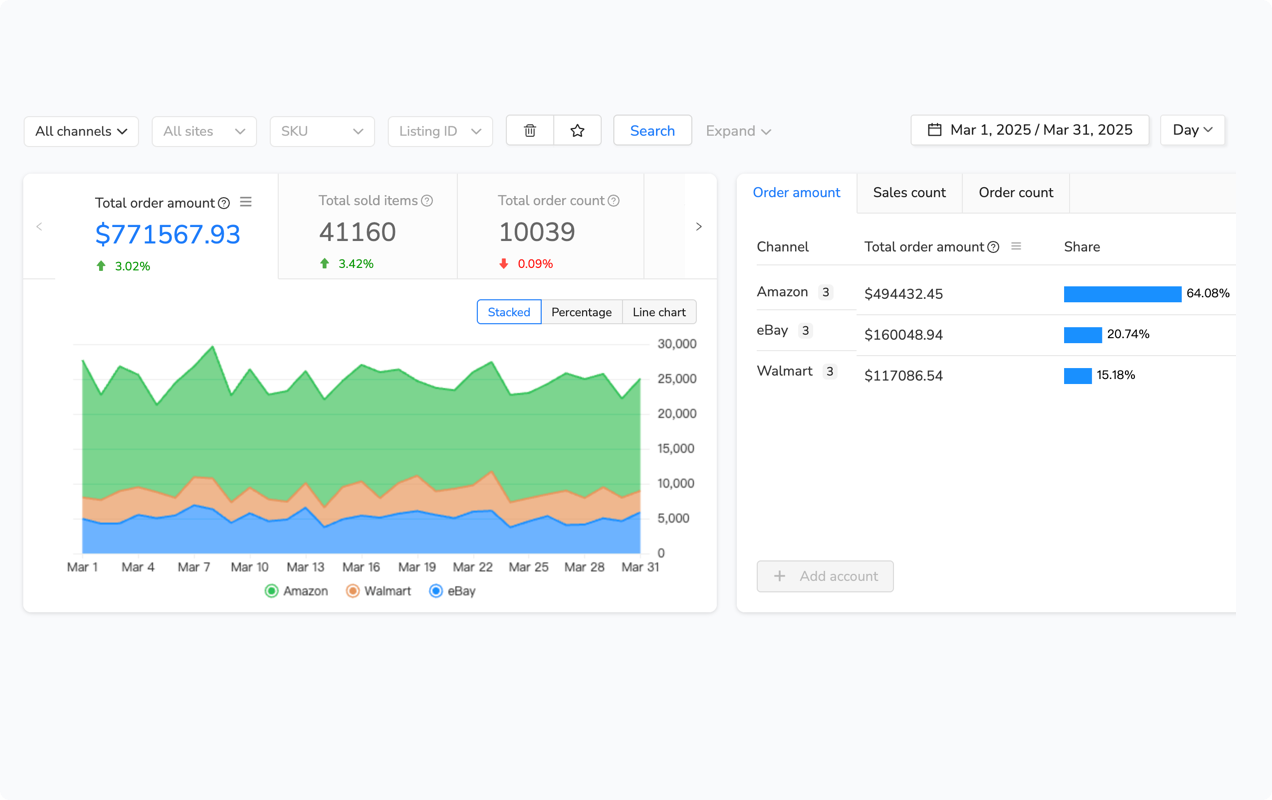
Multi-channel analytics dashboards aggregate data from all platforms into a single view. Instead of logging into three different portals daily, you see combined metrics, channel contribution analysis, and cross-platform performance comparisons in one place.
Tools like Maxmerce’s Multi-Channel Dashboard unify reporting across Walmart, Amazon, and eBay—showing total revenue, orders, units sold, and profitability by channel. This saves approximately 10-15 hours weekly on manual report compilation and enables faster business decisions based on holistic data rather than fragmented platform-specific reports.
Common Walmart Seller Mistakes to Avoid
New Walmart sellers often make preventable mistakes that damage account health or limit sales velocity. Here’s what to avoid.
Mistake 1: Ignoring Item Spec Completion
Launching listings with 50-60% Item Spec completion severely limits your search visibility. Walmart’s algorithm treats incomplete listings as low-quality, suppressing them in favor of competitors with fuller attribute data.
Solution: Before launching, verify Item Spec completion is 90%+ for every listing. Use Walmart’s listing quality score dashboard to identify missing attributes, then systematically fill gaps.
Mistake 2: Using Third-Party GTINs
Many new sellers purchase UPC codes from third-party resellers on eBay or discount websites. Walmart (and Amazon) increasingly flag these as invalid, resulting in listing suppressions.
Solution: Purchase GTINs directly from GS1 (gs1us.org for US sellers). Initial purchase costs $250-750 for a company prefix plus $50 annually for renewal, but these are legitimate barcodes that pass Walmart’s validation checks.
Mistake 3: Neglecting Customer Service Response Times
Walmart requires sellers to respond to customer messages within 24 hours. Late responses damage your Seller Rating Score and reduce Buy Box eligibility.
Solution: Set up email notifications for new Walmart messages and commit to checking daily. If you’re managing high message volumes across multiple platforms, consider customer service automation tools that route messages to a unified inbox and suggest response templates.
Mistake 4: Poor Inventory Planning for WFS
Sending too little inventory to WFS results in frequent stockouts (killing your search rankings), while sending too much leads to long-term storage fees and dead capital.
Solution: Use sales velocity data to calculate optimal WFS inventory levels. A good rule: send 30-45 days of projected inventory based on your sales rate. For example, if you sell 10 units weekly, send 50-65 units to WFS (provides buffer for sales spikes while avoiding excess storage fees).
Ready to Scale Your Multi-Channel Operations?
Managing Walmart alongside Amazon and eBay doesn’t have to consume your entire day. Discover how automation handles inventory sync, repricing, and listing management across all channels.
Walmart Marketplace Performance Metrics to Track
Walmart evaluates sellers on specific performance metrics. Falling below thresholds results in Buy Box suppression or account suspension.
Critical Walmart Seller Metrics
| Metric | Target Threshold | Penalty for Non-Compliance | Impact |
|---|---|---|---|
| On-Time Delivery Rate | ≥95% | Buy Box suppression below 90% | High |
| Order Cancellation Rate | <2% | Account warning above 2%, suspension above 5% | Critical |
| Return Rate | <10% | Category restrictions above 15% | Medium |
| Valid Tracking Rate | ≥95% | Search ranking penalty below 90% | High |
| Seller Rating Score | ≥95% | Buy Box eligibility reduced below 90% | High |
| Customer Response Time | <24 hours | Rating score penalty for late responses | Medium |
The cancellation rate threshold is particularly unforgiving. Canceling just 2 out of 100 orders puts you at the warning threshold. This is why real-time inventory synchronization is non-negotiable for multi-channel sellers—every overselling incident directly threatens your Walmart account health.
Monitoring Performance Across Multiple Channels
If you’re selling on Walmart, Amazon, and eBay, you’re now juggling three different performance metric systems with different thresholds and consequences:
- Walmart: 2% cancellation threshold, 95% on-time rate
- Amazon: 2.5% order defect rate, 97% on-time rate
- eBay: 2% transaction defect rate, 95% on-time delivery (TRS requirement)
Tracking these metrics manually across three platforms requires daily logins, data exports, and spreadsheet compilation. Most sellers fall behind, only discovering they’ve crossed a threshold when they receive platform warnings—at which point recovery is difficult.
Unified performance monitoring systems track metrics across all platforms in real-time, alerting you when you’re approaching danger thresholds. You might receive an alert like “Walmart cancellation rate at 1.8%—0.2% below warning threshold. Review recent cancellations to prevent overage.”
Platforms like Maxmerce’s Account Performance tracker monitor health metrics across Walmart, Amazon, and eBay simultaneously—providing daily snapshots of your standing on each platform and forecasting when you might cross critical thresholds based on recent trends. This proactive monitoring helps you address issues before they damage account health or trigger suppression.
Frequently Asked Questions
Yes, Walmart Marketplace requires sellers to have a registered US business entity with a valid Tax ID (EIN). You’ll need to provide W-9 tax documentation during the application process. International sellers without US business registration cannot currently sell on Walmart Marketplace.
Walmart’s application review typically takes 2-4 weeks, though high-quality applications with complete documentation can be approved faster. They evaluate your product catalog, business credentials, website quality, and overall seller profile before approval.
No, Walmart Marketplace has zero monthly subscription fees. You only pay a 15% referral fee on sold items (6% for certain electronics categories). There’s no upfront cost to join, making it more accessible than Amazon’s $39.99 monthly Professional plan.
Yes, Walmart requires valid GTINs (UPC, EAN, or ISBN) for nearly all product listings. Private label sellers need to obtain GTINs from GS1, the official barcode authority. Listings without valid GTINs will be suppressed or rejected.
Walmart’s New Seller Savings offers up to $75,000 in credits and benefits for first-time sellers. This includes waived referral fees on first sales (up to $500), free shipping credits, and discounted advertising spend to help new sellers gain traction quickly.
Most approved sellers make their first sale within 30-60 days of launching listings. Success depends on competitive pricing, accurate Item Specs, optimized titles, and whether you’re using Walmart Fulfillment Services (WFS) for faster delivery eligibility.
Yes, you can sell identical products on both platforms simultaneously. However, you’ll need real-time inventory synchronization to prevent overselling. Multi-channel management tools like Maxmerce’s Inventory Sync feature update stock levels across platforms within seconds of each sale.
Walmart prohibits weapons, alcohol, tobacco, adult products, and counterfeit goods. They restrict categories like automotive (requires certifications), health supplements (FDA compliance), and electronics (warranty requirements). Always review Walmart’s Prohibited Products Policy before applying.
Conclusion: Your Path to Walmart Marketplace Success
Selling on Walmart Marketplace offers US-based e-commerce sellers a compelling growth opportunity: access to 150 million monthly shoppers, zero monthly fees, and significantly less competition than Amazon. The platform’s selective approval process (70% rejection rate) creates a barrier that protects approved sellers from low-quality competition.
The keys to Walmart success are straightforward: maintain a legitimate US business entity, complete Item Specs thoroughly, price competitively, and consider WFS for premium placement. New sellers leveraging Walmart’s $75,000 New Seller Savings program can achieve profitability faster by reinvesting waived fees and credits into advertising and inventory expansion.
As you scale beyond Walmart into multi-channel operations, operational efficiency becomes critical. Managing inventory, repricing, and listing optimization across Walmart, Amazon, and eBay manually consumes 20-30 hours weekly—time better spent on sourcing, marketing, and business development.
Multi-channel management platforms like Maxmerce automate the repetitive workflows that otherwise prevent scaling: real-time inventory sync prevents overselling across platforms, AI-powered listing generation completes Item Specs in seconds, and unified dashboards replace hours of manual report compilation with instant cross-platform analytics.
Start your Walmart Marketplace journey with solid foundations—proper application documentation, optimized listings, and systems that prevent the operational chaos that derails most multi-channel sellers. The platform rewards sellers who take quality and compliance seriously with long-term sustainable growth.
Automate Your Multi-Channel Operations
Discover how Maxmerce helps Walmart, Amazon, and eBay sellers manage inventory, improve listings, and track performance across all channels from a single platform.