Amazon Keyword Rank vs BSR: Read the Right Number

Amazon keyword rank vs BSR is a comparison of two different things: where a product appears for a search query, and how it ranks by sales within a category. A better Best Sellers Rank does not prove that your product moved up for a particular keyword. A better keyword position does not tell you how many units you sold.
If a report says “rank improved,” ask which rank. That small question can prevent a large mistake: rewriting a listing, changing an advertising budget or ordering stock because two unrelated numbers were treated as one result.

What does each rank measure?
Amazon’s Best Sellers Rank guide describes BSR as sales rank within a category. It uses recent and historical sales, with more weight on recent sales. A product can have different ranks in different categories and Amazon stores. Search ranking, by contrast, concerns the results shown for a query. Amazon explicitly notes that strong performance in one ranking does not guarantee strong performance in the other.
| Measure | Question it helps answer | Label to preserve | It does not establish |
|---|---|---|---|
| Keyword search position | Where did this product appear for this query in this observation? | Query, product, marketplace, source, time and result type. | Total sales or a category-wide sales rank. |
| Best Sellers Rank | How did this product rank by sales in this category? | Product, exact category, Amazon store and observation time. | Its position for any particular keyword. |
| Sponsored placement | Where did an advertisement appear? | Ad/result type, query or placement, source and time. | An organic search position. |
Sponsored placement deserves its own row. Amazon Ads explains that Sponsored Products can appear in shopping results and on product pages. Seeing a product near the top of a results page is therefore not enough to call it a high organic ranking; identify the result type first.
A worked example: one product, four observations
Imagine you sell a plain white ceramic mug. The following numbers are fictional teaching examples, not Amazon data or Maxmerce tool results. Assume the same product, marketplace and measurement method for each pair.

| Record | Measure | Earlier observation | Later observation | Supported reading |
|---|---|---|---|---|
| A | Organic position for “white ceramic mug” | 18 | 11 | Earlier position in the later recorded result set. |
| B | Organic position for “coffee mug with handle” | 9 | 15 | Later position for this different query. |
| C | BSR in the same recorded category | 8,000 | 6,000 | Better category sales rank; not a count of additional orders. |
| D | A sponsored result was seen | No observation recorded | Seen | An ad was observed; the earlier blank is not proof that no ad ran. |
It would be wrong to conclude that every keyword improved because the BSR number fell. Query A and query B moved in different directions. It would also be wrong to subtract 6,000 from 8,000 and report 2,000 extra sales. Rank positions are not units sold.
A useful note would say: “The recorded position improved for query A and worsened for query B. Category BSR improved. Check actual sales and traffic before attributing the changes to our recent listing edit.” That statement is less dramatic than “SEO worked,” but another person can verify it.
Build a two-track monitoring note
Seller best practice: keep search observations and category-sales observations in separate sections. This is a suggested record format, not an Amazon reporting requirement.
- Search track: product/ASIN, exact query, Amazon store, source or tool, observation time, result type, position and any search settings supplied by the source.
- Category track: the same product, exact category name, Amazon store, observation time and BSR.
- Business context: sales and traffic from reports you can access, plus dated changes to content, pricing, availability or advertising.
- Decision: what the evidence supports, what remains unknown, and which check comes next.
If two tools report different keyword positions, check their definitions before picking the more flattering number. A provider may document how it handles sponsored results, variants, result depth or refresh time. Preserve that method with the observation. A manual spot check and an automated report are not automatically comparable simply because both use the word “rank.”

Choose the next action from the question
For query relevance, review whether the product and listing actually answer the search. Amazon’s SEO guide covers product-detail content and search terms as parts of discoverability. It is not a guarantee that adding a phrase will produce a particular position.
For sales performance, inspect actual business reports rather than converting BSR into an exact order count. For an advertising decision, review ad results and costs; do not cut a campaign merely because one organic observation improved. A ranking change can suggest where to investigate without identifying its cause.
Do not mix these product rankings with the search-frequency rank of a query. Our guide to keyword counts, ranks and estimates explains that separate measurement problem. “Rank” needs a subject: a product for a query, a product within a category, or a query within a report.
Choose relevant keywords before you monitor them
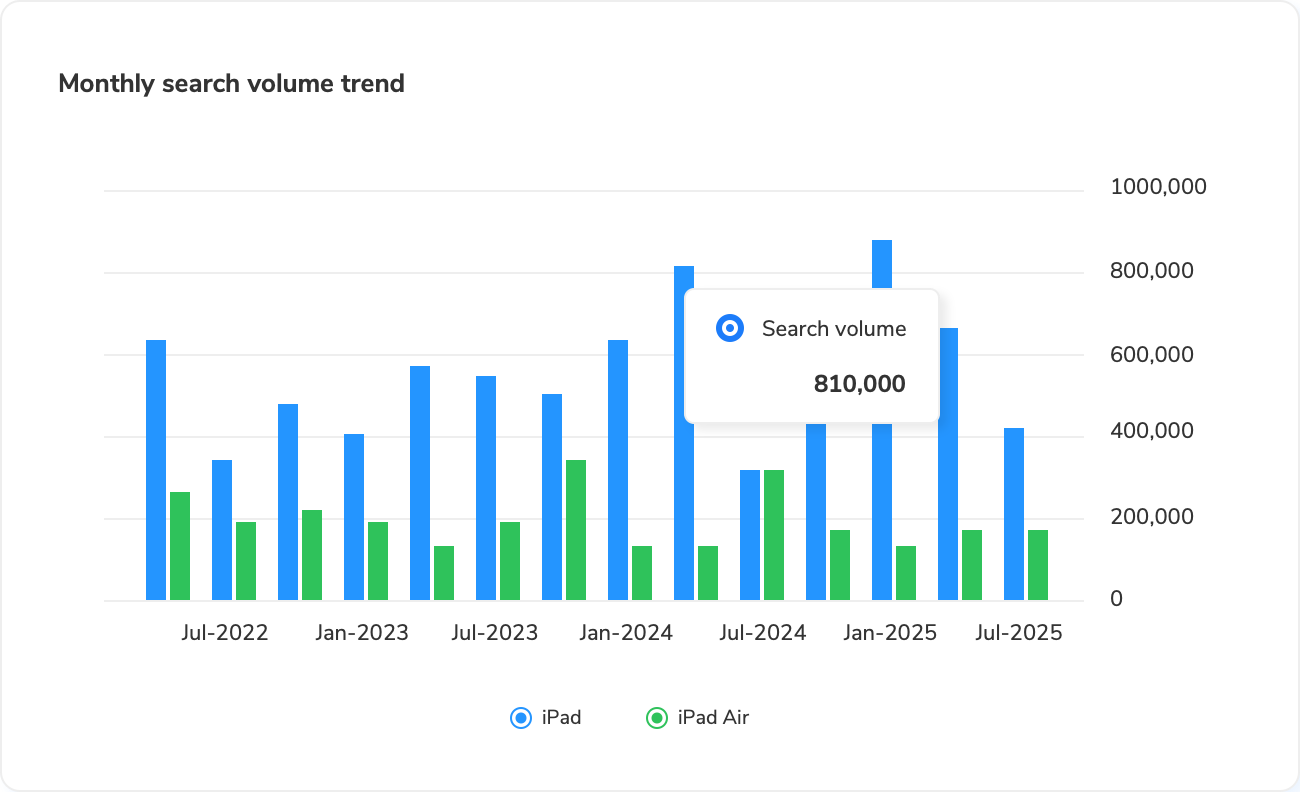
The Maxmerce Amazon keyword tool expands a seed term into related phrases and supports market and category filtering. Use it to identify language worth evaluating against the product. Its keyword-trend labels and search-volume views are research inputs—not a product’s organic position for a query, its BSR or a promise of continuous rank tracking.
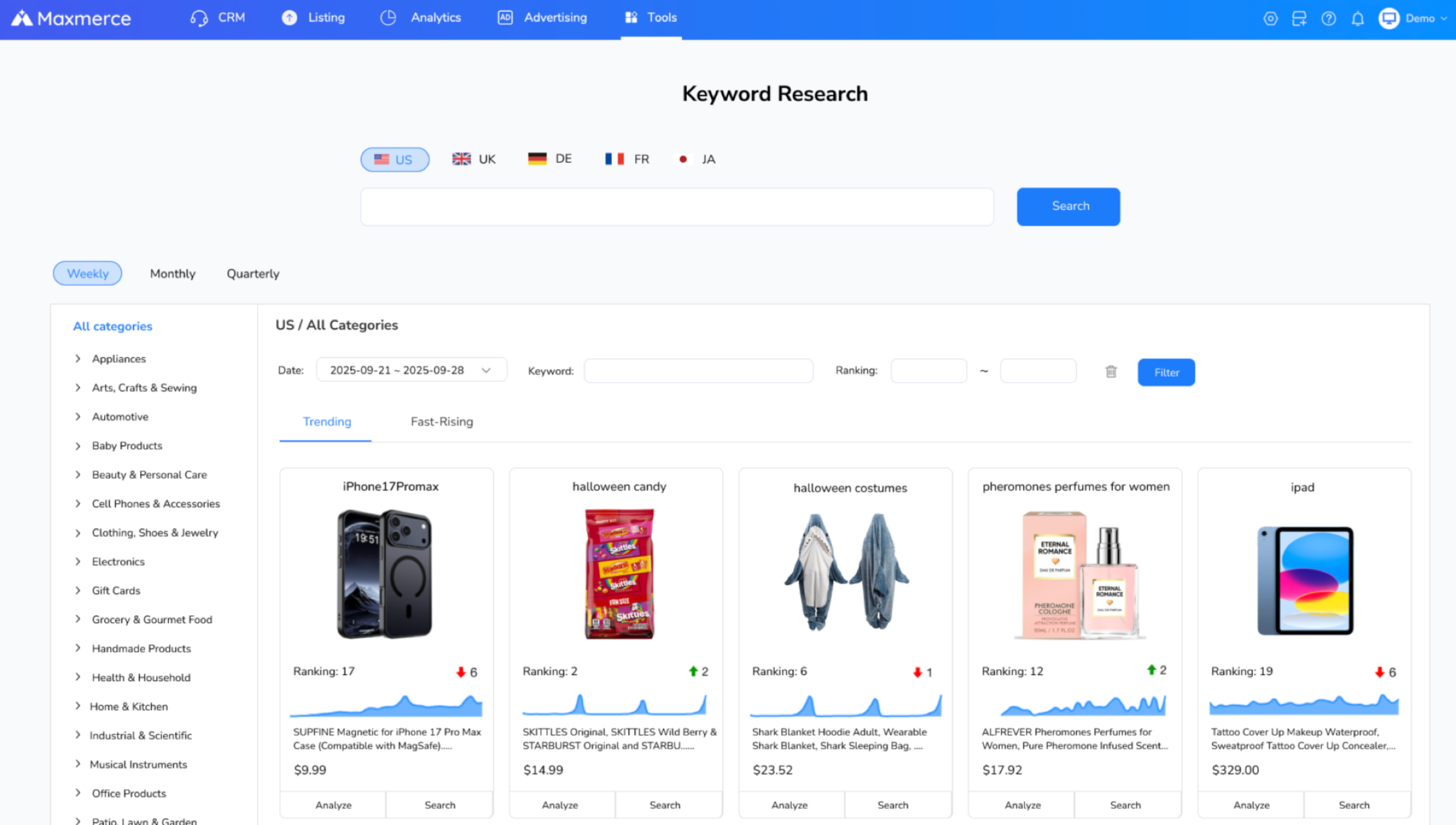
Keep phrases supported by real attributes and buyer needs, then bring only relevant terms into the two-track note. Preserve the source label, marketplace, date range and measurement method. A long keyword list is not evidence that every phrase belongs in the listing.
FAQ
Can a product have a good BSR and a weak position for my keyword?
Yes. Category sales rank and the result for a particular query answer different questions. Check whether your query describes the product and review the recorded result type and settings; BSR alone cannot resolve that query-level question.
Is a BSR of 500 in one category better than 1,000 in another?
You cannot use those numbers alone to compare sales volume. They refer to different comparison groups. Keep the category and marketplace attached, and use appropriate sales evidence for a business comparison.
Is keyword rank the same as search-frequency rank?
No. In this article, keyword rank means a product’s position for a query. Search-frequency rank describes the query’s relative search popularity within its report. Label the subject and source before comparing either one.
Does a keyword research tool replace a rank tracker?
Not automatically. Finding relevant phrases and repeatedly measuring product positions are different jobs. Verify a tool’s current capabilities and measurement method rather than assuming one includes the other.
Official Amazon sources reviewed October 2, 2026. Numerical examples and the two-track note are original editorial teaching aids. AI assisted with the draft and cover. Maxmerce screenshots show keyword research and search-volume views; they do not show product organic position or BSR.