Amazon Refund Administration Fee: Check the Credit

The Amazon refund administration fee is the part of an eligible fee credit that Amazon retains when you refund a buyer. For a full refund of a non-media product, Amazon’s US refund administration fee guidance describes a fee equal to the lesser of $5 or 20% of the applicable referral fee. It is not 20% of the buyer’s entire refund.
Start with the actual referral-fee record and the product being refunded. Do not apply one $5 cap to a whole mixed order, multiply the cap by every physical unit without checking the product grouping, or treat the expected fee credit as your remaining profit.

Calculate the retained fee and the expected credit separately
For the bounded case of a full non-media product refund, start with the original order-related fee or referral-fee basis shown in Amazon’s transaction record, then keep the retained fee and expected credit separate:
- R: the applicable original referral fee for the product or product group being refunded, verified in the transaction records.
- A: the refund administration fee retained: the smaller of $5 and 0.20 × R.
- C: the expected referral-fee credit under these assumptions: R − A.
This is a reconciliation worksheet, not a complete refund or profit calculator. It does not settle partial refunds, media exceptions, tax-calculation charges, fulfillment costs or other transaction adjustments. Those need their own applicable rules and records.
For example, if the applicable referral fee is $1.50, 20% is $0.30. That is below $5, so the retained administration fee is $0.30 and the expected referral-fee credit is $1.20. The buyer’s refund is a separate amount.
Check what the cap applies to
Amazon’s separate refund credits and administration fees guidance distinguishes different products in one order from multiple units of the same product. Its examples apply a separate cap to each different product, while multiple units of the same product are calculated together for that product’s cap.
That is why “up to $5 per order” is an incomplete shortcut. The help page’s example of two different products has a combined maximum of $10; that example is not a universal $10 ceiling for every possible order. Read the actual product grouping and the applicable help page before reconciling a multi-item refund.
Do not invent the grouping from similar titles or assume that every SKU you use internally is a separate fee group. Confirm how the products and refunded quantities are represented in Amazon’s records.
| Refunded products | Assumed applicable referral fee R | Retained administration fee A | Expected referral-fee credit C |
|---|---|---|---|
| One product | $1.50 | 20% × $1.50 = $0.30 | $1.20 |
| One product | $30.00 | 20% × $30 = $6; capped at $5 | $25.00 |
| Two different products, calculated separately | $30.00 and $6.00 | $5.00 and $1.20; total $6.20 | $25.00 and $4.80; total $29.80 |
| Two units of the same product, one applicable product group | $60.00 combined | 20% × $60 = $12; product-group cap $5 | $55.00 |

The examples assume that each stated referral fee is the correct basis for a full refund and that no other adjustment changes the result. The rates and product prices behind those fees are deliberately not invented. Use your actual records instead of copying a fictional amount into a claim.
A buyer refund and a referral-fee credit are different entries
A seller reviewing a refunded order may see money moving in opposite directions: the refund to the buyer and the return of eligible seller fees. The administration fee reduces the latter. A $1.20 referral-fee credit in the first example does not mean the buyer receives $1.20, or that your total loss is only $0.30.
Product cost, outbound fulfillment, return transport, any applicable returns-processing charges and the condition of returned inventory can affect the broader economics. This guide does not establish whether those amounts are refundable. Keep them outside this narrow formula until their own rules and actual entries have been checked.
Amazon’s administration-fee examples also show why reconstructing the original referral fee from the item price alone can be misleading. Its examples include relevant shipping and gift-wrap amounts and distinguish tax treatment. Start from the applicable recorded fee and the exact refund situation rather than applying a remembered category percentage to an incomplete price.
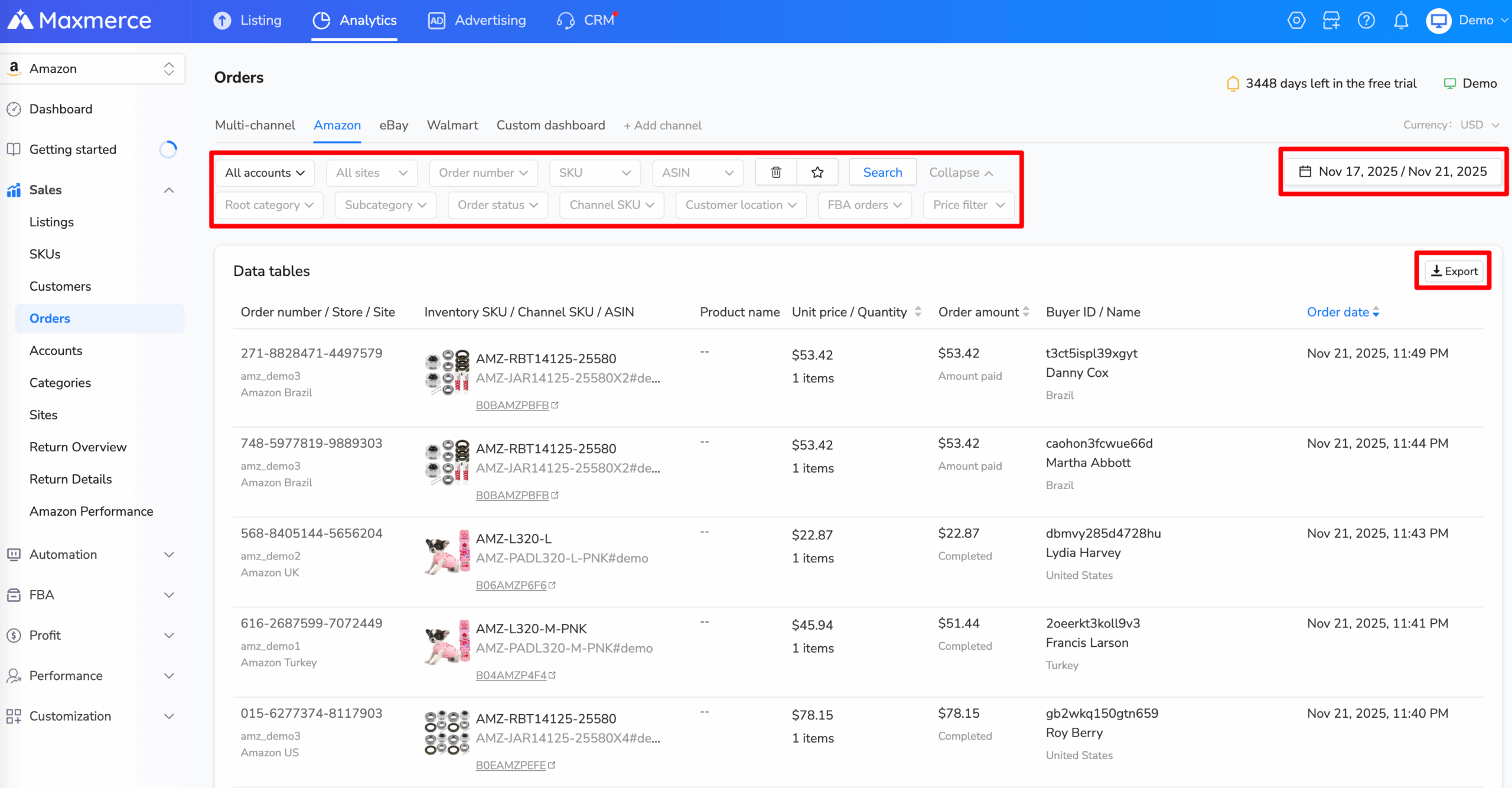
A Maxmerce Amazon Orders report can help a team retrieve the affected order by account, order number, SKU, ASIN or status before it compares entries. Use it as a locator and review layer; it does not issue the refund or prove that Amazon posted the expected fee credit.
Do not reuse the formula for every refund
Media products follow a separate path
The current US help table lists a $0 administration fee for a full refund of media products such as books, music and video. Partial media refunds have different treatment involving proportional referral-fee credits and closing fees. Determine the applicable fee category before choosing a formula; “a refund happened” is not enough information.
Partial refunds need a separate review
Amazon describes proportional fee-credit treatment for partial refunds. Its examples also discuss subsequent refunds of the same product after that product’s administration-fee cap has been reached. Do not apply the full-refund table above to each partial payment as though every payment resets the product cap.
Check the percentage refunded, the product group, previous refund entries and the relevant current policy. If the relationship between entries is unclear, keep it unresolved and ask through the appropriate Amazon support path rather than submitting the refund again to see what happens.
The Individual plan’s per-item fee is another charge
The administration-fee guidance says the Individual selling plan’s per-item fee is retained on a refunded product. That charge is distinct from the retained percentage of the referral fee. Do not assume that a referral-fee credit reverses every fee on the original sale.
Use a private refund-to-credit record
Seller best practice: keep a small reconciliation record for a confusing refund. This is an original editorial checklist, not an Amazon-required form. Store order identifiers, buyer information and transaction evidence privately.
- Scope: record the marketplace, fee category and whether the refund is full or partial.
- Product grouping: identify the refunded product or products and quantities in the actual order record.
- Original fee: locate the applicable referral-fee entry instead of estimating it from an incomplete price.
- Prior refunds: check earlier refund and administration-fee entries for the same product group.
- Expected result: for a qualifying full non-media case, record R, A and C with the assumptions beside them.
- Observed result: match the actual retained fee and fee credit, keeping other charges and the buyer refund separate.
- Unresolved difference: document which entry, grouping or rule still needs clarification. A calculation is evidence for a question, not proof that Amazon owes a particular credit.
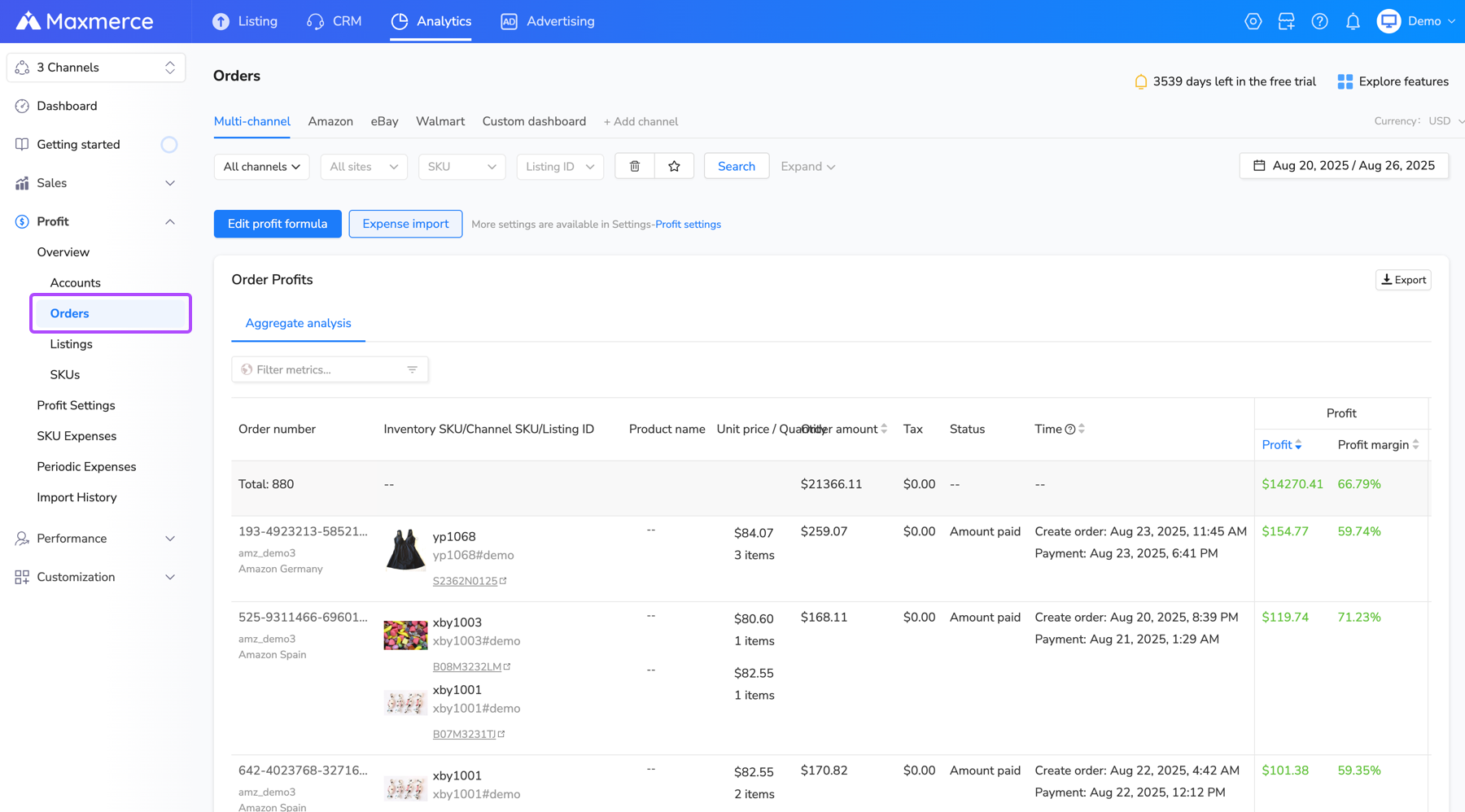
If your team uses Maxmerce Amazon Profit Analytics, an order-level profit report can help compare configured income and expense fields after the underlying data is current. Keep Amazon’s actual transaction entries as the source for the refund administration fee; a profit report reflects your configured model and is not proof of a marketplace credit.
Consider a fictional seller who calculates a $5 administration fee from a $30 referral fee but sees another small debit nearby. Before disputing both amounts as the same fee, the seller checks their descriptions, product grouping and earlier refund entries. Combining unrelated debits would hide the issue the record is meant to resolve.
Keep future pricing scenarios separate from completed refunds
For future offers, keep any manual return-cost or refund-fee scenario clearly labeled and separate from completed transactions. A forecast can improve planning, but it is not evidence of an actual administration-fee credit or a promise that a completed refund leaves the estimated profit.
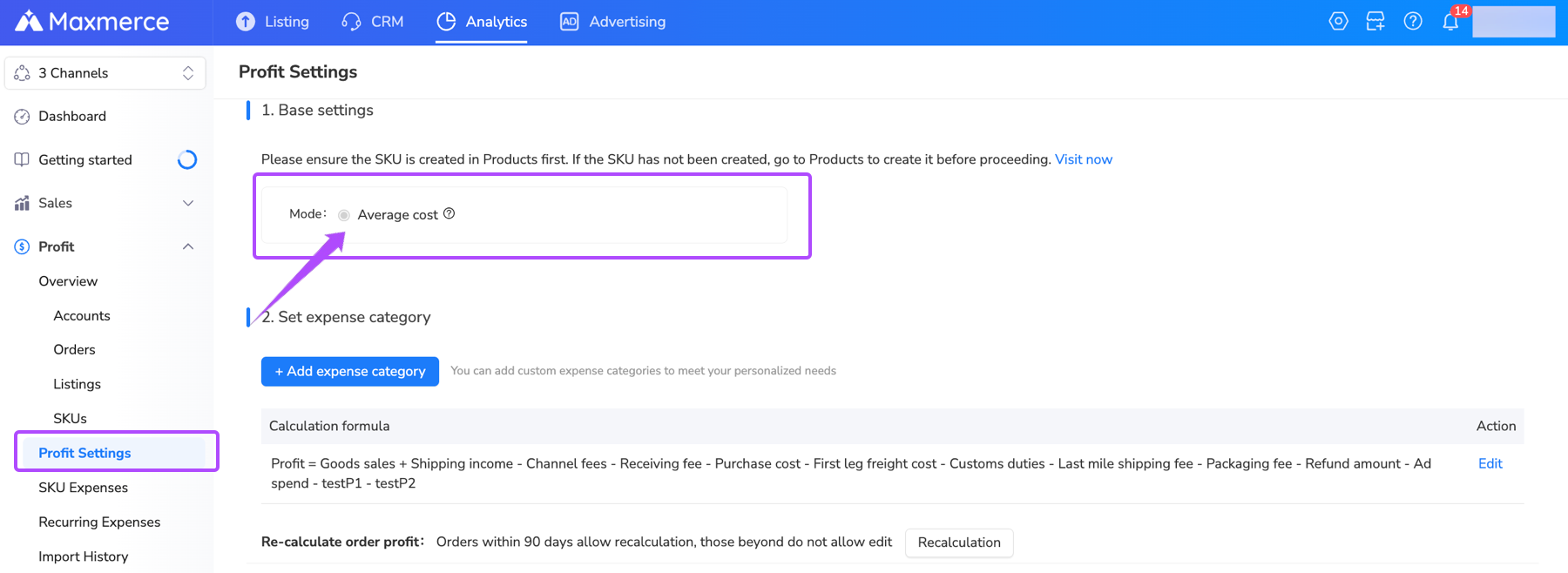
Maxmerce Profit Settings can help a team define the expense fields used in its own reporting model. Review those settings before comparing historical results, and do not treat a configured “refund amount” or custom expense field as an automatic reconstruction of Amazon’s retained fee.
Reconcile the completed transaction first. Then use what you learned to improve future cost assumptions, without turning one order into a guaranteed return rate or inventing a historical average.
Frequently asked questions
Is the fee 20% of the amount refunded to the buyer?
No. In the full non-media case described here, the percentage is applied to the applicable referral fee, subject to the product’s $5 cap. The buyer’s refund and the seller’s fee credit are different amounts.
Is $5 the maximum for an entire order?
Do not use that as a universal rule. Amazon distinguishes different products in an order from multiple units of the same product. Its two-different-product example applies a separate cap to each product. Verify the actual grouping and current rule for your order.
Is this the same as an FBA returns-processing fee?
No. This guide concerns the refund administration fee retained from eligible fee credits. It does not determine whether a separate FBA returns-processing or fulfillment charge applies or can be refunded.
Can I use the examples for a partial refund?
No. They assume a full non-media product refund. Partial refunds require review of proportional credits, product grouping and earlier refunds; media categories also have separate treatment.
Does my calculated credit prove the money has arrived?
No. The worksheet gives an expectation under stated assumptions. Confirm the actual transaction entries and any unresolved adjustment before treating the credit as received.
Amazon US refund-credit and refund-administration-fee guidance reviewed October 27, 2026. Check the linked official policies and the actual transaction before acting. The worksheet and fictional examples are original editorial aids.