Amazon Barcode Requirements: Choose the FBA Label
Quick answer: For US FBA shipments sent on or after March 31, 2026, resellers—including authorized resellers—must use Amazon barcode labels even when a manufacturer barcode is present. Eligible brand owners with the Brand Representative selling role may continue using manufacturer barcodes for qualifying products. Products without manufacturer barcodes still require Amazon barcode labels.
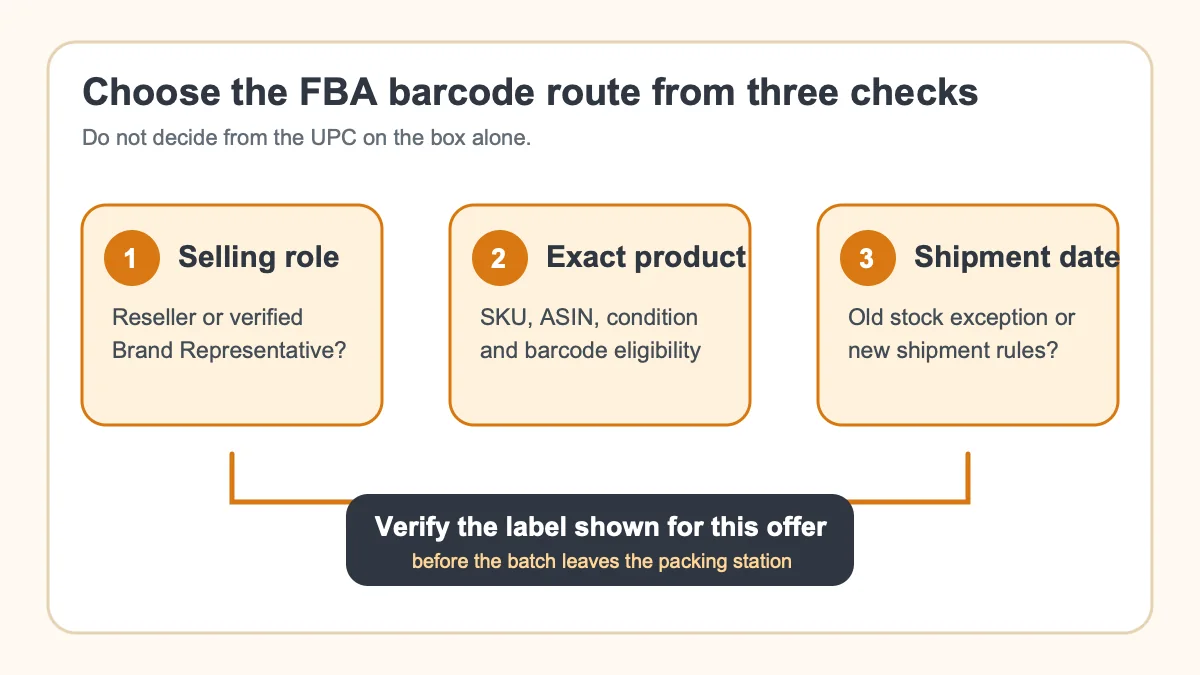
Do not choose the route from a supplier letter, the barcode visible on a similar item, or an old SKU alone. Verify the role, offer, condition and instructions shown for the exact inventory you are preparing. These are US FBA requirements and should not be generalized to every Amazon marketplace or fulfillment method.
Read the current rule before using an old checklist
Amazon’s US FBA barcode requirements distinguish manufacturer barcodes—such as UPC, EAN, JAN and ISBN—from Amazon barcodes, including FNSKU labels that commonly begin with X. The same page now carries a March 31, 2026 notice: brand owners can keep using manufacturer barcodes without stickers where eligible, while resellers must use Amazon barcodes.
That change ends the shortcut “the package has a UPC, so use the UPC.” Product eligibility still matters, but so does the selling account’s role. An authorized resale relationship is not the same as the Brand Representative selling role in Amazon Brand Registry.
Amazon’s announcement about ending commingling applies the new route to inventory shipped on or after March 31, 2026. It also says products without manufacturer barcodes need Amazon barcode stickers whether the seller is a brand owner or reseller. Check the live Seller Central instructions before printing a batch.
Choose the route from role, product and timing
This matrix is a routing aid based on Amazon’s current US guidance. It is not a substitute for the barcode option shown for the actual offer.
| Situation | Route to verify | Evidence needed |
|---|---|---|
| Reseller preparing a new FBA shipment | Use Amazon barcode labels even when a manufacturer barcode exists. | Exact SKU, ASIN, condition and label generated for that offer. |
| Authorized reseller preparing a new shipment | The reseller requirement still applies. | Do not treat resale authorization as the Brand Representative role. |
| Brand owner with the Brand Representative role | Manufacturer barcode may be available for eligible products. | Verify the role, brand-product association and offer-level eligibility. |
| Product has no manufacturer barcode or has a GTIN exemption | Use the Amazon barcode required for FBA tracking. | A catalog GTIN exemption is not a physical-label exemption. |
| Stickerless reseller stock already in transit or stored before March 31, 2026 | Follow Amazon’s documented transition treatment for that stock. | Keep the shipment history separate from new inventory. |

Keep a five-field label-route record
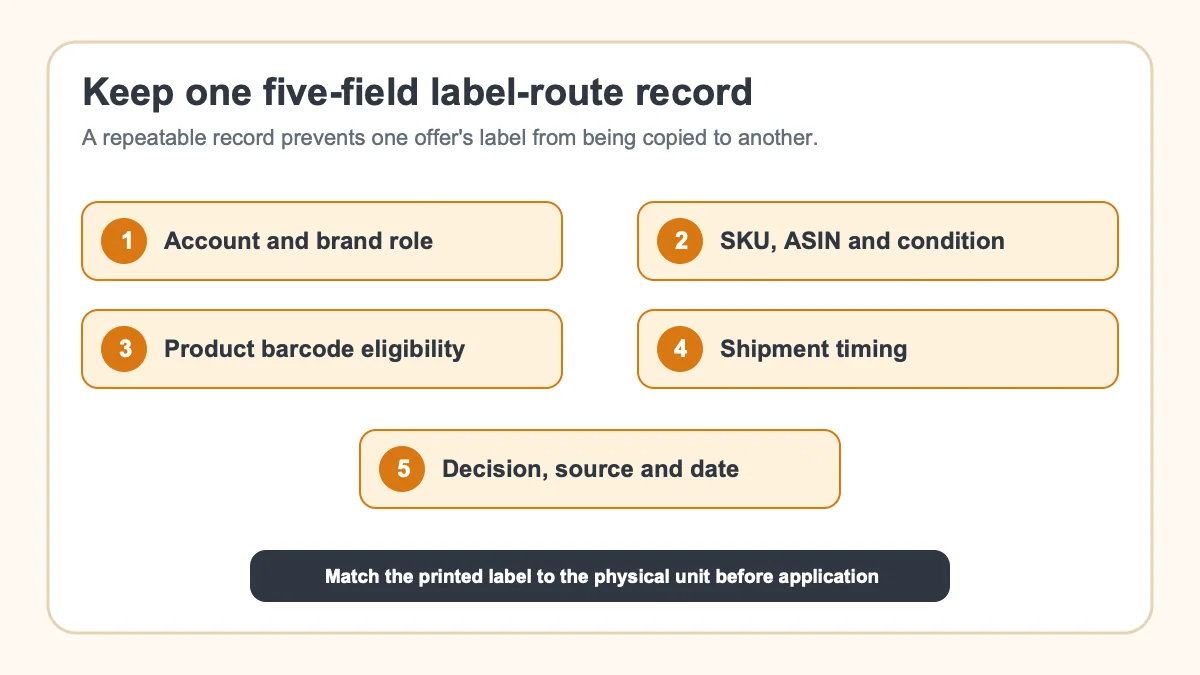
Record the evidence before a team repeats a label across a batch. The minimum record should contain:
- Account and brand role: record the verified role for this selling account and brand.
- Exact offer: preserve the seller SKU, ASIN, condition and physical configuration.
- Product eligibility: record the manufacturer identifier, any GTIN exemption and the current barcode option.
- Shipment timing: separate documented pre-March 31 inventory from the new shipment.
- Decision, source and date: keep the current Seller Central source with the selected route.
For example, a fictional reseller has supplier permission to sell a branded desk organizer, and the retail box has a UPC. Neither fact gives that reseller the Brand Representative role. For a new FBA shipment, the team should obtain the Amazon barcode for the intended offer instead of treating supplier permission as a stickerless exception.
A brand-owner account still checks eligibility. If a product has no manufacturer barcode—even with a GTIN exemption—it needs the Amazon barcode used for FBA tracking. Catalog identity and fulfillment-center labeling are related but separate controls.
Separate older stock from the next shipment
The transition treatment follows inventory timing, not the age of the SKU. Inventory that was already in transit to or stored in an Amazon fulfillment center before March 31, 2026 should not be mixed operationally with a fresh reseller shipment prepared after the change.
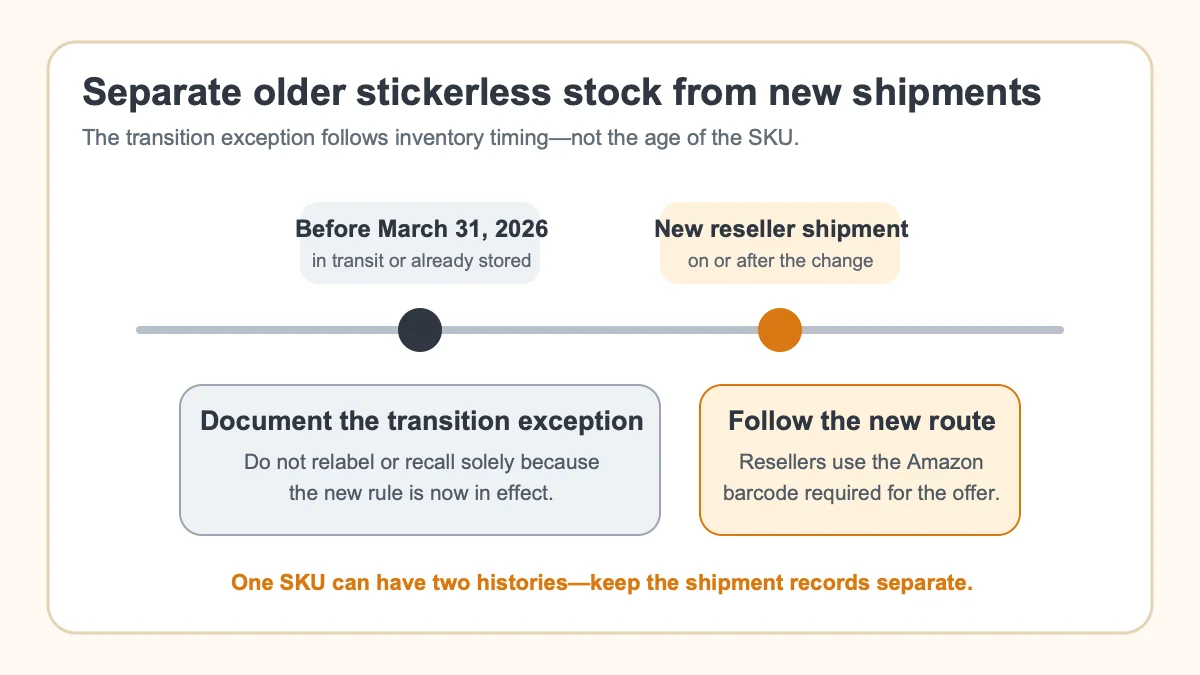
Keep the historical shipment reference and the new preparation record separate. Do not recall or relabel older stock merely because a new rule now applies. Equally, do not send a new stickerless batch just because units under the same SKU are still selling.
If the required barcode option does not appear, use Amazon’s transition instructions or Seller Support. Do not create a duplicate product detail page simply to force a label choice; changing the label route is not the same as changing product identity.
Print and apply the Amazon barcode correctly
Choosing the right label is only half the job. Amazon’s current US guidance says the printed label should match the Seller Central format and remain scannable. Its 2026 FBA preparation guide recommends a label one to two inches tall and two to three inches wide, black ink on non-reflective adhesive paper and a 300 DPI laser printer.
| Check | Practical requirement | Failure to prevent |
|---|---|---|
| Label identity | Match the FNSKU, title and condition to the physical unit. | A valid label being applied to the wrong offer. |
| Print quality | Use clean black printing on non-reflective adhesive stock; avoid faded or damaged labels. | Receiving scans that fail or read inconsistently. |
| Placement | Use a flat, smooth surface; avoid corners, curves and seams. | Wrinkles or curvature interfering with the scanner. |
| Other barcodes | Cover other scannable product barcodes when the Amazon barcode is required. | The wrong barcode being captured at receiving. |
| Additional packaging | Place the required barcode on the outside of poly bags, bubble wrap or other prep. | A correct label becoming inaccessible after prep. |
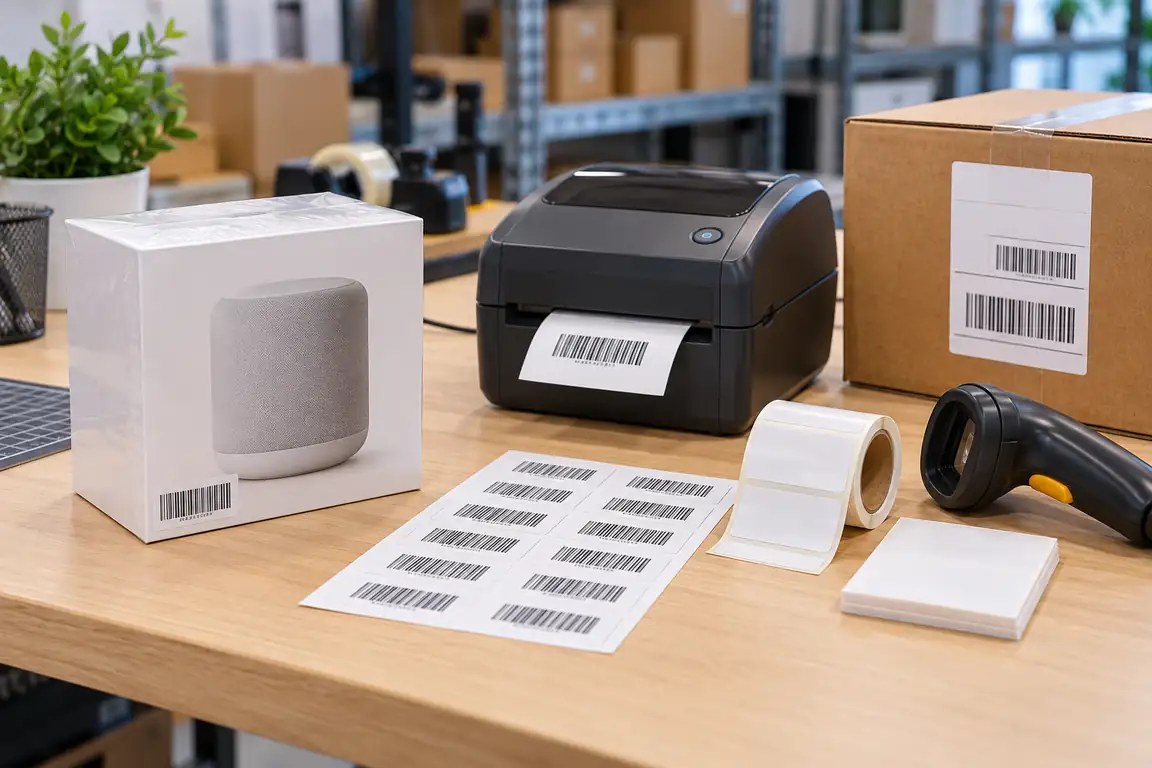
What happens when required labels are missing or wrong?
Amazon identifies missing Amazon barcodes and unit-label mismatches as inbound problems. The fulfillment center may attempt corrective work and surface issues in the Inbound Performance Dashboard, but that is not a preparation strategy. Amazon may refuse, return or repackage noncompliant inventory at the seller’s expense.
Amazon’s guidance also warns that improperly labeled units can be difficult to track. Do not promise that every mislabeled unit will be corrected or reimbursed. Preserve the batch record, label file and shipment reference so the team can investigate the exact units involved.
Listing content does not establish barcode eligibility
A listing title, product description or image can help identify the intended item, but it cannot prove a Brand Registry role or create barcode eligibility. Complete the labeling decision in Amazon’s actual FBA workflow. Catalog teams can use Maxmerce Listing to organize listing work and review current Listing plans, but barcode selection remains an Amazon account and shipment decision.
Frequently asked questions
Can an authorized reseller keep using manufacturer barcodes for new FBA shipments?
No. Amazon’s current US guidance includes authorized resellers in the Amazon-barcode requirement effective March 31, 2026. Resale authorization does not create the brand-owner exception.
Does a GTIN exemption mean the product needs no FBA label?
No. A GTIN exemption addresses catalog identification. Products without manufacturer barcodes still require the Amazon barcode used for FBA tracking.
Must I relabel stickerless stock sent before the change?
Amazon’s transition guidance says no action is required for qualifying stickerless reseller inventory that was already in transit to or stored in fulfillment centers before March 31, 2026. Keep evidence of the shipment timing and distinguish it from new inventory.
Does changing the seller SKU erase product reviews?
Not automatically. Amazon states that product ratings and reviews are measured at ASIN level. However, that does not mean every operational setting transfers, so follow the actual transition workflow before changing an offer.
Bottom line
Choose the FBA barcode from verified role, exact product eligibility and shipment timing. Then match the printed label to the SKU, ASIN, condition and physical unit before applying it. A five-field record makes that decision auditable when the next batch reaches the packing station.
{“@context”:”https://schema.org”,”@type”:”BlogPosting”,”headline”:”Amazon Barcode Requirements: Choose the FBA Label”,”description”:”Choose the correct Amazon FBA barcode by checking seller role, product eligibility and shipment timing, then verify label quality and placement.”,”image”:”https://cdn.maxmerce.com/blog/wp-content/uploads/2026/10/cover-850-29.webp”,”mainEntityOfPage”:”https://www.maxmerce.com/blog/amazon-fba-barcode-requirements/”,”dateModified”:”2026-10-19″}{“@context”:”https://schema.org”,”@type”:”FAQPage”,”mainEntity”:[{“@type”:”Question”,”name”:”Can an authorized reseller keep using manufacturer barcodes for new FBA shipments?”,”acceptedAnswer”:{“@type”:”Answer”,”text”:”No. Amazon’s current US guidance includes authorized resellers in the Amazon-barcode requirement effective March 31, 2026.”}},{“@type”:”Question”,”name”:”Does a GTIN exemption mean the product needs no FBA label?”,”acceptedAnswer”:{“@type”:”Answer”,”text”:”No. Products without manufacturer barcodes still require the Amazon barcode used for FBA tracking.”}},{“@type”:”Question”,”name”:”Must I relabel stickerless stock sent before the change?”,”acceptedAnswer”:{“@type”:”Answer”,”text”:”Amazon’s transition guidance says no action is required for qualifying reseller inventory already in transit to or stored in fulfillment centers before March 31, 2026.”}},{“@type”:”Question”,”name”:”Does changing the seller SKU erase product reviews?”,”acceptedAnswer”:{“@type”:”Answer”,”text”:”Not automatically. Amazon states that product ratings and reviews are measured at ASIN level.”}}]}