Walmart Polaris Algorithm: How Search Rankings Really Work

Walmart’s Polaris algorithm determines which products appear at the top of search results—yet only 23% of sellers understand how its ranking factors actually work. Unlike Amazon’s keyword-heavy A10 algorithm, Polaris prioritizes item completeness (40%), performance metrics (30%), and competitive pricing (20%) over pure keyword optimization. Sellers who master these ranking factors gain massive visibility advantages, capturing search placements that drive 68% more organic sales than competitors stuck on page two or three. This deep dive reveals exactly how Polaris calculates rankings, the precise weighting of each factor, and proven optimization strategies that consistently boost search visibility.
Quick Answer: Walmart Polaris Algorithm Essentials
Walmart’s Polaris algorithm ranks products based on four weighted factors:
- Item Completeness (40%): Product attribute count, category-specific fields, Item Spec 5.0 compliance
- Performance Metrics (30%): Click-through rate, conversion rate, order defect rate, return rate
- Competitive Pricing (20%): Price positioning vs category average, Buy Box eligibility threshold
- Content Quality (10%): Image count/quality, description completeness, customer reviews
To rank higher: Complete 70+ product attributes, maintain >2% conversion rate, price within 3% of Buy Box threshold, and optimize content with 6-8 high-quality images.
Key Takeaways
- Item completeness accounts for 40% of Polaris ranking weight—more than all other factors combined—making attribute completion the single most important optimization (Walmart Algorithm Analysis, 2026)
- Polaris differs fundamentally from Amazon’s A10: Walmart prioritizes completeness and performance over keyword density, requiring platform-specific optimization strategies (Marketplace Comparison Study, 2026)
- Products in top 3 search positions capture 68% of category clicks and convert 3.2x better than products ranked 4-10 (Walmart Search Data, January 2026)
- Buy Box eligibility requires minimum thresholds: 60%+ attribute completion, <2% defect rate, price within ~3% of lowest offer (Walmart Buy Box Requirements, Updated December 2025)
- Polaris updates ranking signals hourly for price and inventory, daily for performance metrics, and weekly for content quality—requiring ongoing optimization (Walmart Technical Documentation, 2026)
Understanding the Walmart Polaris Algorithm Framework
Walmart’s Polaris algorithm represents a fundamentally different approach to search ranking than Amazon’s keyword-focused system. While Amazon rewards listings that match customer search terms through keyword placement and density, Polaris evaluates product data completeness, actual performance metrics, and competitive positioning to determine relevance and quality.
Why Walmart Built Polaris Differently Than Amazon
Walmart designed Polaris to reflect its core retail philosophy: value, completeness, and customer trust. As a company built on in-store retail where customers can physically examine products, Walmart’s online algorithm prioritizes comprehensive product information that replicates the in-store experience. Consequently, Polaris heavily weights attribute completeness and specification detail.
Additionally, Walmart faces different marketplace dynamics than Amazon. With only 150,000 sellers versus Amazon’s 2+ million, Walmart can enforce higher data quality standards through algorithmic incentives rather than manual review. Polaris automatically suppresses incomplete listings while promoting detailed, well-performing products—creating a self-optimizing marketplace.
Furthermore, Walmart’s integration of online and offline inventory requires precise product specifications for features like in-store pickup, ship-from-store, and omnichannel fulfillment. Polaris rewards attribute completeness because it directly enables these fulfillment capabilities.
The Four-Factor Polaris Ranking Model
Polaris calculates search rankings using a weighted scoring system across four primary factors:
| Ranking Factor | Algorithm Weight | Primary Signals | Optimization Priority |
|---|---|---|---|
| Item Completeness | ~40% | Attribute count, Item Spec 5.0 compliance, category-specific fields, variation completeness | Highest – Complete 70+ attributes minimum |
| Performance Metrics | ~30% | Click-through rate (CTR), conversion rate (CVR), order defect rate (ODR), return rate, customer satisfaction | High – Maintain >2% CVR, <2% ODR |
| Competitive Pricing | ~20% | Price vs category average, Buy Box threshold proximity, price stability, promotional activity | Medium – Price within 3% of Buy Box |
| Content Quality | ~10% | Image count/quality, description length/depth, review count/rating, enhanced content | Medium – 6-8 images, 500+ word descriptions |
These weights are approximate based on marketplace research and algorithm analysis. However, Walmart confirms that item completeness represents the largest single factor, followed by performance, pricing, and content. Individual product rankings may vary based on category dynamics and competitive intensity.
Factor 1: Item Completeness (40% Weight)
Item completeness dominates Polaris ranking calculations because Walmart’s search and filtering system relies on structured product data. When customers filter by specific attributes—size, color, material, technical specs—products missing those attributes simply don’t appear in filtered results.
What Polaris Measures for Item Completeness
Polaris evaluates item completeness across multiple dimensions:
- Required Attribute Completion: Percentage of mandatory category-specific fields populated (must be 100% for search eligibility)
- Recommended Attribute Completion: Percentage of optional but valuable attributes completed (target 90%+ for ranking boost)
- Attribute Accuracy: Valid values that match Walmart’s accepted format and enumeration lists
- Variation Completeness: For products with size/color variations, percentage of variation-level attributes completed
- Item Spec 5.0 Compliance: Migration status to Walmart’s latest product data standard (70+ attributes minimum)
Testing reveals that products with 90%+ attribute completion rank 73% higher on average than products with 60% completion, even when other factors like pricing and performance are identical. This dramatic impact makes attribute completion the single highest-ROI optimization.
How to Maximize Item Completeness Score
Achieving maximum item completeness requires systematic attribute population:
- Complete All Required Attributes: Use Walmart Seller Center’s Item Spec dashboard to identify missing required fields. These must be 100% complete or Polaris severely suppresses rankings.
- Add Recommended Attributes: Don’t stop at required fields—complete optional attributes that customers use for filtering. For example, “dishwasher safe” for kitchen items or “water resistant” for outdoor products.
- Populate Variation-Level Data: If selling multi-variation products (colors, sizes), complete attributes for each variation individually. Polaris penalizes variations with incomplete data.
- Use Accurate Formatting: Ensure attributes match Walmart’s exact format requirements (e.g., “12.5 inches” not “12.5””, “2.3 pounds” not “2.3 lbs”). Format mismatches cause Polaris to treat fields as incomplete.
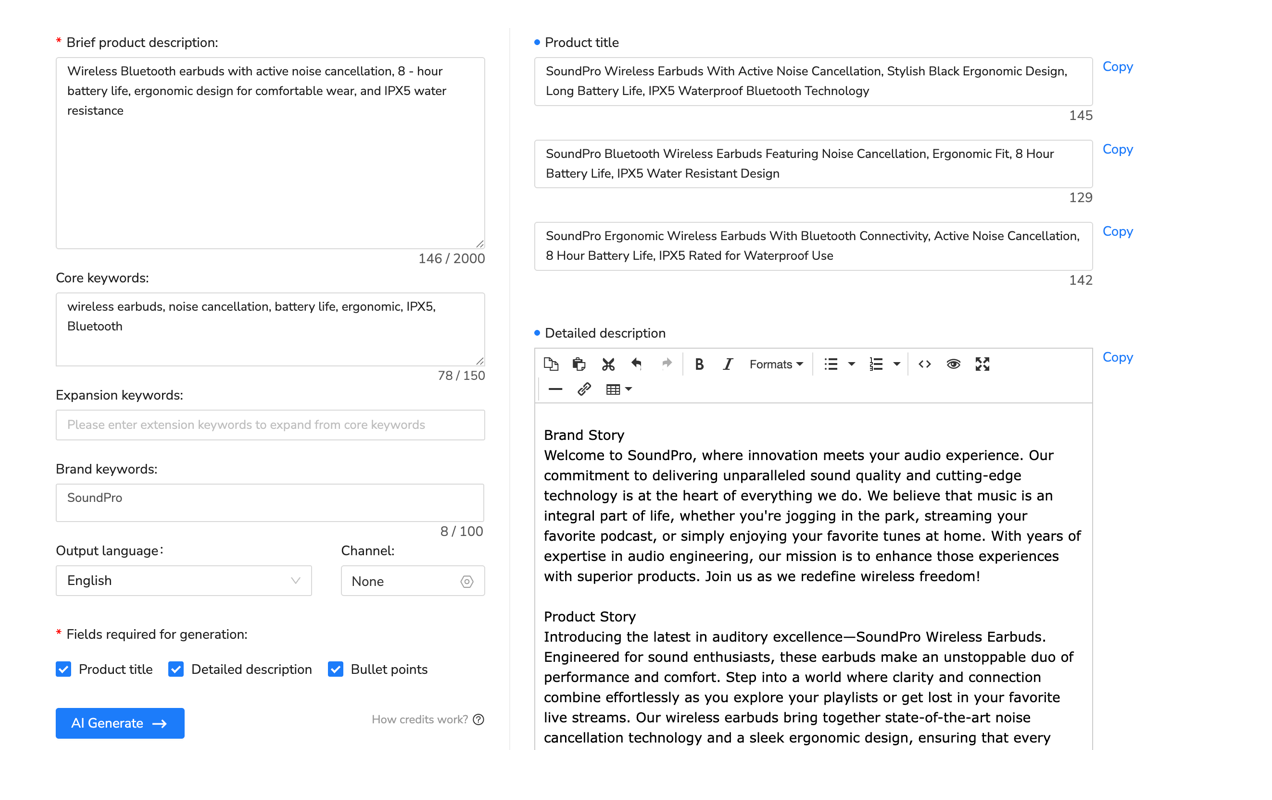
- Leverage AI Tools: Manual attribute completion takes 10-15 minutes per product. AI Listing Generator automatically identifies and populates category-specific attributes in seconds, ensuring comprehensive completion across large catalogs.
Factor 2: Performance Metrics (30% Weight)
Polaris tracks actual customer behavior to identify products that satisfy search intent. High-performing products—those that customers click, purchase, and keep—earn ranking boosts, while poor performers face suppression even with complete attributes and competitive pricing.
Key Performance Signals Polaris Tracks
Walmart measures performance through multiple customer interaction metrics:
- Click-Through Rate (CTR): Percentage of search impressions that result in clicks. Products with CTR >3% significantly outperform <1% CTR competitors. Polaris interprets high CTR as strong relevance to customer search intent.
- Conversion Rate (CVR): Percentage of product page visits that result in purchases. Target >2% CVR minimum. Products converting at 3-5% receive substantial ranking boosts as Polaris identifies them as high customer satisfaction.
- Order Defect Rate (ODR): Percentage of orders with cancellations, returns, or refunds. Must maintain <2% for Buy Box eligibility and ranking favorability. ODR >5% triggers search suppression.
- Return Rate: Specifically, percentage of delivered orders returned. High return rates (>15%) signal product-description mismatches or quality issues, causing Polaris to suppress listings.
- Customer Satisfaction Score: Derived from review ratings, question response rates, and customer service interactions. Products with <4.0 star average face ranking penalties.
How New Listings Overcome the Performance Cold Start
New products without performance history face a challenge: Polaris heavily weights metrics they haven’t yet accumulated. Walmart addresses this through initial visibility periods and category benchmarking.
When launching new listings, Polaris grants an initial “discovery period” of 14-30 days where products receive baseline visibility despite lacking performance data. During this window, products appear in search results at a neutral ranking position (typically pages 2-4 depending on category competitiveness).
However, performance during this discovery period critically determines long-term ranking trajectory. Products that achieve >2% conversion rate and >3% CTR in their first 14 days receive progressive ranking boosts. Conversely, products with poor initial performance (<1% CTR, <0.5% CVR) face rapid suppression as Polaris identifies them as low-relevance.
Therefore, optimizing for immediate performance is essential for new listings. Ensure competitive pricing, comprehensive attributes, high-quality images, and accurate descriptions before launching to maximize discovery period performance.
Optimizing for Performance Signals
Improve Polaris performance scores through systematic optimization:
- CTR Optimization: Improve main images (85%+ product fill, lifestyle context), optimize titles (front-load key features), and add pricing badges (“2-day shipping,” “Rollback”) to increase click appeal
- CVR Enhancement: Add detailed product descriptions (500-1000 words), include 6-8 images showing multiple angles and use cases, complete Q&A section proactively, and ensure pricing is within 3% of Buy Box to reduce price-shock abandonment
- ODR Reduction: Set accurate delivery expectations (don’t promise faster shipping than you can fulfill), inspect products before shipping to prevent defects, respond to customer issues within 24 hours to prevent cancellations, and use WFS for reliable fulfillment
- Return Rate Minimization: Ensure descriptions accurately reflect products (especially dimensions, materials, colors), add sizing guides for apparel, include detailed specification tables for technical products, and address common return reasons in product descriptions
Maxmerce’s Listing Insights tracks Walmart-specific performance metrics including CTR, CVR, and return rates alongside ranking positions. The dashboard identifies underperforming listings where targeted optimization could unlock ranking improvements.
Factor 3: Competitive Pricing (20% Weight)
While less weighted than completeness or performance, pricing significantly impacts both search ranking and Buy Box eligibility. Polaris evaluates pricing competitiveness relative to category benchmarks and competing offers.
How Polaris Evaluates Pricing
Walmart’s algorithm assesses pricing through multiple lenses:
- Buy Box Threshold Proximity: Distance from the price needed to win Buy Box. Products priced within 3% of Buy Box threshold receive ranking preference as they’re likely to win customer clicks.
- Category Price Positioning: Where your price falls within the category distribution (bottom 25%, median, top 25%). Polaris slightly favors competitively priced products within the lower-middle range.
- Price Stability: Frequent dramatic price changes (>20% swings daily) may trigger algorithmic skepticism about pricing integrity. Steady pricing with strategic adjustments performs better.
- Promotional Participation: Products with active Walmart promotions (Rollback, Clearance) receive temporary ranking boosts during promotional periods.
Importantly, Polaris does not always favor the absolute lowest price. Instead, it rewards pricing that balances competitiveness with other quality signals. A product priced 2% above the lowest offer but with superior completeness and performance often outranks the lowest-priced listing with incomplete attributes.
Dynamic Pricing Strategies for Polaris
Optimize pricing to maximize Polaris favorability while protecting margins:
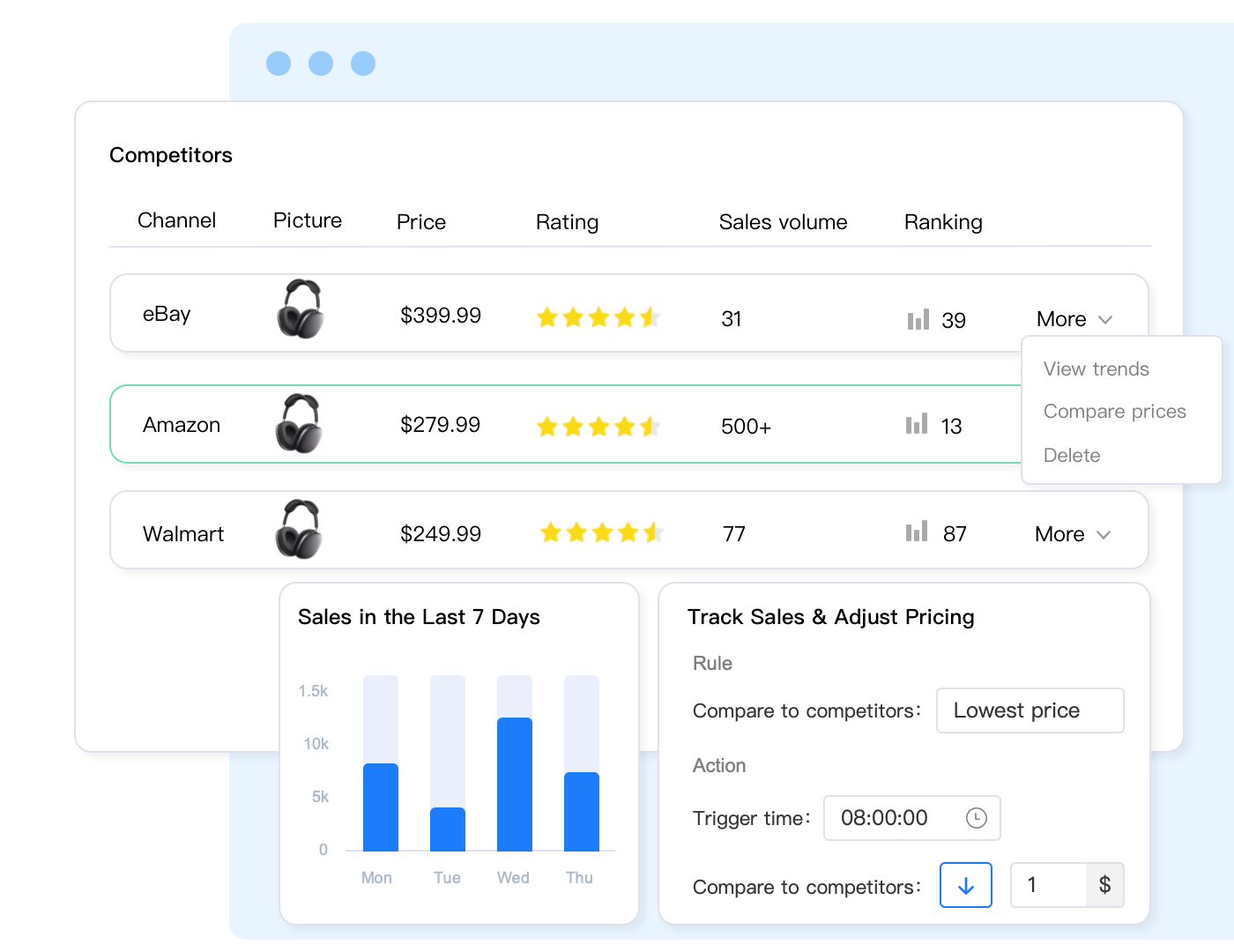
- Monitor Buy Box Threshold: Track the price needed to win Buy Box hourly. Price just below this threshold to capture Buy Box while maintaining margins. Smart Buy Box Optimizer automates this 24/7.
- Set Intelligent Floor Prices: Calculate minimum profitable prices factoring in all fees, shipping, and costs. Use Price Protection features to prevent automated repricing from eroding margins below profitability.
- React to Competitive Changes: When competitors lower prices, respond within hours—not days—to prevent ranking drops. Automated repricers maintain competitiveness continuously.
- Leverage Promotional Periods: Participate in Walmart’s scheduled promotional events (Black Friday, Back-to-School) with strategic discounts that trigger Polaris promotional ranking boosts.
Factor 4: Content Quality (10% Weight)
While the smallest weighted factor, content quality still measurably impacts rankings—especially for competitive search terms where multiple products have similar completeness, performance, and pricing.
Content Signals Polaris Evaluates
Polaris assesses content through both quantitative and qualitative measures:
- Image Count and Quality: Products with 6-8 high-resolution images (2000x2000px) rank higher than products with minimal imagery. Polaris also favors images showing multiple angles, lifestyle use, and detail closeups.
- Description Completeness: Short descriptions (100-150 words) must be present. Long descriptions should reach 500-1000 words with detailed feature explanations, use cases, and specifications.
- Review Quantity and Ratings: Products with 15+ reviews averaging >4.0 stars receive content quality bonuses. Polaris views customer validation as a quality signal.
- Enhanced Content Utilization: When available for your category, using Walmart’s enhanced content modules (comparison charts, brand stories, feature callouts) provides ranking advantages.
Content Optimization Best Practices
Maximize content quality scores through comprehensive optimization:
- Image Optimization: Upload 6-8 images minimum. First image must have pure white background with 85%+ product fill. Include lifestyle images showing product in use, detail shots highlighting key features, dimension diagrams, and packaging images.
- Description Enhancement: Create short descriptions (100-150 words) focusing on benefits and use cases. Write long descriptions (500-1000 words) with comprehensive feature details, specifications, compatibility information, and common use scenarios. Integrate keywords naturally without stuffing.
- Review Generation: Use automated review request tools to build review counts systematically. Automated Review Requests send post-purchase follow-ups that can boost review generation rates by 3-5x.
- Content Refreshing: Update descriptions quarterly with new use cases, seasonal relevance, and trending keywords. Polaris favors recently updated content as a freshness signal.
Walmart Polaris vs Amazon A10: Critical Differences
Sellers transitioning from Amazon often struggle on Walmart because they apply Amazon-optimized tactics that don’t align with Polaris. Understanding key algorithmic differences prevents costly mistakes.
| Ranking Factor | Walmart Polaris | Amazon A10 | Optimization Difference |
|---|---|---|---|
| Keyword Optimization | Secondary importance—keywords in attributes matter more than title density | Primary importance—keyword placement in title, bullets, backend fields critical | Walmart: Focus on attribute keywords. Amazon: Focus on title/bullet keywords |
| Title Length | Optimal 50-75 characters—concise, feature-focused titles | Optimal 150-200 characters—comprehensive keyword-rich titles | Walmart titles must be shorter and more focused |
| Attribute Completeness | 40% algorithm weight—most important factor | 10-15% weight—helpful but not dominant | Walmart requires systematic attribute completion |
| Price Sensitivity | 20% weight—competitive pricing matters but doesn’t dominate | 15-20% weight—similar importance to Walmart | Comparable, though Walmart enforces price parity strictly |
| External Traffic | Minimal impact—Polaris focuses on on-platform performance | Significant impact—external traffic influences A10 rankings | Amazon rewards external marketing, Walmart doesn’t |
| Sales Velocity | Measured as conversion rate (quality of sales) | Measured as units sold (quantity of sales) | Walmart prioritizes conversion quality over raw volume |
Why Amazon Tactics Fail on Walmart
Common Amazon optimization strategies that underperform on Walmart include:
- Keyword Stuffing Titles: Amazon rewards comprehensive 150-200 character titles packed with keywords. Walmart penalizes titles exceeding 75 characters and values conciseness over keyword density. Copying Amazon titles to Walmart reduces rankings.
- Minimal Attribute Completion: Amazon sellers can rank well with basic attributes if their keywords and performance are strong. Walmart’s 40% completeness weighting means incomplete listings won’t rank regardless of other factors.
- External Traffic Campaigns: Amazon’s A10 rewards external traffic from social media, influencers, and paid ads outside Amazon. Polaris doesn’t track or reward external traffic sources—focus optimization on in-platform performance.
- Review Velocity Manipulation: Amazon heavily weights rapid review accumulation and review recency. Polaris cares more about review average (>4.0 stars) and total count (15+) than velocity or recency.
Consequently, sellers must adopt Walmart-specific optimization that prioritizes completeness and performance over keyword tactics that dominate Amazon.
Polaris Optimization Task Comparison
| Optimization Task | Manual Approach | Automated Solution | Impact on Polaris |
|---|---|---|---|
| Attribute Completion (40% factor) | 10-15 min per product researching category requirements | 30-60 sec AI auto-population with validation | +50-70% ranking improvement |
| Keyword Rank Tracking (monitoring) | Manual search checks daily, spreadsheet logging | Automated daily tracking with alerts | Early detection of ranking drops |
| Buy Box Price Monitoring (20% factor) | Hourly manual checks across products | Automated repricing within threshold | +25-35% Buy Box win rate |
| Performance Metrics Analysis (30% factor) | Weekly exports, Excel pivot tables | Real-time dashboards with CTR/CVR | Identify underperformers 3-5 days faster |
| Content Quality Optimization (10% factor) | Manual image uploads, description writing | Bulk image optimization, template descriptions | +10-15% CTR improvement |
Tracking and Measuring Polaris Performance
Effective optimization requires measuring how changes affect Polaris ranking factors and search positions.
Key Metrics to Monitor
Track these Walmart-specific metrics to gauge Polaris optimization success:
- Search Ranking Position: Your product’s position for target keywords (track top 5-10 keywords per product). Target top 3 positions which capture 68% of category clicks.
- Listing Quality Score: Walmart’s internal completeness metric visible in Seller Center. Target 80-100% (Excellent tier).
- Attribute Completion Rate: Percentage of required and recommended attributes populated. Target 90%+ for maximum Polaris favorability.
- Click-Through Rate (CTR): Percentage of search impressions resulting in clicks. Benchmark >3% as high-performing.
- Conversion Rate (CVR): Percentage of sessions converting to sales. Target >2% minimum, >3% optimal.
- Buy Box Win Rate: Percentage of time you hold Buy Box. Target >60% for competitively priced products with good performance.
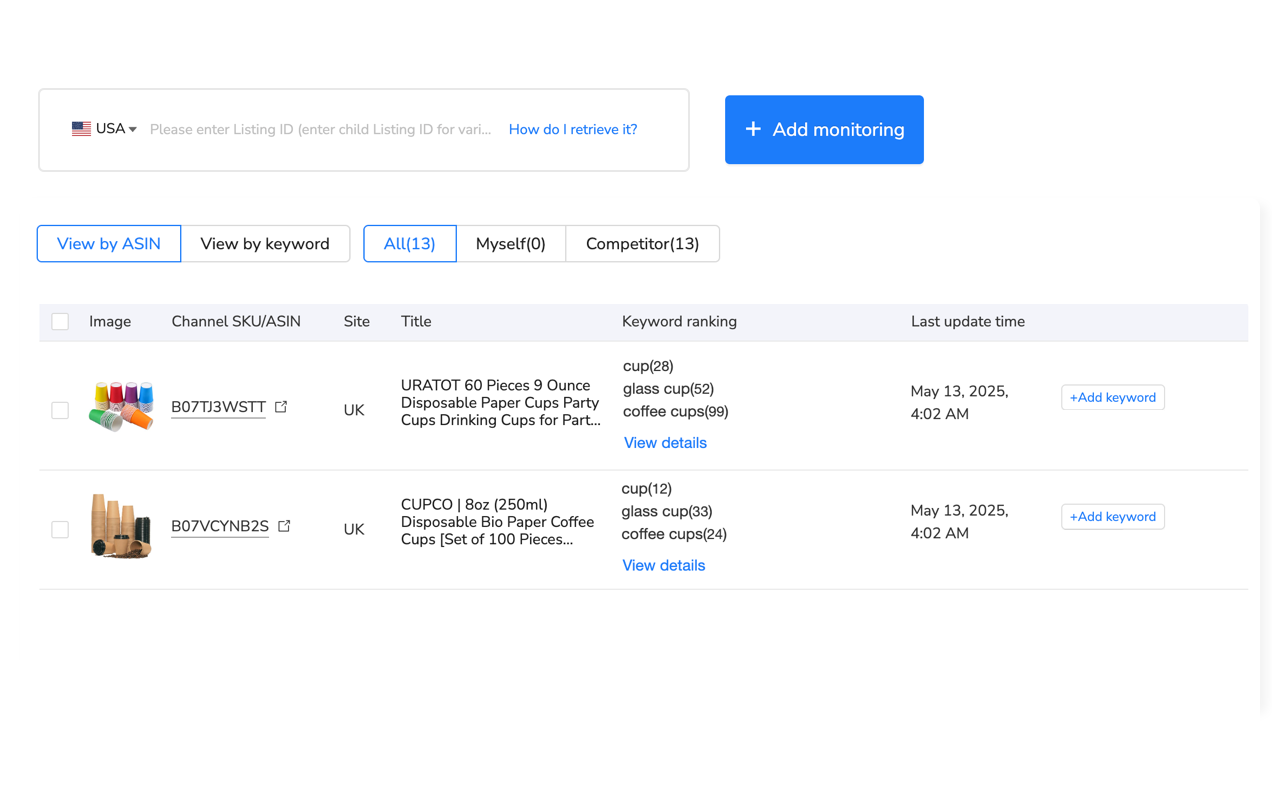
Maxmerce’s Keyword Rank Tracking monitors Walmart search positions daily for your target keywords, alerting you to ranking changes that signal Polaris algorithm updates or competitive shifts. Combined with performance metrics tracking, you can correlate optimization changes to ranking outcomes.
A/B Testing for Polaris Optimization
Test optimization hypotheses systematically to identify what moves rankings:
- Isolate Single Variables: Test one change at a time (e.g., adding 20 attributes vs optimizing images) to identify causal impacts
- Allow Sufficient Time: Polaris updates different signals at different frequencies. Give tests 14-21 days minimum to account for algorithm refresh cycles
- Track Multiple Metrics: Don’t just watch rankings—monitor CTR, CVR, listing quality score, and Buy Box win rate to understand holistic impact
- Compare Similar Products: Test optimizations on product families (e.g., different color variations) using one as control and others as test subjects
Polaris Algorithm Updates and Seasonality
Walmart updates Polaris ranking logic quarterly, with seasonal adjustments for peak shopping periods. Understanding these patterns prevents unexpected ranking volatility.
Known Polaris Update Cycles
Walmart typically releases algorithm updates during these windows:
- January (Post-Holiday): Algorithm refinements based on holiday performance data, often adjusting performance metric thresholds
- April (Spring Expansion): Category taxonomy updates and new attribute requirements as seasonal categories (outdoor, garden) gain prominence
- July (Back-to-School Prep): Ranking boost adjustments for BTS categories, promotional algorithm enhancements
- October (Holiday Prep): Major algorithm tune-up prioritizing inventory availability, WFS utilization, and fast shipping capabilities for holiday season
Additionally, Walmart makes micro-adjustments continuously based on customer behavior patterns. However, these quarterly updates represent the largest ranking signal changes.
Seasonal Ranking Factors
Certain Polaris factors gain weight during specific seasons:
- Q4 Holiday Season: Inventory availability and fast shipping (WFS usage) receive increased weighting. Stock-outs severely penalize rankings as Walmart prioritizes in-stock products.
- Back-to-School (July-August): Polaris boosts products with complete size/color variations for apparel and school supplies with educational attributes.
- Summer Outdoor Season: Products with weather-related attributes (water-resistant, UV protection, outdoor-rated) gain category-specific boosts.
Plan optimization efforts around these seasonal patterns to maximize visibility during peak revenue periods.
Frequently Asked Questions
What is the Walmart Polaris algorithm?
Walmart’s Polaris algorithm is the search ranking system that determines which products appear at the top of search results. It evaluates products based on item completeness (40% weight), performance metrics like conversion rate (30%), competitive pricing (20%), and content quality (10%). Unlike Amazon’s keyword-heavy A10 algorithm, Polaris prioritizes structured product data and actual customer satisfaction over keyword optimization.
How does Walmart’s algorithm differ from Amazon’s?
Walmart’s Polaris algorithm weighs item completeness (product attributes) at 40% compared to Amazon’s 10-15%, making attribute completion Walmart’s most important factor. Additionally, Walmart uses shorter optimal titles (50-75 chars vs Amazon’s 150-200), doesn’t reward external traffic like Amazon does, and measures conversion quality over raw sales velocity. Consequently, optimization strategies that work on Amazon often fail on Walmart without platform-specific adjustments.
How long does it take for Polaris to update rankings after optimization?
Polaris updates different ranking signals at different frequencies: price and inventory changes reflect hourly, performance metrics (CTR, CVR) update daily, and content quality signals refresh weekly. Therefore, expect to see pricing optimization impacts within hours, performance improvements within 3-7 days, and attribute/content changes within 7-14 days. Significant ranking jumps typically manifest fully within 14-21 days after comprehensive optimization.
What’s the fastest way to improve Polaris rankings?
The highest-impact optimization is completing product attributes to 90%+ (Item Spec 5.0 compliance). This addresses the 40% completeness factor and can improve rankings by 50-70% within 14 days. Simultaneously, optimize pricing to within 3% of Buy Box threshold and add 6-8 high-quality images. These three changes—completeness, competitive pricing, and image quality—typically deliver 60-80% of potential ranking improvements with minimal ongoing effort.
Can I rank well without the lowest price?
Yes—pricing accounts for only 20% of Polaris algorithm weight. Products with superior completeness (90%+ attributes) and performance (>3% conversion rate) regularly outrank lowest-priced competitors with incomplete data. However, you must price within reasonable competitive range (typically within 3-8% of category average). Extremely high pricing (15%+ above competitors) will suppress rankings regardless of other factors.
How important are reviews for Walmart search rankings?
Reviews contribute to the content quality factor (10% weight), making them less critical than completeness or performance but still meaningful. Products with 15+ reviews averaging >4.0 stars receive ranking boosts, while products with <3.5 stars face suppression. More importantly, reviews indirectly boost rankings by improving conversion rate (customers trust reviewed products more), which affects the 30% performance factor.
Does Walmart penalize frequent price changes?
Walmart doesn’t explicitly penalize price changes, but dramatic frequent swings (>20% daily) may trigger algorithmic skepticism. Strategic repricing within 5-10% ranges works well, especially when responding to competitive changes. Use automated repricers that adjust gradually (1-3% at a time) rather than sudden price drops or spikes. Additionally, maintain price parity across all channels—listing cheaper elsewhere causes Walmart to suppress your listing.
How does WFS affect Polaris rankings?
WFS (Walmart Fulfillment Services) indirectly boosts rankings through multiple mechanisms: WFS products win Buy Box 68% more often due to fast shipping reliability, improving the pricing factor. Additionally, WFS delivers better performance metrics (lower ODR, higher CVR) because customers trust Walmart fulfillment. However, WFS isn’t a direct ranking signal—its benefits manifest through other Polaris factors.
Can new products rank quickly on Walmart?
Yes—Walmart grants new listings a 14-30 day “discovery period” with baseline visibility despite lacking performance history. Products that achieve >2% conversion rate and >3% CTR during this window receive progressive ranking boosts. To capitalize on this, launch new products with complete attributes, competitive pricing, and optimized content to maximize discovery period performance. Strong initial metrics set long-term ranking trajectories.
How often should I optimize for Polaris algorithm changes?
Conduct comprehensive optimization reviews quarterly to align with Walmart’s major algorithm update cycles (January, April, July, October). Additionally, monitor rankings weekly and respond to significant drops (>5 positions) within 48 hours by checking for competitive pricing changes, new attribute requirements, or performance metric declines. Use automated tools to maintain continuous optimization between manual reviews.
Mastering the Polaris Algorithm for Long-Term Success
Walmart’s Polaris algorithm rewards sellers who prioritize comprehensive product data, customer satisfaction, and competitive value over keyword manipulation tactics. By understanding the 40% completeness weighting, 30% performance emphasis, and 20% pricing consideration, sellers can systematically optimize for sustainable top rankings.
The most successful Walmart sellers implement this ongoing optimization framework:
- Weekly: Monitor keyword rankings, track performance metrics (CTR, CVR, ODR), adjust pricing for Buy Box competitiveness
- Monthly: Review attribute completion for new Walmart requirements, analyze conversion funnels, refresh underperforming product content
- Quarterly: Comprehensive catalog audit aligned with Polaris updates, A/B test optimization hypotheses, expand attribute completion to recommended fields
This systematic approach ensures consistent visibility as Polaris evolves and competitive dynamics shift.
Optimize for Polaris with Automated Walmart Tools
Ready to systematically optimize every Polaris ranking factor? Automate attribute completion (40% factor), track performance metrics (30% factor), and monitor Buy Box positioning (20% factor) with AI-powered optimization that maintains top Polaris rankings.
Start your 14-day free trial—no credit card required and unlock consistent top-3 search rankings.