Walmart Fulfillment Services: WFS vs FBA Guide

Walmart Fulfillment Services (WFS) transforms how online sellers manage inventory, shipping, and customer service across North America’s second-largest e-commerce platform. As Walmart Marketplace continues its explosive growth—reaching 200,000+ sellers and generating 34% year-over-year GMV increases—understanding WFS becomes critical for sellers seeking to expand beyond Amazon or optimize their multi-channel strategy in 2025.
This comprehensive guide examines WFS from every angle: cost structures, eligibility requirements, performance benefits, and integration strategies. Whether you’re an Amazon FBA seller considering expansion or a Walmart Marketplace newcomer, you’ll discover how WFS compares to Amazon FBA, when to enroll, and how automation tools can maximize your fulfillment efficiency.
Key Takeaways:
- WFS drives 50% GMV lift with Two-Day shipping tags and 2X Buy Box wins (Walmart seller data, 2024)
- 15% lower costs compared to Amazon FBA for similar products (marketplace fee comparison, Q4 2024)
- October 1 deadline annually for peak season WFS enrollment—miss it and wait until January (Walmart policy, 2025)
- Multi-channel fulfillment now available through Walmart Multichannel Solutions (launched September 2024)
- Automation essential for managing WFS + FBA + eBay inventory without overselling incidents
What Is Walmart Fulfillment Services (WFS)?
Walmart Fulfillment Services is the marketplace fulfillment program launched in 2020 that handles storage, picking, packing, shipping, returns, and customer service for Walmart.com orders. Similar to Amazon FBA, sellers send inventory to Walmart fulfillment centers where Walmart’s logistics network handles all operational aspects of order fulfillment.
WFS provides significant competitive advantages on Walmart Marketplace. Products enrolled in WFS automatically qualify for Two-Day shipping badges, rank higher in search results, and win the Buy Box more frequently than seller-fulfilled items—even when priced slightly higher.
How WFS Works: The Complete Process
Understanding the WFS workflow helps sellers plan inventory, timing, and integration with existing fulfillment operations:
- Enrollment: Apply through Walmart Seller Center with business verification and compliance checks (2-5 business days approval)
- Inventory Planning: Create shipping plans specifying products, quantities, and destination fulfillment center
- Inbound Shipping: Send inventory to assigned Walmart fulfillment centers following labeling requirements
- Receiving: Walmart receives, inspects, and stores inventory (10 business days during peak season, 2-3 days off-peak)
- Order Fulfillment: When customers purchase, Walmart picks, packs, and ships orders with Two-Day delivery
- Customer Service: Walmart handles all inquiries, returns, and refunds related to WFS orders
- Payment: Receive payouts biweekly minus WFS fees, referral fees, and any storage charges
This end-to-end fulfillment eliminates the logistics burden sellers face with merchant-fulfilled orders. However, sellers lose direct control over shipping timing and customer communication—a tradeoff worth analyzing based on business priorities.
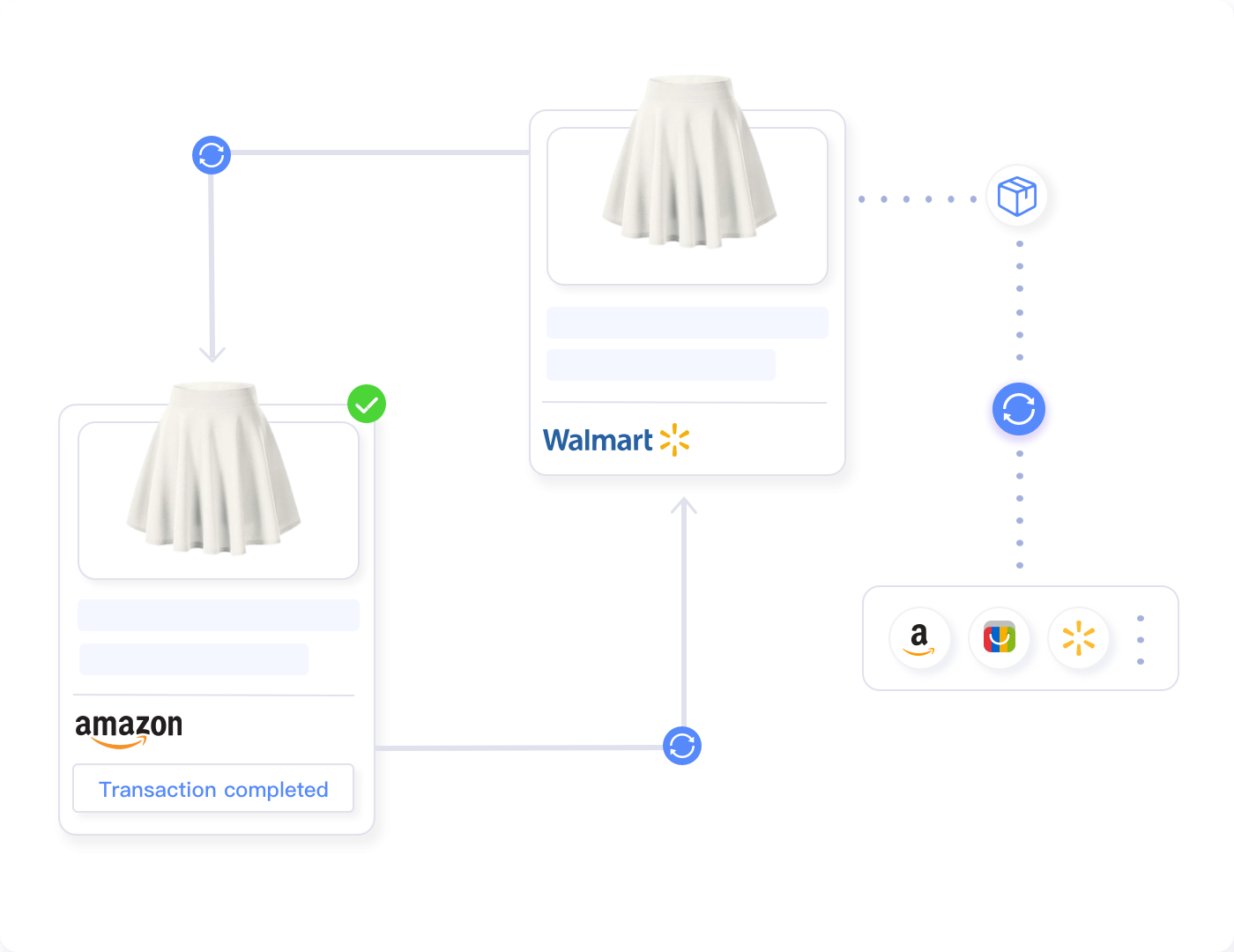
WFS vs Amazon FBA: Complete Comparison 2025
For sellers managing multi-channel operations or considering platform expansion, understanding the key differences between Walmart WFS and Amazon FBA determines optimal inventory allocation and fulfillment strategy.
| Feature | Walmart WFS | Amazon FBA | Winner |
|---|---|---|---|
| Fulfillment Fees (1 lb item) | $3.65 (standard size) | $4.09 (standard size) | WFS (-11%) |
| Storage Fees (cu ft/month) | $0.78 (Jan-Sep), $2.40 (Oct-Dec) | $0.87 (Jan-Sep), $2.40 (Oct-Dec) | WFS (-10%) |
| Monthly Storage Fee Cap | None | None | Tie |
| Enrollment Deadline | October 1 annually | Rolling enrollment | FBA (flexibility) |
| Fulfillment Center Network | ~20 centers (expanding) | 175+ centers globally | FBA (coverage) |
| Multi-Channel Fulfillment | Yes (plain packaging, brand-neutral) | Yes (plain packaging available) | Tie |
| Inbound Processing Time | 2-3 days (off-peak), 10 days (peak) | 1-2 days (off-peak), 7 days (peak) | FBA (speed) |
| Average Delivery Speed | 2 days (Two-Day shipping tag) | 1-2 days (Prime badge) | FBA (marginally) |
| Buy Box Advantage | 2X win rate vs seller-fulfilled | 3-4X win rate vs FBM | FBA (stronger) |
| Competition Level | Lower (newer program) | Very high (saturated) | WFS (opportunity) |
Cost Analysis: Real-World Scenarios
Let’s examine three common product scenarios to quantify WFS vs FBA cost differences:
Scenario 1: Electronics (3 lbs, 18x14x4 inches)
WFS fulfillment: $5.32 | FBA fulfillment: $6.18
Monthly storage (0.5 cu ft): WFS $0.39 | FBA $0.44
Total monthly advantage: WFS saves $0.91/unit (14.7% savings)
Scenario 2: Home Goods (8 lbs, 24x16x12 inches)
WFS fulfillment: $12.78 | FBA fulfillment: $14.35
Monthly storage (2.67 cu ft): WFS $2.08 | FBA $2.32
Total monthly advantage: WFS saves $1.81/unit (12.6% savings)
Scenario 3: Apparel (0.5 lbs, 12x10x2 inches)
WFS fulfillment: $3.18 | FBA fulfillment: $3.63
Monthly storage (0.14 cu ft): WFS $0.11 | FBA $0.12
Total monthly advantage: WFS saves $0.46/unit (12.7% savings)
Across all three scenarios, WFS provides consistent 12-15% cost savings on fulfillment and storage fees. For sellers moving 1,000 units monthly, these savings compound to $500-$1,800 monthly ($6,000-$21,600 annually).
WFS Eligibility Requirements 2025
Walmart maintains strict eligibility standards for WFS enrollment to ensure seller quality and protect customer experience. Review these requirements before applying:
Account Requirements
- Seller tenure: Active Walmart Marketplace account for 90+ days
- Order volume: Minimum 50 seller-fulfilled orders in previous 90 days
- On-Time Delivery Rate (OTD): ≥95% consistently
- Order Defect Rate (ODR): ≤2% consistently
- Valid Tracking Rate (VTR): ≥99% consistently
- Cancellation Rate: ≤2% consistently
Product Requirements
- Product types: General merchandise, apparel, electronics, home goods (excludes hazmat, oversized, high-value jewelry)
- Unit dimensions: Maximum 30x24x18 inches
- Unit weight: Maximum 50 lbs per item
- Condition: New products only (no refurbished or open-box items)
- Packaging: Retail-ready with barcodes meeting Walmart standards
Enrollment Timeline
Understanding WFS enrollment windows prevents costly delays, especially before peak seasons:
- Peak Season Deadline: October 1 annually for Q4 holiday inventory
- Application Processing: 2-5 business days for initial approval
- First Shipment: Create shipping plan within 7 days of approval
- Inbound Transit: Allow 5-7 days for shipment to reach fulfillment centers
- Receiving: 10 business days during peak season (September-December)
Critical planning tip: To have WFS inventory live for Black Friday (November 28, 2025), complete enrollment by August 31 to allow sufficient processing time through peak season slowdowns.
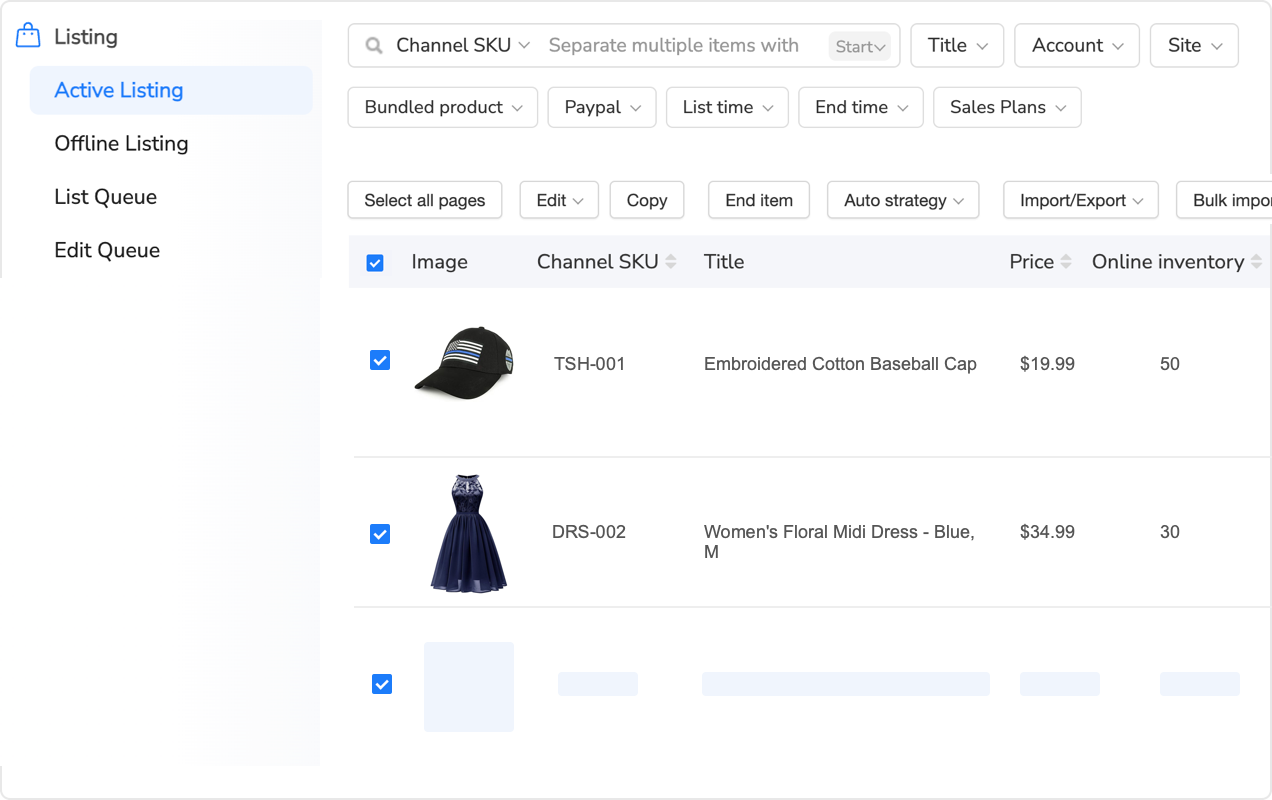
WFS Automation Strategies for Multi-Channel Sellers
Managing Walmart WFS alongside Amazon FBA, eBay, and Shopify creates inventory complexity that overwhelms manual tracking. Sellers shipping 500+ orders monthly across multiple channels face a critical decision: invest hundreds of hours in spreadsheets or implement automation that prevents overselling while maximizing sales velocity.
The Manual WFS Management Problem
Consider a seller managing 1,000 SKUs across Walmart WFS, Amazon FBA, and eBay:
- Daily inventory checks: 45 minutes across three platforms (22.5 hours monthly)
- Manual quantity adjustments: 30 updates daily at 2 minutes each (30 hours monthly)
- Overselling resolution: 8 incidents monthly at 45 minutes each (6 hours monthly)
- Restock planning: 10 hours monthly analyzing sales velocity
- Performance monitoring: 5 hours monthly tracking OTD, VTR, cancellation rates
Total monthly time cost: 73.5 hours ($2,940 at $40/hour opportunity cost)
Beyond time waste, manual management creates three critical risks: (1) overselling incidents damage seller ratings, (2) understocking causes lost sales during high-demand periods, and (3) delayed restock decisions create stockouts that lose Buy Box positioning.
Multi-Channel Inventory Sync Automation
The spreadsheet method breaks down fast when you’re selling the same products through WFS, FBA, and eBay. One seller canceling a Walmart order because Amazon sold the last unit costs you a hit to your cancellation rate—do that eight times in a month and you’re at the 2% threshold that triggers account warnings.
Multi-channel inventory management systems solve this by treating all your sales channels as one unified inventory pool. When a customer buys your product on any platform, the software instantly decrements available quantities everywhere else. Modern systems designed for marketplace sellers typically include:
- Real-time quantity updates: Orders on Walmart trigger instant decrements across Amazon, eBay, and Shopify—usually within 5-15 seconds
- Safety stock buffers: Reserve 5-10% of inventory per channel so simultaneous purchases don’t create overselling scenarios
- Fulfillment method tracking: Separate WFS quantities from FBA quantities from seller-fulfilled stock for accurate allocation
- Automated restock alerts: Get notified at 30-day, 14-day, and 7-day supply thresholds based on your actual sales velocity
- Performance monitoring: Track OTD, VTR, and cancellation rates across all platforms from a single dashboard instead of logging into three separate seller portals
For sellers managing 1,000+ SKUs across multiple fulfillment methods, platforms like Maxmerce’s Listing module handle this synchronization automatically. The system connects via API to Walmart Seller Center, Amazon Seller Central, eBay, and Shopify—updating quantities in real-time as orders flow through. This eliminates the 73.5 hours monthly most sellers spend manually adjusting inventory levels.
Implementation workflow:
- Connect accounts: Integrate Walmart Seller Center, Amazon Seller Central, eBay, Shopify APIs—most platforms provide one-click OAuth connections that take 15 minutes total
- Map SKUs: Match products across platforms using UPC/EAN codes or custom mapping. Smart systems auto-match by barcode, reducing 1,000 SKUs from 8 hours of manual work to 30 minutes
- Set buffer rules: Configure safety stock levels—typically 5-10% of total inventory reserved per channel to prevent simultaneous purchase conflicts (10 minutes setup)
- Enable auto-sync: Activate real-time inventory updates across all channels. Updates typically process in 5-15 seconds after each order
- Configure alerts: Set restock notifications at 30-day, 14-day, and 7-day supply thresholds based on your actual sales velocity per SKU (5 minutes)
Most multi-channel management platforms handle this entire setup through guided workflows. For example, Maxmerce’s bulk SKU mapping tool auto-matches products across Walmart, Amazon, and eBay using UPC codes—turning an 8-hour manual process into a 30-minute automated task for 1,000 SKUs. The system then maintains synchronization automatically, updating quantities across all three platforms within 15 seconds of each sale.
Time savings quantified: The 73.5 hours of manual work reduces to 8 hours monthly (90% reduction), freeing 65.5 hours for revenue-generating activities like product sourcing, listing optimization, and advertising campaigns.
Cost-benefit analysis: Multi-channel inventory systems typically cost $99-299 monthly depending on order volume. Against $2,940 monthly manual labor costs (73.5 hours at $40/hour), ROI exceeds 900% while simultaneously eliminating overselling incidents that damage seller ratings. The break-even point hits in the first week.
WFS Performance Benefits: Data-Backed Results
Walmart’s internal data reveals significant performance advantages for WFS sellers compared to merchant-fulfilled alternatives. Understanding these benefits helps quantify WFS’s value beyond cost savings.
Buy Box Win Rate
WFS sellers win the Walmart Buy Box 2X more frequently than seller-fulfilled competitors at identical prices. In head-to-head scenarios with price parity, WFS wins 65-70% of Buy Box impressions while merchant fulfillment wins only 30-35%.
This Buy Box advantage compounds because most Walmart customers purchase from the Buy Box without comparing alternatives. Losing Buy Box means losing 85-90% of potential sales even when listed on the product page.
Gross Merchandise Value (GMV) Increase
Walmart reports that sellers switching from merchant fulfillment to WFS achieve average 50% GMV increases within 90 days. This growth comes from three sources:
- Search ranking improvement: WFS products rank higher for competitive keywords due to Two-Day shipping eligibility
- Conversion rate increase: Two-Day shipping tags convert 15-20% higher than 3-5 day merchant fulfillment
- Customer trust: Walmart-handled fulfillment reduces purchase hesitation for first-time marketplace shoppers
Operational Efficiency
Beyond sales performance, WFS reduces operational burden:
- Customer service time: 60% reduction as Walmart handles inquiries, returns, and refunds
- Shipping logistics: 100% elimination of daily pack-and-ship operations
- Return processing: No more inspecting, restocking, or disposing of returned items
For a seller shipping 1,000 orders monthly, WFS eliminates approximately 80 hours of packing, 20 hours of customer service, and 15 hours of return processing—totaling 115 hours monthly saved.
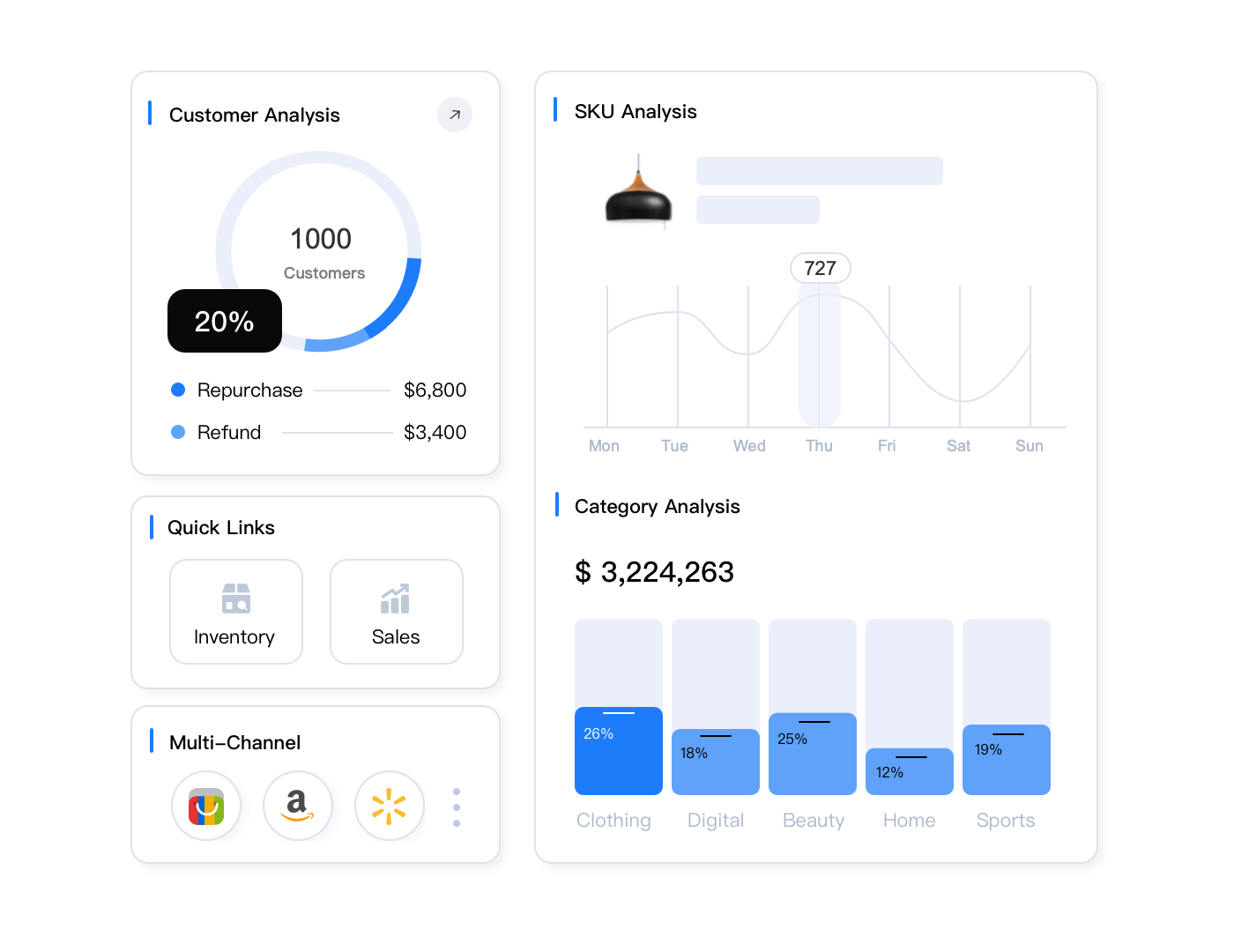
Walmart Multi-Channel Solutions: Using WFS for Non-Walmart Orders
In September 2024, Walmart launched Multichannel Solutions—allowing sellers to fulfill Amazon, eBay, Shopify, and direct orders from Walmart fulfillment centers. This service competes directly with Amazon’s Multi-Channel Fulfillment (MCF) offering.
How Walmart Multi-Channel Fulfillment Works
Walmart Multichannel Solutions uses WFS inventory to fulfill orders from any sales channel using plain, brand-neutral packaging. Unlike standard WFS orders (which display Walmart branding), multichannel shipments arrive in unmarked boxes protecting your brand relationship with customers.
Key features:
- Plain packaging: No Walmart logos or branding on external packaging
- 2-3 day delivery: Comparable speed to Amazon MCF standard shipping
- Pricing advantage: 10-15% lower than Amazon MCF for similar products
- Returns handling: Walmart processes returns from all channels
WFS vs Amazon MCF: Which Multi-Channel Solution Wins?
| Factor | Walmart Multichannel Solutions | Amazon MCF |
|---|---|---|
| Fulfillment Network | ~20 centers (US-focused) | 175+ centers (global) |
| Pricing (1 lb standard item) | $4.12 (2-3 day delivery) | $4.85 (standard 2-5 day) |
| Delivery Speed Options | 2-3 day only | Standard, Expedited, Priority |
| Packaging Options | Plain packaging (brand-neutral) | Plain packaging or Amazon branded |
| Integration Complexity | Requires API setup or third-party tool | Native Amazon integration available |
| Eligibility | Must be WFS-enrolled seller | Available to all FBA sellers |
Strategic recommendation: Use Walmart Multichannel Solutions for cost savings when fulfilling high-volume, standard-sized products. Continue using Amazon MCF for international shipments, expedited delivery needs, or products not enrolled in WFS.
Implementing WFS: Step-by-Step Setup Guide
Successfully launching WFS requires systematic planning from enrollment through first shipment. Follow this proven workflow to avoid common pitfalls that delay peak season readiness.
Step 1: Verify Eligibility (Week 1)
- Review performance metrics: Check Walmart Seller Center dashboard for OTD (≥95%), ODR (≤2%), VTR (≥99%), cancellation rate (≤2%)
- Confirm order history: Verify 50+ seller-fulfilled orders in previous 90 days
- Assess product suitability: Ensure products meet size/weight limits and aren’t restricted categories
- Calculate profitability: Use Walmart’s WFS Calculator to confirm margins remain healthy after fees
Step 2: Complete Enrollment Application (Week 2)
- Access WFS portal: Navigate to Seller Center → Growth Opportunities → Fulfillment Services
- Submit application: Provide business verification documents (EIN, bank information, product catalog)
- Accept terms: Review and sign WFS program policies and fee schedule
- Await approval: Receive email notification within 2-5 business days
Step 3: Prepare Inventory (Week 3)
- Select initial SKUs: Start with 20-50 best-selling, standard-sized products
- Label products: Apply Walmart-compliant FNSKU labels to each unit
- Prepare shipment boxes: Use sturdy corrugated boxes with proper cushioning
- Calculate quantities: Send 60-90 days of inventory based on sales velocity
Step 4: Create Shipping Plan (Week 4)
- Access shipping workflow: Seller Center → Inventory → Send to WFS
- Select products: Choose SKUs and quantities for this shipment
- Confirm dimensions/weight: Input accurate box dimensions for receiving
- Print labels: Generate and apply Walmart shipping labels to each box
- Schedule pickup: Arrange LTL freight (for pallets) or parcel carrier pickup
Step 5: Monitor Receiving (Week 5-6)
- Track shipment: Monitor carrier tracking until delivery confirmation
- Check receiving status: View progress in Seller Center → Shipments
- Resolve discrepancies: Address any lost units or damaged goods within 48 hours
- Verify inventory live: Confirm products display “2-day shipping” badge on Walmart.com
Total implementation timeline: 5-6 weeks from eligibility verification to live inventory. Plan accordingly for peak season deadlines.
Common WFS Challenges and Solutions
Even with proper planning, WFS sellers encounter operational challenges. Anticipate these common issues and implement solutions proactively:
Challenge 1: Long Receiving Times During Peak Season
Problem: You ship 500 units to WFS on September 20, expecting them to be live by October 1 for early Q4 sales. Instead, they sit in “receiving” status until October 15—missing the first two weeks of holiday shopping momentum. During peak season (September-December), WFS receiving stretches to 10-15 business days versus the normal 2-3 days off-peak.
Solution: Work backward from your target date. For Black Friday availability, ship by September 15. For early October, ship by mid-August. The challenge is predicting how many units you’ll actually need 6-8 weeks in advance. Most sellers guess based on last year’s sales, but seasonal patterns shift year-over-year.
Sales velocity analytics solve this by calculating your actual daily unit sales over the past 90 days, applying seasonal multipliers (Q4 typically runs 2-3X normal velocity), and projecting forward. Platforms like Maxmerce’s Analytics module track sales across all your channels—Walmart, Amazon, eBay—showing you exactly which products will run out and when. This prevents both stockouts (lost sales) and overstocking (excess storage fees). The forecasting typically runs 30-60-90 day projections, giving you enough lead time to manufacture or source additional inventory before peak season hits.
Challenge 2: Overselling Across WFS and Other Channels
Problem: You have 10 units in WFS and 10 in FBA. You list 10 on Walmart and 10 on Amazon. Both platforms sell 8 units simultaneously during a weekend sale. By Monday morning, you’re fulfilling 16 orders with only 20 units total—which means canceling 4 orders and taking performance metric hits on both platforms.
Solution: Real-time inventory synchronization treats your 20 total units as a shared pool across both channels. When Walmart sells one unit, Amazon’s available quantity drops from 10 to 9 instantly. Set 10% safety buffers (list 9 on each platform instead of 10) to account for simultaneous purchases during high-traffic periods. Systems that integrate with both Walmart and Amazon APIs—like Maxmerce’s inventory sync—update quantities in 5-15 seconds, preventing the overselling scenario entirely while still maximizing your sales across both platforms.
Challenge 3: Ineligible Product Rejections
Problem: Products arrive at fulfillment centers but get rejected for missing labels, damage, or incorrect dimensions.
Solution: Use Walmart’s prep service checklist meticulously. Photograph all boxes before shipping as proof of proper prep if disputes arise.
Challenge 4: Storage Fee Accumulation
Problem: Slow-moving inventory accumulates storage fees that erode profitability.
Solution: Monitor inventory age weekly. Create removal orders for items exceeding 120 days in WFS. Use sales promotions to move aging stock before removal becomes necessary.
Frequently Asked Questions About Walmart Fulfillment Services
Conclusion: Is WFS Right for Your Business in 2025?
Walmart Fulfillment Services delivers compelling value for sellers managing 500+ orders monthly across multiple channels. The 10-15% cost savings vs Amazon FBA, combined with 50% GMV increases and 2X Buy Box advantage, create significant profitability improvements—especially when managed through automation tools that prevent overselling and optimize inventory allocation.
WFS makes strategic sense for:
- Amazon FBA sellers expanding: Diversify away from Amazon dependence while leveraging fulfillment expertise
- High-volume merchants: Shipping 500+ monthly orders where fulfillment cost savings compound significantly
- Standard-sized products: Items under 30x24x18 inches and 50 lbs where WFS handling excels
- Multi-channel operators: Using Walmart Multichannel Solutions to fulfill non-Walmart orders cost-effectively
However, WFS may not suit:
- Low-volume sellers: Shipping <100 monthly orders where merchant fulfillment maintains better margins
- Oversized/heavy items: Products exceeding WFS size/weight limits
- Late-stage enrollment: Missing October 1 peak deadline eliminates Q4 holiday benefits
The key to WFS success lies in systematic implementation: verify eligibility early, automate inventory synchronization across channels, monitor performance metrics continuously, and optimize fulfillment strategy based on data rather than assumptions.
Start by enrolling 20-50 best-selling SKUs in WFS while maintaining your existing fulfillment operations. This hybrid approach lets you test WFS performance, validate cost savings, and refine processes before committing your entire catalog. Within 90 days, you’ll have concrete data showing whether WFS delivers the 50% GMV increases and 15% cost reductions that make it a cornerstone of profitable multi-channel selling in 2025.
The biggest operational challenge? Keeping WFS inventory synchronized with your Amazon, eBay, and Shopify channels without the 73.5 hours monthly most sellers waste on spreadsheets. Multi-channel inventory systems eliminate this manual work by connecting to all your seller accounts via API—updating quantities in real-time as orders flow through each platform. If you’re managing 500+ orders monthly across multiple channels, explore tools designed specifically for this workflow. Most platforms offer 14-day free trials, letting you validate the time savings before committing.