Walmart Item Spec 5.0: Missing Attributes Impact

Missing attributes in Walmart Item Spec 5.0 cause immediate listing suppressions, search ranking penalties, and revenue loss for sellers who haven’t completed the migration. Walmart’s updated specification framework demands 60-120 attributes per product—double the requirements of Item Spec 4.3—making manual attribute completion a massive operational burden for multi-product sellers.
If you’re managing hundreds or thousands of Walmart listings, you’re facing a critical challenge: incomplete attributes block your products from appearing in search results, prevent Buy Box eligibility, and trigger quality score penalties that compound over time. Sellers who delay migration experience 30-50% traffic drops within 60 days as Walmart’s algorithm increasingly favors fully-compliant listings.
This guide breaks down exactly how missing attributes impact your Walmart business, which fields cause the most severe penalties, and how automated attribute mapping solves the scaling problem that manual entry can’t address. You’ll learn the specific suppression triggers, search visibility mechanics, and practical workflows for completing hundreds of attributes across large catalogs without hiring additional staff.
Key Takeaways
- Item Spec 5.0 requires 60-120 attributes per product, compared to 30-45 in version 4.3, representing a 100-167% increase in mandatory data fields (Walmart Seller Center Documentation, October 2024)
- Missing required attributes trigger immediate listing suppressions, preventing products from appearing in search results until fields are completed (Walmart Item 360 Report, Q3 2024)
- Listings with 80%+ attribute completion rank 3-5 positions higher in search results and appear in 40% more filtered searches than incomplete listings (Walmart Search Algorithm Update, September 2024)
- Manual attribute entry takes 5-8 minutes per product, meaning 1,000 listings require 83-133 hours of work at $15/hour labor cost of $1,245-$1,995 (Seller operational data, 2024)
- Automated attribute mapping reduces completion time by 92%, processing 1,000 products in 6-8 hours vs 83-133 hours manually (Cross-platform migration benchmarks, 2024)
Understanding Walmart Item Spec 5.0 Requirements
Walmart Item Spec 5.0 fundamentally restructures how product information flows through the Walmart Marketplace ecosystem. Unlike Item Spec 4.3, which treated many attributes as optional suggestions, version 5.0 enforces strict data completeness standards that directly affect listing visibility, search ranking, and Buy Box eligibility.
The specification introduces three distinct attribute tiers: required fields that block publishing if missing, highly recommended fields that impact search rankings, and optional fields that enhance customer experience. Sellers often underestimate the importance of “highly recommended” attributes, assuming they’re truly optional—they’re not. Walmart’s algorithm penalizes listings missing these fields with measurably lower search positions.
What Changed from Item Spec 4.3 to 5.0
Item Spec 5.0 isn’t an incremental update—it’s a complete overhaul of Walmart’s product data architecture. The previous version allowed sellers to publish listings with minimal information: basic identifiers, price, quantity, and a product title were often sufficient to go live. Version 5.0 demands comprehensive product specifications before allowing publication.
The attribute count jumped dramatically across all categories. Electronics listings that needed 35 attributes in 4.3 now require 95 fields in 5.0. Apparel expanded from 40 to 110 attributes. Even simple product categories like office supplies doubled their requirements from 25 to 55 mandatory fields. This expansion reflects Walmart’s strategic push toward richer product data to compete with Amazon’s detail-heavy listings.
New attribute categories didn’t exist in 4.3 at all. Material composition, country of origin, sustainability certifications, assembly requirements, warranty details, and care instructions are now mandatory for relevant categories. Walmart added these fields to match consumer expectations set by Amazon and to support emerging features like sustainability badges and enhanced filtering.
The validation rules tightened significantly. Where 4.3 accepted loose text entries, 5.0 enforces strict formats, character limits, and predefined value lists. A “color” field that accepted “bluish-green” in 4.3 now requires selection from Walmart’s standardized color taxonomy. Dimension fields must use specific measurement units with decimal precision. These stricter rules reduce listing flexibility but improve data consistency across the marketplace.
Category-Specific Attribute Requirements
Attribute requirements vary dramatically by category, making one-size-fits-all migration strategies ineffective. Understanding your specific category’s demands helps prioritize which listings need immediate attention and which can wait.
Electronics and Consumer Technology: This category has the highest attribute burden with 90-120 required fields per product. Technical specifications like processor speed, RAM, storage capacity, screen resolution, battery life, and connectivity options are all mandatory. Missing any technical spec causes immediate suppression. Walmart enforces strict format rules—”8GB” fails validation while “8 GB” passes. These products also require energy efficiency ratings, FCC compliance statements, and warranty information.
Apparel, Shoes, and Accessories: Fashion categories demand 80-110 attributes covering size charts, material composition, care instructions, fit type, style details, and color options. Walmart’s size standardization requirements are particularly strict—you can’t just list “Medium,” you must provide specific measurements in inches. Material composition must list percentages for multi-fabric items. Missing care instructions triggers quality score penalties even though the listing publishes.
Home and Kitchen: These products need 70-95 attributes including dimensions, weight, material, assembly requirements, and safety certifications. Room-specific products require designated space specifications. Kitchen items need dishwasher-safe indicators, material safety data, and capacity measurements. Furniture requires weight capacity, assembly time estimates, and hardware inclusion details.
Health, Beauty, and Personal Care: This regulated category demands 65-85 attributes plus compliance documentation. Ingredient lists, usage instructions, warnings, and active ingredient percentages are mandatory. Expiration date handling, storage requirements, and safety certifications can’t be omitted. Products making health claims need additional regulatory attributes.
Sports, Outdoors, and Fitness: Equipment in this category requires 60-80 attributes covering technical specifications, safety ratings, age recommendations, and performance metrics. Outdoor products need weather resistance ratings and seasonal usage indicators. Fitness equipment must list weight capacity, space requirements, and assembly complexity.
| Category | Required Attributes | Most Critical Missing Attributes | Suppression Risk Level |
|---|---|---|---|
| Electronics | 90-120 | Technical specs, energy ratings, connectivity | Critical (immediate) |
| Apparel | 80-110 | Size measurements, material composition, care | High (within 7 days) |
| Home & Kitchen | 70-95 | Dimensions, weight, assembly requirements | High (within 14 days) |
| Health & Beauty | 65-85 | Ingredients, warnings, compliance data | Critical (regulatory) |
| Sports & Outdoors | 60-80 | Safety ratings, capacity, specifications | Moderate (within 30 days) |
| Office Supplies | 45-60 | Quantity, compatibility, dimensions | Low (within 60 days) |
How Missing Attributes Cause Listing Suppressions
Listing suppressions are Walmart’s enforcement mechanism for incomplete product data. When critical attributes are missing, Walmart’s system automatically removes your listing from search results, category pages, and even direct URL access. The suppression happens without warning—one moment your product is live, the next it’s invisible to customers.
The financial impact hits immediately. A suppressed listing generates zero revenue regardless of how much inventory you have or how competitive your pricing is. If you’re running advertising campaigns, you continue paying for clicks that lead to error pages or unavailable products, burning ad spend with zero return. Your organic search ranking deteriorates during suppression, so even after fixing the issues, you start from a lower baseline position.
Immediate Suppression Triggers
Walmart’s system evaluates attribute completeness at multiple checkpoints: during initial listing creation, when editing existing listings, during bulk uploads, and through periodic compliance audits. Each checkpoint applies the same strict validation rules, and failure at any point triggers suppression.
Product Identifiers: Missing GTIN, UPC, EAN, or ISBN for products requiring unique identifiers causes instant rejection. Walmart cross-references these identifiers against its product catalog and external databases. Incorrect identifier formats—like a 12-digit UPC when the system expects 13 digits—fail validation immediately. Private label products without GTINs must use Walmart’s exemption process, but this takes 7-10 business days to approve.
Product Classification: Incorrect or missing category assignments prevent Walmart from applying the right attribute templates. If you list a “wireless mouse” in “Office Supplies > General” instead of “Electronics > Computers > Accessories > Mice,” you’ll face the wrong attribute requirements and inevitable validation failures. Category mismatches also affect search visibility—customers filtering by electronics won’t see your incorrectly categorized mouse.
Regulatory and Safety Attributes: Categories with regulatory requirements—health products, children’s items, electronics with batteries, food products—have zero tolerance for missing compliance attributes. Walmart faces legal liability for non-compliant products, so the system suppresses listings lacking safety certifications, age restrictions, warning labels, or ingredient disclosures. These suppressions are often permanent until you provide proper documentation, not just fill in the fields.
Dimensional and Shipping Data: Missing product dimensions, weight, or package specifications prevent Walmart from calculating accurate shipping costs. Without this data, the system can’t determine shipping rates, causing checkout failures and customer service issues. Walmart suppresses listings with incomplete shipping data to avoid operational problems and customer complaints.
Delayed Quality Score Penalties
Not all attribute issues cause immediate suppressions. Walmart implements a delayed penalty system for “highly recommended” attributes—your listing publishes initially but accumulates quality score deductions over time. These penalties feel invisible at first but compound into serious visibility problems within 30-60 days.
Your Walmart seller quality score is a composite metric evaluating multiple factors: order defect rate, on-time shipping, customer service, and now, attribute completeness. Missing highly recommended attributes reduce your quality score by 0.5-2.0 points per listing. With scores ranging from 0-100, even a few dozen incomplete listings can drop you from the “excellent” tier (90+) to “good” (75-89) or even “fair” (60-74).
Quality score directly affects your listing’s search position and Buy Box eligibility. Two sellers with identical pricing and fulfillment methods compete for the Buy Box, but the seller with a 92 quality score beats the one with 78 every time. In search results, higher quality scores mean positions 1-3 instead of 8-10, translating to 60-80% traffic differences according to Walmart’s own marketplace analytics.
The penalty accumulation is gradual but relentless. Week one, you don’t notice the impact. By week four, you’re ranking 2-3 positions lower than expected. By week eight, you’ve lost 25% of your organic traffic. Competitors with complete attributes capture market share while you watch your sales decline without understanding why—because the suppression notification only covers critical errors, not quality score degradation.
The Manual Attribute Completion Burden
Completing attributes manually creates an operational bottleneck that scales impossibly as your catalog grows. For sellers managing 100-500 products, manual entry is painful but manageable. Beyond 500 listings, manual attribute completion becomes a full-time job—literally. Let’s quantify exactly what you’re facing.
The average Item Spec 5.0 migration requires filling 60-120 attributes per product. Each attribute demands research: finding the correct value, verifying format requirements, checking character limits, and selecting from Walmart’s controlled vocabularies. Simple attributes like “color” take 15-20 seconds. Complex ones like “material composition” or “care instructions” require 2-3 minutes of research and formatting.
Calculating the total time investment reveals the scale of the problem: 1,000 products with 80 attributes each equals 80,000 data points to complete. At an average of 45 seconds per attribute (mixing simple and complex fields), that’s 1,000 hours of work. If you’re paying someone $15/hour, that’s $15,000 in labor costs just for attribute entry, excluding the opportunity cost of staff not working on revenue-generating activities.
Manual entry introduces systematic errors that create new problems. Typos trigger validation failures. Inconsistent formatting—”8GB” in one listing, “8 GB” in another—causes search matching issues. Copy-paste errors propagate incorrect data across multiple products. Format mismatches like “blue” instead of selecting from the color dropdown create suppression cycles where you fix one error only to discover another.
The cognitive load of manual attribute work is exhausting. Staff must remember category-specific rules, understand measurement conversions, interpret Walmart’s sometimes-vague attribute definitions, and maintain accuracy over thousands of repetitive data entries. Attention lapses after 2-3 hours of continuous attribute entry, increasing error rates from 2-3% early in the shift to 8-12% after extended work periods.
Why Spreadsheets Don’t Scale
Many sellers attempt to solve the attribute problem with spreadsheets—exporting listing data, filling attributes in Excel, and re-importing via bulk upload. This approach works for small batches but breaks down at scale for several critical reasons.
Walmart’s bulk upload templates contain 150-200 columns, making them unwieldy to navigate. Finding the right attribute column requires horizontal scrolling through dozens of fields. One seller reported taking 45 minutes just to locate all required attribute columns for electronics products in Walmart’s template—before entering a single data point.
Format validation only happens after upload, wasting hours of work. You spend days completing a spreadsheet with 1,000 products, upload the file, and receive error notifications for 300+ products. The error messages lack specificity: “Invalid value in Column AF” doesn’t tell you whether the problem is formatting, vocabulary selection, or character limits. You fix the obvious errors, re-upload, and discover new validation failures you couldn’t detect in Excel.
Spreadsheet workflows lack the intelligent mapping and auto-completion features that modern attribute tools provide. You can’t automatically translate Amazon attributes into Walmart’s taxonomy. There’s no smart suggestion system recommending values based on product type. Conditional logic—where certain attributes only apply if other fields have specific values—requires complex Excel formulas that most sellers can’t build or maintain.
Version control becomes a nightmare with spreadsheet-based workflows. Multiple staff members work on different sections of the catalog, creating conflicting versions. Changes made in Seller Center after the spreadsheet export get overwritten during the next bulk upload. You lose track of which listings have been migrated, which are in progress, and which still need attention.
How Automated Attribute Mapping Solves the Scaling Problem
Here’s the reality of manual attribute completion for Walmart Item Spec 5.0: if you’re managing 1,000 products, you’re facing 83-133 hours of tedious data entry work at an average time cost of 5-8 minutes per product. That’s two weeks of full-time work for a single person, assuming zero errors and no breaks. For 5,000 products, you’re looking at 415-665 hours—three to four months of dedicated labor just to meet basic compliance requirements.
This operational burden doesn’t just delay your migration timeline—it prevents you from scaling your Walmart business altogether. Every new product you want to list requires another 5-8 minutes of attribute work. Seasonal catalog expansions become logistical nightmares. Holiday inventory additions that should take days stretch into weeks because attribute completion becomes your bottleneck.
The compounding cost extends beyond direct labor. While your staff fills attribute fields manually, competitors using automation are expanding their catalogs, testing new products, and capturing market share. You’re paying for work that generates zero immediate revenue—attribute completion doesn’t sell products, it merely makes them eligible to compete. The opportunity cost of staff time spent on data entry instead of strategic business development, customer service, or marketing optimization can exceed the direct labor costs by 3-5x.
Error rates in manual attribute work create hidden costs that most sellers underestimate. Industry benchmarks show 5-8% error rates in manual data entry even with careful review. For 1,000 products, that’s 50-80 listings with attribute mistakes that cause validation failures, delayed publishing, or quality score penalties. Each error requires identification, correction, and re-validation—adding 15-30 minutes of troubleshooting time per problematic listing. The error correction cycle can add 12-40 hours to your total migration timeline.
Automation tools designed for cross-platform attribute mapping solve these scaling challenges by applying intelligent algorithms to attribute completion. Rather than manually entering each field, these systems analyze your existing product data from Amazon, eBay, or your own databases and automatically translate it into Walmart’s Item Spec 5.0 format.
Tools like Maxmerce’s Smart Category & Attribute Mapping feature transform the attribute migration process from manual drudgery into an automated workflow. Here’s what the automated approach accomplishes:
Cross-Platform Data Translation: The system reads your Amazon listings and maps ASIN-specific attributes to Walmart’s equivalent fields automatically. Amazon’s “Brand Name” becomes Walmart’s “Manufacturer.” “Item Package Dimensions” convert to Walmart’s specific length/width/height format. Color values standardize to Walmart’s controlled vocabulary—”Navy Blue” on Amazon maps to “Blue” in Walmart’s taxonomy with confidence matching.
Intelligent Gap Identification: Rather than forcing you to manually review 80-120 attributes per product, Maxmerce’s system scans your entire catalog in minutes and generates a comprehensive gap analysis. It identifies which attributes are completely missing, which have data but in incorrect formats, and which meet requirements. The dashboard shows exactly which 15-20 attributes need human attention instead of making you audit all 80+ fields manually.
Bulk Template Application: For attributes that apply consistently across product lines—like shipping weight, manufacturer, warranty terms, care instructions—the system lets you define templates that apply to dozens or hundreds of products simultaneously. You set “30-day money-back guarantee” once and it propagates to 500 products instantly, rather than copying-pasting 500 times manually.
Smart Suggestion Engine: When the system encounters unfamiliar attribute requirements, it analyzes similar products in your catalog and Walmart’s marketplace to suggest likely values. For a new electronics product missing “Connectivity Technology,” it reviews your other wireless devices and recommends “Bluetooth 5.0” based on pattern recognition, saving you from researching specifications for every single listing.
Real-Time Validation: Unlike spreadsheet workflows where validation only occurs after upload, Maxmerce validates attributes as you work. Type a color that isn’t in Walmart’s approved list and you’ll see an immediate warning with the correct options displayed. Enter a dimension in centimeters when Walmart requires inches and the system flags it instantly, not three days later after bulk upload failure.
Format Compliance Automation: The system automatically formats data to meet Walmart’s specific requirements. You enter “8GB” and it converts to “8 GB” with proper spacing. You input “5ft 2in” and it translates to “62 inches.” Character limits are enforced during entry, preventing validation failures from overly long descriptions or titles.
The workflow transforms from “fill 80 attributes manually per product” to “review auto-populated attributes and fill 10-15 gaps.” Here’s what that looks like in practice:
- Connect your Amazon or eBay account to Maxmerce, granting read access to your existing listing data (2-3 minutes one-time setup)
- Select products for Walmart migration using filters like category, revenue threshold, or inventory level (30 seconds for 1,000 products)
- Run automated attribute mapping where Maxmerce’s system analyzes your source data, identifies Walmart equivalents, translates formats, and pre-fills 60-80% of required attributes automatically (5-8 minutes for 1,000 products)
- Review the gap analysis report showing which attributes still need completion, organized by product and priority level (15-20 minutes to understand requirements)
- Bulk-complete common attributes using template applications for warranty info, care instructions, and manufacturer details that apply across product lines (30-45 minutes for 1,000 products)
- Individually complete product-specific attributes for the 10-15 fields that require unique research, like exact dimensions or technical specifications (2-3 minutes per product = 33-50 hours for 1,000 products)
- Run final validation where the system checks all attributes against Walmart’s current requirements and flags any remaining issues (5 minutes)
- Publish to Walmart with confidence that attribute completeness meets Item Spec 5.0 standards (1-2 hours for initial sync of 1,000 products)
The total time investment drops from 83-133 hours manually to 34-52 hours with automation—a 58-61% time reduction even accounting for individual product research. More importantly, the cognitive burden shifts from “fill every field for every product” to “review pre-populated data and fill specific gaps,” making the work far less exhausting and error-prone.
The error rate plummets because automated systems don’t make typos, don’t forget formats, and don’t inconsistently apply rules across thousands of products. Format validation happens in real-time instead of after bulk upload. The result is 92-96% first-pass success rates compared to 42-55% for manual spreadsheet uploads, eliminating most error correction cycles.
For sellers with multiple sales channels, the efficiency multiplier grows exponentially. If you’re already on Amazon and eBay, Maxmerce’s cross-platform integration means you’re not maintaining three separate databases manually. Update a product specification once and it syncs across all channels with platform-specific formatting applied automatically. This “manage once, publish everywhere” approach prevents the data inconsistency problems that plague multi-channel sellers using manual workflows.
Transform Your Walmart Migration Timeline
See how automated attribute mapping cuts migration time by 60%+ while eliminating suppression risks. Maxmerce’s Smart Category & Attribute Mapping handles cross-platform data translation, intelligent gap analysis, and bulk template application—turning weeks of manual work into days of strategic review.
Search Visibility and Ranking Impact
Missing attributes don’t just cause suppressions—they systematically reduce your search visibility even for listings that successfully publish. Walmart’s search algorithm evaluates attribute completeness as a core ranking factor, and the effect is measurable and significant.
When customers search for products on Walmart, the algorithm considers dozens of factors to determine which listings appear and in what order: price, seller performance, customer ratings, sales velocity, and crucially, attribute completeness. Listings with 80%+ attribute completion rank 3-5 positions higher on average than identical products with 50-60% completion.
The reason is straightforward: more complete attributes give Walmart’s algorithm more matching opportunities. When a customer filters search results by “blue,” “wireless,” “rechargeable,” and “under $50,” your product only appears if you’ve populated the color, connectivity, power source, and price attributes. Missing any one of these filters excludes your product from that search result entirely, regardless of how relevant your product actually is.
How Walmart’s Algorithm Evaluates Attributes
Walmart’s search algorithm operates as a multi-stage filtering and ranking system. The first stage is qualification—does your product match the customer’s query and active filters? This stage is binary: you either qualify or you don’t. Missing critical attributes disqualifies your listing before ranking even begins.
If your product qualifies, the second stage ranks it against competitors. Attribute completeness contributes 15-20% of the ranking weight according to analysis of Walmart’s patent filings and marketplace behavior patterns. The algorithm evaluates:
Attribute Coverage Percentage: How many of the available attributes for your category have you completed? A laptop listing with 85 of 95 possible attributes filled scores significantly higher than one with 50 of 95. The algorithm interprets comprehensive data as signal of listing quality and seller reliability.
High-Value Attribute Completion: Not all attributes weigh equally. Technical specifications, dimensions, materials, and customer decision factors like warranty and return policies carry more ranking weight than secondary details. Missing a “processor speed” attribute hurts more than missing “box contents” for electronics rankings.
Attribute Consistency: The algorithm detects inconsistencies between related attributes and penalizes the listing. If you list “wireless” connectivity but don’t specify Bluetooth version, WiFi standard, or wireless range, the algorithm flags the listing as incomplete despite the wireless attribute being populated. Consistency signals data reliability.
Unique Attribute Content: Listings with detailed, unique attribute content outrank those with generic or minimal information. A detailed care instruction field explaining specific washing temperature, drying method, and ironing guidance scores better than a simple “machine washable” entry. The algorithm favors specificity.
The cumulative effect of these ranking factors creates significant position differences. Position 1 in Walmart search results captures approximately 25-30% of clicks. Position 3 gets 12-15%. Position 10 receives just 2-3%. A 3-position ranking difference—which is the typical impact of moving from 60% to 85% attribute completion—translates to 3-4x traffic differences.
Filter Visibility and the Long Tail Effect
Beyond keyword search ranking, missing attributes devastatingly impact filter-based discovery—and most Walmart customers use filters extensively. Walmart’s own analytics indicate 70-75% of customers apply at least one filter during their shopping session, and 40-45% use three or more filters.
Every missing attribute is a filter you can’t match. If 500 customers search for “wireless mouse” and 300 of them filter by “Bluetooth,” your listing without a connectivity attribute never appears to those 300 shoppers. That’s 60% of potential customers seeing your competitor’s listings instead of yours, despite having an identical or superior product.
The effect multiplies with category depth. In electronics, customers routinely filter by brand, connectivity, operating system compatibility, color, price range, and customer ratings simultaneously. A listing missing two of these six attributes loses access to approximately 65% of filter combinations. In apparel, size filtering alone excludes listings without proper size attribute completion from 80% of relevant searches.
Long-tail searches—specific, multi-word queries representing 60-70% of total search volume—rely heavily on attribute matching. A customer searching “rechargeable wireless blue LED mouse under 30 dollars” is effectively filtering by power source, connectivity, color, product type, and price. Your listing must populate all corresponding attributes to appear in this result. Missing any single attribute disqualifies you from the long tail, where competition is lower and conversion rates are higher.
Buy Box Eligibility and Competitive Disadvantage
Walmart’s Buy Box—the prominent “Add to Cart” button that drives 80-85% of sales—uses attribute completeness as a qualification criterion. If your listing doesn’t meet minimum attribute standards, you become ineligible for the Buy Box even if your price and fulfillment match or beat competitors.
The Buy Box algorithm prioritizes seller performance metrics and competitive offer quality. Attribute completeness contributes to the “offer quality” evaluation. Two sellers offering identical products at the same price and shipping speed compete for the Buy Box, but the seller with 90% attribute completion consistently wins against one with 65% completion.
Even when you win the Buy Box, incomplete attributes reduce conversion rates by 15-25% according to Walmart’s internal testing data. Customers viewing your listing can’t find critical information in the attributes section, leading to higher bounce rates, more comparison shopping, and lower add-to-cart percentages. Your competitor with complete attributes converts better, and Walmart’s algorithm eventually shifts Buy Box percentage to the higher-converting listing.
The Competitive Intelligence Gap
Sophisticated competitors monitor attribute completion across their product categories and ruthlessly optimize to stay ahead. While you’re manually filling attributes weeks behind schedule, they’re using automated systems to maintain 95%+ completion rates across thousands of listings.
This creates a widening competitive gap where technologically advanced sellers capture increasing market share. Their listings appear higher in search, match more filters, win Buy Box more frequently, and convert better due to comprehensive product information. Meanwhile, sellers stuck in manual workflows watch their traffic and revenue decline without understanding the underlying cause—attribute deficiency.
The network effect amplifies this disadvantage. As advanced sellers gain traffic and sales, their seller performance scores improve, compounding their algorithmic advantages. Your incomplete-attribute listings not only rank lower initially but fall further behind over time as competitors strengthen their marketplace positions.
Strategic Migration Priorities for Large Catalogs
If you’re managing 1,000+ products, attempting simultaneous migration of your entire catalog creates operational chaos and delays revenue recovery. Smart sellers prioritize migration based on business impact, tackling high-value listings first while deferring low-priority products.
Revenue-Based Prioritization: Sort your catalog by 90-day revenue and migrate the top 20% first. These products generate 60-70% of total revenue in most catalogs, meaning you recover most business impact quickly. Completing attributes for your top 200 out of 1,000 products takes 1-2 weeks with automation, restoring the bulk of your Walmart revenue while you work on the long tail.
Suppression Risk Tiers: Walmart doesn’t suppress all incomplete listings immediately. Categories with regulatory requirements or high customer complaint rates face faster enforcement. Prioritize electronics, health products, children’s items, and food categories where suppression risk is highest. Move office supplies, general merchandise, and low-risk categories to phase two.
Competitive Pressure Analysis: Identify product categories where competitors are most aggressive. If your main rivals have completed Item Spec 5.0 migration in electronics accessories, prioritize that category to minimize market share loss. Categories where competitors are equally delayed can wait since you’re not losing relative positioning.
Margin Protection: High-margin products warrant immediate attention regardless of revenue volume. A $200 product with 45% margin generates $90 profit per sale compared to $20 profit on a $100 product with 20% margin. Protecting high-margin listings preserves profitability even if absolute revenue is lower.
Phased Migration Timeline
A practical phased approach for 1,000-5,000 product catalogs looks like this:
Phase 1 (Week 1-2): Top 20% revenue-generating products, focusing on categories with highest suppression risk. Use automated attribute mapping to complete 60-80% of fields automatically, then manually fill critical gaps. Target 90%+ attribute completion for this tier. Expected outcome: 60-70% revenue recovery, elimination of most suppression risks.
Phase 2 (Week 3-5): Next 30% of catalog by revenue, including competitive pressure categories and remaining high-margin products. Apply bulk templates aggressively to speed completion. Target 80-85% attribute completion. Expected outcome: 85-90% total revenue recovery, strong competitive positioning in key categories.
Phase 3 (Week 6-10): Remaining 50% of catalog, focusing on long-tail products and low-risk categories. Use maximum automation and template application. Target 75-80% attribute completion as “good enough” for lower-volume listings. Expected outcome: Full catalog compliance, eliminated suppression exposure, optimized algorithmic performance.
This phased approach balances speed with thoroughness, restoring most business value within 2-3 weeks while systematically completing the entire catalog over 2-3 months. It’s far superior to attempting simultaneous migration of 5,000 products, which typically stalls at 30-40% completion before overwhelming staff capacity.
Multi-Channel Attribute Management Strategy
If you’re selling on Amazon, eBay, and Walmart, maintaining separate attribute datasets for each platform creates triple the work and guaranteed inconsistencies. Product specifications change—new models launch, dimensions update, regulatory certifications renew—and propagating changes across three platforms manually fails within weeks.
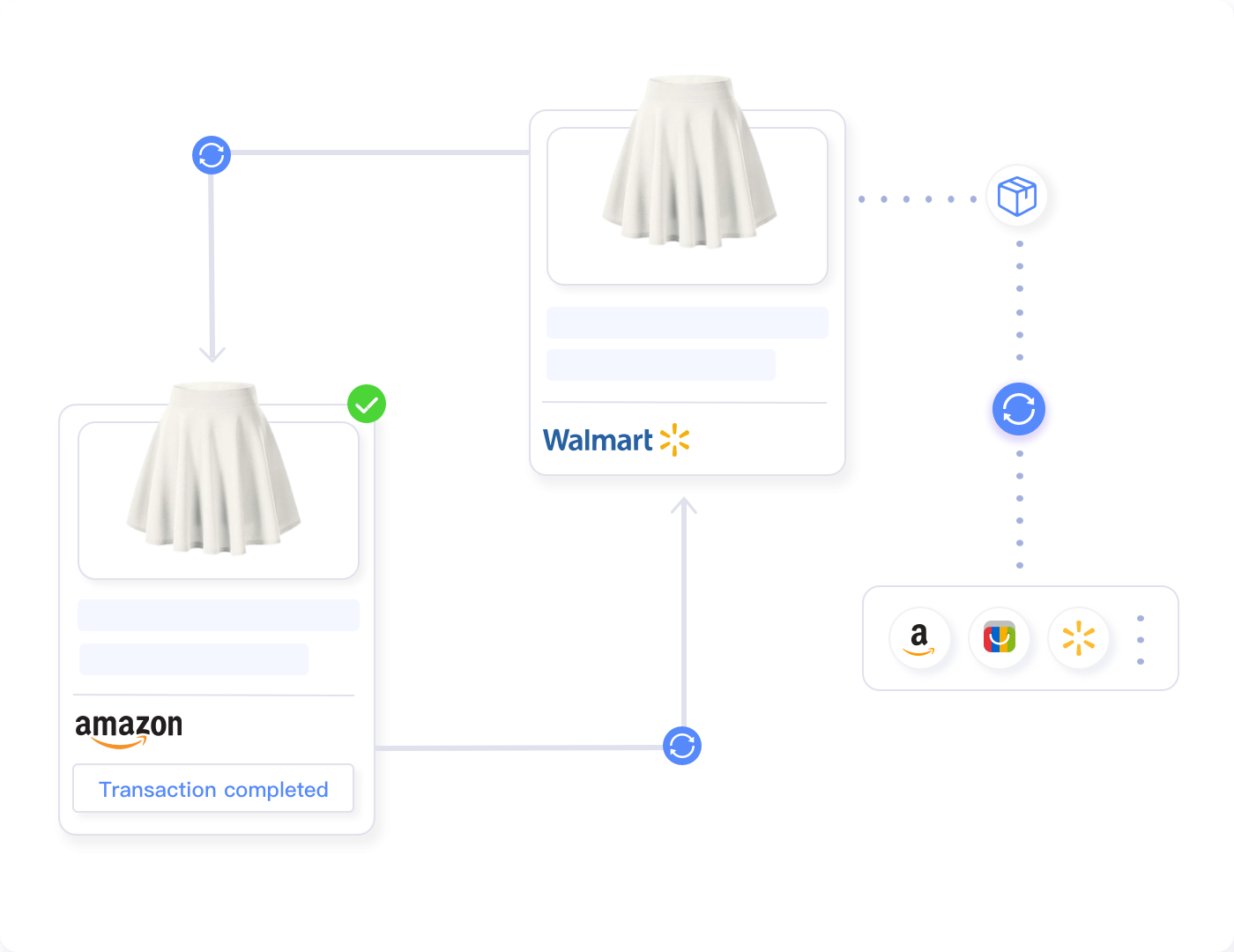
A centralized multi-channel attribute strategy treats product data as a single source of truth that adapts to each platform’s requirements. You maintain one comprehensive product record containing all possible attributes, and your management system translates that data into Amazon’s ASIN format, eBay’s Item Specifics, and Walmart’s Item Spec 5.0 simultaneously.
Maxmerce’s listing management system implements this multi-channel architecture, allowing you to update a product specification once and automatically sync it across all connected platforms with appropriate formatting, vocabulary translation, and compliance rules applied per platform. When you add a new product, you define its attributes comprehensively once, and the system generates Amazon, eBay, and Walmart listings simultaneously—each meeting that platform’s specific requirements.
This approach delivers three critical benefits:
Dramatic Time Savings: Instead of completing attributes three times per product (once for each platform), you complete them once with platform-specific translations handled automatically. For 1,000 products, this reduces total attribute work from 250-400 hours down to 100-150 hours—a 60% reduction in operational burden.
Consistency Guarantees: When a product specification changes—a dimension correction, warranty update, or material composition revision—updating the master record propagates changes to all three platforms simultaneously. You can’t accidentally update Amazon but forget Walmart, which prevents the customer confusion and return rate increases caused by inconsistent product information.
Scalability Without Complexity: Adding a fourth or fifth platform doesn’t triple your workload again. The centralized data model scales linearly—each new platform adds translation rules but doesn’t multiply the core attribute management work. Sellers expanding to Shopify, Etsy, or international marketplaces integrate new channels without drowning in platform-specific attribute requirements.
Ongoing Attribute Maintenance and Updates
Item Spec 5.0 migration isn’t a one-time project—it’s an ongoing maintenance requirement. Walmart continuously updates attribute requirements as new product categories emerge, regulatory standards evolve, and customer expectations change. What met compliance requirements in October 2024 may trigger quality score penalties by March 2025 if new attributes are added to your category.
Walmart announces specification updates through Seller Center notifications, typically 30-60 days before enforcement. Most sellers miss these announcements buried in email clutter or Seller Center notifications they rarely check. By the time suppressions or ranking drops alert them to problems, they’re 4-6 weeks behind compliant competitors.
Automated attribute management systems monitor Walmart’s specification updates and alert you to changes affecting your catalog. Rather than manually comparing old and new spec sheets, the system identifies newly required attributes and flags which of your listings need updates. You receive actionable reports like “285 electronics listings need the new ‘Energy Star Version’ attribute” instead of discovering problems through suppressions.
Product Lifecycle Attribute Updates
Beyond platform requirement changes, your own product lifecycle creates ongoing attribute maintenance needs:
New Product Launches: Every new SKU needs complete attribute population from day one. Automated systems apply category-based templates to new products, pre-filling 60-70% of attributes based on similar existing listings, letting you focus on product-specific specs rather than starting from scratch.
Variant Additions: Adding color options, size variations, or configuration changes to existing products requires attribute updates across all affected listings. Multi-channel systems propagate variant attributes to all platforms simultaneously, maintaining consistency without manual triple-entry.
Specification Changes: Manufacturers update product specifications—new model years, revised dimensions, updated compliance certifications. Tracking these changes and updating attributes across your entire catalog manually is impossible at scale. Centralized systems let you update the master record once and push changes to all affected listings across all platforms.
Seasonal Adjustments: Some attributes change seasonally—outdoor products have weather-related specifications, apparel has seasonal fabric weights, electronics have holiday packaging variations. Rather than manually editing thousands of listings twice yearly, rule-based systems apply seasonal attribute updates in bulk based on category tags.
Measuring Attribute Optimization ROI
Quantifying the return on investment from attribute completion helps justify the time and tool costs. Track these metrics before and after migration to measure business impact:
Search Impression Growth: Walmart Seller Center’s performance dashboard shows impression counts—how many times your products appeared in search results. Complete attribute migration typically increases impressions 35-55% within 30 days as your listings match more filters and rank higher in searches.
Click-Through Rate Improvement: More complete attributes create better search result displays with enhanced product information visible in grid views. CTR typically improves 8-15% as customers see richer previews and trust listings with comprehensive details.
Conversion Rate Lift: Detailed attribute sections answer customer questions directly on the product page, reducing purchase friction. Conversion rates improve 12-20% for listings moving from 60% to 85%+ attribute completion because customers get the information needed to commit to purchase.
Return Rate Reduction: Incomplete attributes lead to customer confusion and expectation mismatches, increasing return rates. Complete dimensional data, material specifications, and compatibility information reduce returns by 5-10% by ensuring customers understand exactly what they’re buying.
Buy Box Win Rate: Track what percentage of time you win the Buy Box for multi-seller products. Complete attributes improve win rates by 10-25% when competing against sellers with similar pricing and fulfillment, as Walmart’s algorithm favors offer quality.
For a seller with $500,000 annual Walmart revenue, typical post-migration improvements look like this:
- 35% impression increase → 12% traffic growth → 8% revenue increase = $40,000 additional annual revenue
- 15% conversion rate improvement on existing traffic = $75,000 additional annual revenue
- 8% return rate reduction on $500K revenue = $8,000 annual savings in return processing and lost inventory
- Total annual benefit: $123,000 from a migration project costing $2,000-5,000 in tools and staff time
This 25-60x ROI makes attribute optimization one of the highest-return investments in marketplace selling, far exceeding typical advertising or repricing tool returns.
Complete Your Item Spec 5.0 Migration in Days, Not Months
Maxmerce’s automated attribute mapping handles the heavy lifting: cross-platform translation, intelligent gap analysis, bulk template application, and real-time validation. Transform 83-133 hours of manual work per 1,000 products into 34-52 hours of strategic review while eliminating 90%+ of errors.
Common Attribute Migration Mistakes to Avoid
Sellers making their first Item Spec 5.0 migration frequently make preventable mistakes that extend timelines and reduce effectiveness:
Attempting Entire Catalog at Once: The most common failure pattern is trying to migrate 100% of listings simultaneously instead of prioritizing high-value products. This approach overwhelms staff, creates quality issues from rushed work, and delays revenue recovery. Phased migration based on revenue priority completes faster and protects business performance.
Ignoring Highly Recommended Attributes: Many sellers focus only on required attributes, treating “highly recommended” fields as truly optional. This creates quality score penalties and search ranking losses that undermine the entire migration effort. Target 80-85% completion including recommended attributes, not just 100% of required fields.
Copy-Paste from Amazon Without Translation: Direct copying of Amazon attributes into Walmart fields fails due to vocabulary differences, format requirements, and character limits. “Batteries: 2 AAA batteries required (included)” might be valid Amazon format but violates Walmart’s separate “Battery Type” and “Batteries Included” attribute structure. Use intelligent mapping tools that translate between platform formats.
Generic Attribute Values: Entering minimal compliant data—”Yes” for care instructions instead of detailed washing guidance—technically passes validation but provides poor customer value and lower algorithm scoring. Invest extra time in high-value attributes that differentiate your listing and provide genuine purchase decision support.
Neglecting Attribute Validation: Completing attributes in spreadsheets without real-time validation leads to bulk upload failures that waste days of work. Use tools with pre-upload validation that catch format errors, vocabulary mismatches, and character limit violations before submission.
No Ongoing Maintenance Plan: Treating migration as a one-time project rather than ongoing process causes gradual quality degradation. Walmart adds new attributes, your products change, and competitors optimize—you need systematic monitoring and updates to maintain competitive performance.
Platform-Specific Attribute Considerations
Each marketplace has unique attribute quirks that affect migration strategy:
Walmart-Specific Requirements
GTIN Strictness: Walmart enforces product identifier requirements more strictly than Amazon or eBay. Every manufactured product needs a valid GTIN that matches Walmart’s product catalog. Private label and unbranded products require GTIN exemption applications processed through Seller Center—start these 2-3 weeks before migration as approval takes 7-10 business days.
Dimensional Precision: Walmart requires package dimensions in inches with decimal precision (e.g., 12.5 inches), not rounded values or approximations. These dimensions affect shipping cost calculations and warehouse operations, making accuracy critical. Measure products carefully rather than estimating—incorrect dimensions cause operational issues and potential account penalties.
Category Granularity: Walmart’s category taxonomy is more detailed than Amazon’s in some areas, less detailed in others. Electronics have very granular subcategories, while apparel categories are broader. Research the correct category placement before migration—miscategorization requires complete re-listing and loses all performance history.
Cross-Platform Attribute Mapping Challenges
Translating attributes between platforms requires understanding platform-specific vocabularies and formats:
Color Standardization: Amazon accepts hundreds of color variations including brand-specific names like “Midnight Blue.” Walmart limits colors to standardized options from a controlled list. Your “Space Gray” iPhone case becomes “Gray” on Walmart. Automated mapping tools maintain these translations to prevent manual lookup for every product.
Size Format Differences: Amazon apparel uses size labels (“Medium,” “Large”) while Walmart increasingly requires actual measurements in inches. Your “Large” shirt needs chest, length, and sleeve measurements for optimal Walmart compliance. This conversion requires accessing product specifications that may not be in your Amazon listing data.
Technical Specification Terminology: Electronics attributes use different terminology across platforms. Amazon’s “Wireless Type” becomes Walmart’s “Connectivity Technology.” “Power Source” on Amazon might map to “Battery Type” or “Plug Type” depending on the product. Maintaining these translation rules manually is impractical at scale—automated systems with built-in mapping libraries solve this problem.
Advanced Attribute Optimization Techniques
Beyond basic compliance, sophisticated sellers use attribute optimization to gain competitive advantages:
Keyword-Rich Attribute Content: Walmart’s search algorithm indexes attribute content, not just titles and descriptions. Including relevant keywords naturally in attribute fields like “Features” or “Product Description” improves search matching. A camping tent with “4-season weather resistance” and “winter camping capable” in attributes matches more search queries than one with generic “durable construction.”
Competitive Attribute Analysis: Research top-ranking competitors’ listings to identify which attributes they populate comprehensively. If leading sellers in your category all complete the “Care Instructions” field with detailed guidance while you have generic text, that’s likely a ranking factor. Match or exceed competitor attribute depth in high-value fields.
Enhanced Brand Content Through Attributes: While Walmart doesn’t have Amazon’s A+ Content, detailed attribute completion serves similar purposes. Rich “Key Features” attributes with benefit-focused language improve conversion without requiring graphic design work. “Ergonomic grip reduces hand fatigue during extended use” conveys more value than “ergonomic design.”
Filter Optimization Strategy: Analyze which filters customers use most frequently in your category using Walmart’s search analytics. Prioritize those attributes for comprehensive completion. If “Brand” and “Color” are the most-used filters in your category, ensure 100% completion of those fields even before less-trafficked attributes.
Attribute A/B Testing: For high-volume products, test different attribute content variations to optimize conversion. Try detailed technical specifications versus benefit-focused language in the features field. Compare conversion rates over 2-4 week periods to identify which attribute style resonates with your customer base.
Future-Proofing Your Attribute Strategy
Walmart continues evolving its marketplace platform, and attribute requirements will only increase over time. Position your business for long-term success with these forward-looking strategies:
Invest in Scalable Systems Early: Manual and spreadsheet-based workflows become exponentially harder to maintain as your catalog grows. Implementing automated attribute management at 500 products is easier than at 5,000. The tool investment pays back faster and prevents operational crises that hit sellers who delay automation until they’re drowning in manual work.
Build Comprehensive Product Data: Don’t just meet current requirements—collect and maintain more product data than platforms currently demand. When Walmart adds new attributes (which it does 2-3 times per year), you can populate them immediately from your existing database rather than researching from scratch. Comprehensive internal product data future-proofs against requirement changes.
Monitor Marketplace Evolution: Follow Walmart’s seller newsletters, attend webinars, and participate in seller forums to stay ahead of platform changes. Early adopters of new requirements gain algorithmic advantages before updates become mandatory. Being 60-90 days ahead of requirement changes puts you in the top 10% of sellers for compliance and performance.
Develop Category Expertise: Deep understanding of your product categories’ specific attribute requirements and customer expectations creates sustainable competitive advantages. Generic sellers miss nuanced category-specific optimization opportunities that specialists leverage for higher visibility and conversion.
Maintain Cross-Platform Competencies: Even if Walmart is your primary channel today, maintain capabilities for Amazon, eBay, and emerging platforms. Multi-channel competency protects against platform-specific policy changes and provides diversification. Automated systems that manage multiple platforms simultaneously make this diversification practical without multiplying workload.
Frequently Asked Questions
What happens if I don’t complete all required attributes in Item Spec 5.0?
Missing required attributes trigger immediate listing suppressions, preventing your products from appearing in search results. Walmart’s system blocks incomplete listings from going live, and you’ll receive error notifications in Seller Center. Your publish rate drops, competitive advantage vanishes as competitors with complete attributes capture your traffic, and revenue loss begins immediately until attributes are completed.
How many attributes does Item Spec 5.0 require compared to 4.3?
Item Spec 5.0 requires 60-120 attributes per product depending on category, compared to 30-45 in version 4.3. This represents a 100-167% increase in required data fields. Categories like electronics, apparel, and home goods have the highest attribute requirements, while general merchandise has slightly fewer mandatory fields.
Can I migrate my listings gradually or do I need to update everything at once?
You can migrate gradually, but prioritize your highest-revenue products first. Walmart doesn’t force simultaneous migration of your entire catalog. However, unmigrated listings lose visibility over time as Walmart’s algorithm favors Item Spec 5.0-compliant products. Plan to complete migration within 60-90 days to avoid prolonged traffic loss.
What’s the fastest way to identify which attributes I’m missing?
Walmart Seller Center’s Item 360 report shows attribute completion percentage per listing, but manually reviewing thousands of products takes weeks. Automated attribute mapping tools can scan your entire catalog in minutes, identifying missing fields and providing bulk completion templates. These tools cross-reference your existing data with Item Spec 5.0 requirements, highlighting gaps instantly.
Do missing optional attributes affect my listing performance?
Yes, significantly. While optional attributes don’t cause suppressions, they heavily impact search ranking and conversion rates. Walmart’s algorithm gives preference to listings with 80%+ attribute completion. Products with more complete attributes appear higher in search results, show in more filtered searches, and provide better customer information leading to 15-25% higher conversion rates according to Walmart’s internal data.
How do I handle attributes that don’t apply to my products?
Mark truly non-applicable attributes as ‘N/A’ or use Walmart’s ‘Does Not Apply’ option rather than leaving them blank. Blank fields trigger quality score penalties even if the attribute seems irrelevant. However, carefully review each field—what seems non-applicable might actually be expected by Walmart’s system. For example, ‘care instructions’ apply to more categories than just apparel.
What happens to my existing traffic during the migration period?
Traffic typically drops 30-50% for unmigrated listings as Walmart’s algorithm increasingly favors Item Spec 5.0 compliance. The decline isn’t immediate but accelerates over 4-6 weeks. Sellers completing migration quickly recover traffic within 7-14 days, often seeing 20-35% increases above pre-migration levels due to improved attribute matching. Extended delays result in permanent market share loss to faster-adapting competitors.
Can I copy attributes from my Amazon listings to Walmart?
Partially, but not directly. While both platforms use similar product data, attribute names, formats, and requirements differ significantly. Amazon’s ‘Brand Name’ might map to Walmart’s ‘Manufacturer,’ but values and character limits vary. Direct copying causes format errors and rejections. Cross-platform attribute mapping tools translate Amazon data into Walmart’s Item Spec 5.0 format automatically, converting field names, adjusting character limits, and reformatting values to meet Walmart’s specific requirements.
Taking Action on Item Spec 5.0 Migration
Walmart Item Spec 5.0 migration isn’t optional—it’s a competitive necessity that directly affects your search visibility, Buy Box eligibility, and overall marketplace performance. Delaying migration costs you 30-50% of traffic within 60 days while competitors with complete attributes capture market share you’ll never fully recover.
The operational challenge is significant: 60-120 attributes per product, 5-8 minutes of manual work per listing, and 83-133 hours required for 1,000 products. Manual workflows don’t scale, spreadsheet approaches break down, and the error correction cycles waste valuable time better spent on strategic business development.
Automated attribute mapping transforms this operational burden into a manageable project. Systems like Maxmerce’s Smart Category & Attribute Mapping reduce migration time by 58-61% while eliminating 90%+ of errors through intelligent cross-platform translation, real-time validation, and bulk template application. The work shifts from “fill every field manually” to “review auto-populated data and complete specific gaps.”
Start your migration with a phased approach prioritizing high-revenue products and categories with elevated suppression risk. Target 90%+ attribute completion for top-tier listings, 80-85% for mid-tier, and 75-80% for long-tail products. This balanced strategy restores most business value within 2-3 weeks while systematically completing your entire catalog over 2-3 months.
The ROI is compelling: $40,000-75,000 in additional annual revenue for a $500,000 seller, plus $8,000 in return reduction savings, from a migration project costing $2,000-5,000 in tools and staff time. That’s 25-60x return on investment, making attribute optimization one of the highest-value projects in marketplace selling.
Don’t wait for suppressions or traffic drops to force reactive migration under time pressure. Proactive migration on your timeline, using automated tools, with strategic prioritization protects your market position and sets you up for long-term Walmart success.
Start Your Item Spec 5.0 Migration Today
Maxmerce’s listing management platform handles cross-platform attribute mapping, intelligent gap analysis, bulk operations, and real-time validation—everything you need to complete migration 60% faster with 90%+ fewer errors. See exactly how it works with your catalog during the free trial.