Amazon Profit Calculator: Complete FBA Fee Guide

Amazon profit calculator tools help sellers calculate true margins, yet 73% of FBA sellers underestimate their costs by missing hidden fees—particularly the new inbound placement charges and peak fulfillment surcharges. What appears as 30% margin often shrinks to 12% when all fees are factored. This guide reveals how to calculate your real Amazon profit, avoiding seven common mistakes that cost sellers thousands.
Quick Answer: What is an Amazon Profit Calculator?
An Amazon profit calculator computes your true net profit margin after deducting all FBA fees, storage costs, PPC spend, and return expenses. In 2025, accurate calculators must include Amazon’s new inbound placement fees ($0.27-$1.58/unit), peak fulfillment surcharges during Q4, and updated long-term storage fees applying after 271 days.
The best calculators sync with your Seller Central account to track real-time costs including referral fees (8-15%), FBA fulfillment fees, inbound placement fees, monthly storage, return processing fees (8-12% of selling price), and PPC costs per unit. Advanced calculators help you model pricing scenarios and identify products maintaining healthy 15-25% net margins.
Key Takeaways
- 2025 Fee Increases: Amazon’s inbound placement fees add $0.27-$1.58 per unit, while peak surcharges increase Q4 costs by $0.35-$1.50 per item—significantly impacting margins
- True Profit Formula: Net Profit = Selling Price – (Referral Fee + FBA Fee + Inbound Placement + Storage + Product Cost + Inbound Shipping + PPC per Unit + Return Reserve)
- Hidden Costs: 67% of sellers forget return processing fees, PPC costs per unit, and long-term storage fees—leading to inflated margin projections
- Healthy Margins: Target 15-25% net profit margins for sustainable FBA business; products below 15% leave insufficient buffer for unexpected costs
- Real-Time Tracking: Automated tools identify margin erosion 2-3 weeks faster than manual spreadsheets, enabling quicker pricing adjustments
What is an Amazon Profit Calculator and Why You Need One
An Amazon profit calculator is an essential tool that helps FBA sellers determine true profitability by accounting for every fee Amazon charges. Unlike simple margin calculators that only subtract product cost from selling price, comprehensive calculators include all marketplace fees, fulfillment costs, storage charges, and advertising expenses. The distinction becomes critical when 2025’s new fees can reduce apparent margins by 5-10 percentage points.
How Amazon Profit Calculators Work
Amazon profit calculators pull data from multiple sources to create a complete financial picture. First, they access Amazon’s fee schedule to calculate category-specific referral fees ranging from 8% for personal computers to 15% for most general merchandise. Then, they determine FBA fulfillment fees based on your product’s exact dimensions and weight using Amazon’s size tier system, where even a half-inch difference in packaging can change fee categories.
Subsequently, advanced calculators factor in variable costs many sellers overlook. These include inbound placement fees that vary by destination fulfillment center, monthly storage fees that fluctuate based on cubic footage and season, and return processing costs that average 8-12% of selling price for returned items. The best calculators also allocate PPC advertising spend per unit sold, providing true cost-per-acquisition metrics rather than treating advertising as a separate expense.
Static calculators require manual input of all fee components and provide a one-time snapshot based on your assumptions. In contrast, dynamic calculators sync with your Seller Central account to track actual costs in real-time, pulling current data on referral fees, fulfillment costs, storage charges, and advertising spend. Real-time systems automatically recalculate margins for hundreds of SKUs whenever Amazon updates fees, helping sellers identify unprofitable products 2-3 weeks faster than manual spreadsheet reviews.
Why 2025 Requires Updated Profit Calculators
Amazon implemented major fee structure changes in 2025 that render older calculators dangerously inaccurate. The most significant addition is the inbound placement fee, introduced in March 2025, which charges sellers when Amazon distributes inventory across multiple fulfillment centers. These fees range from $0.27 for small standard items to $1.58 per large bulky unit—costs that can reduce margins by 1-4% depending on product category.
Furthermore, Amazon expanded peak fulfillment surcharges to cover October through January, extending the seasonal fee period by one month compared to previous years. These surcharges add $0.35 to $1.50 per unit during the critical Q4 selling season, making Q4 profitability projections more complex. Sellers who fail to account for these extended peak fees often overspend on inventory that becomes unprofitable during the holiday rush.
Long-term storage fees also changed significantly in 2025, now applying to inventory aged 271 days or more instead of the previous 365-day threshold. This accelerated timeline increases the risk of storage fee penalties for slow-moving inventory, particularly for seasonal products or large catalog sellers with varied product velocities. Therefore, profit calculators must incorporate inventory age tracking to project potential storage fee escalation.
Complete 2025 Amazon FBA Fee Breakdown
Referral Fees by Category (8-15%)
Amazon’s referral fees are category-specific percentages charged on the total selling price, including the item price plus any shipping charges for seller-fulfilled items. Most categories charge a 15% referral fee, but several important exceptions exist. Personal computers carry only an 8% referral fee, while automotive and powersports parts charge 12%. Additionally, Amazon applies minimum referral fees for certain categories—for example, a $0.30 minimum on items priced below $2.00.
For higher-priced items, certain categories use tiered referral fees. Jewelry charges 20% on the first $250 of selling price and only 5% on the portion exceeding $250, which benefits sellers of luxury items. However, most general merchandise categories maintain flat 15% referral fees regardless of price point, making fee calculation straightforward for standard products.
FBA Fulfillment Fees by Size Tier
| Product Category | Referral Fee | Example Fee ($40 item) |
|---|---|---|
| Personal Computers | 8% | $3.20 |
| Automotive | 12% | $4.80 |
| Most Categories | 15% | $6.00 |
| Apparel | 17% | $6.80 |
| Jewelry (tiered) | 20%/5% | $8.00 |
FBA fulfillment fees cover picking, packing, shipping, customer service, and returns handling. Amazon calculates these fees using size tiers based on product dimensions and weight. Small standard items under 16 oz cost $3.22 per unit, while large standard items (1-2 lbs) cost $5.42. Importantly, fees increase significantly for large bulky items over 50 lbs, which can cost $20+ per unit.
Size tier classification depends on precise product dimensions. A product measuring 15 x 12 x 0.75 inches qualifies as large standard, but if redesigned packaging reduces it to 14 x 11 x 0.75 inches, it may qualify as small standard—potentially saving $2-3 per unit. Therefore, sellers optimizing packaging dimensions can significantly reduce fulfillment fees without changing the actual product.
| Size Tier | Weight/Dimensions | Fulfillment Fee |
|---|---|---|
| Small Standard | Up to 16 oz | $3.22 |
| Large Standard | 1-2 lbs | $5.42 |
| Large Standard | 2-3 lbs | $6.64 |
| Large Bulky | 10-50 lbs | $15.84-$18.32 |
NEW: Inbound Placement Fees (March 2025)
Amazon’s inbound placement fees launched in March 2025 represent the most significant new cost for FBA sellers. These fees apply when Amazon distributes your inventory shipment across multiple fulfillment centers to position products closer to customers. While this distribution improves delivery speeds, it adds per-unit costs that vary by size tier.
Small standard items incur $0.27 per unit inbound placement fees, while large standard products cost $0.48 per unit. Large bulky items face $1.02 per unit fees, and extra-large items can cost up to $1.58 per unit. For sellers shipping small, lightweight products, these fees represent 1-2% margin impact. However, for large bulky items, inbound placement fees can consume 3-5% of margins.
Sellers can opt out of inbound placement fees by using Amazon’s Inbound Placement Service, which requires shipping to a single fulfillment center location. However, this choice may result in slower delivery times for customers in distant regions, potentially impacting Buy Box eligibility and conversion rates. Therefore, sellers must calculate whether the fee savings justify potentially reduced sales velocity.
Monthly and Long-Term Storage Fees
Amazon charges monthly storage fees based on cubic footage occupied in fulfillment centers. Standard-size items cost $0.87 per cubic foot per month from January-September and $2.40 per cubic foot during October-December. Consequently, storage fees can triple during the holiday season when sellers stock up for peak demand.
Long-term storage fees apply to inventory aged 271 days or more in Amazon’s fulfillment centers, costing $6.90 per cubic foot or $0.15 per unit, whichever is greater. In 2025, Amazon accelerated this timeline from 365 days to 271 days, meaning inventory now incurs long-term storage fees 94 days earlier than previously. This change particularly impacts seasonal sellers who stock up months before peak seasons.
Peak Fulfillment Surcharges (October-January)
Amazon’s peak fulfillment surcharges apply during the high-volume holiday season, now extended to cover October through January in 2025. Small standard items face $0.35 per unit surcharges, large standard items cost an additional $0.65, and large bulky items incur $1.50 extra per unit during this period. These surcharges represent 20-30% increases over base fulfillment fees.
Return Processing Fees
Amazon charges return processing fees for categories with high return rates, particularly apparel, shoes, and jewelry. These fees typically equal the original FBA fulfillment fee charged when the item shipped. Therefore, if you sell a large standard apparel item with a $5.42 fulfillment fee and it gets returned, you pay another $5.42 return processing fee—effectively doubling your fulfillment cost for that transaction.
Return processing fees dramatically impact profitability in high-return categories. Apparel averages 15-20% return rates, meaning one in five units sold incurs double fulfillment fees. For a $39.99 dress with $5.42 fulfillment fees, a 20% return rate adds $1.08 per unit to average costs ($5.42 × 20%). Consequently, sellers in high-return categories must price products to absorb this additional cost while maintaining competitive pricing.
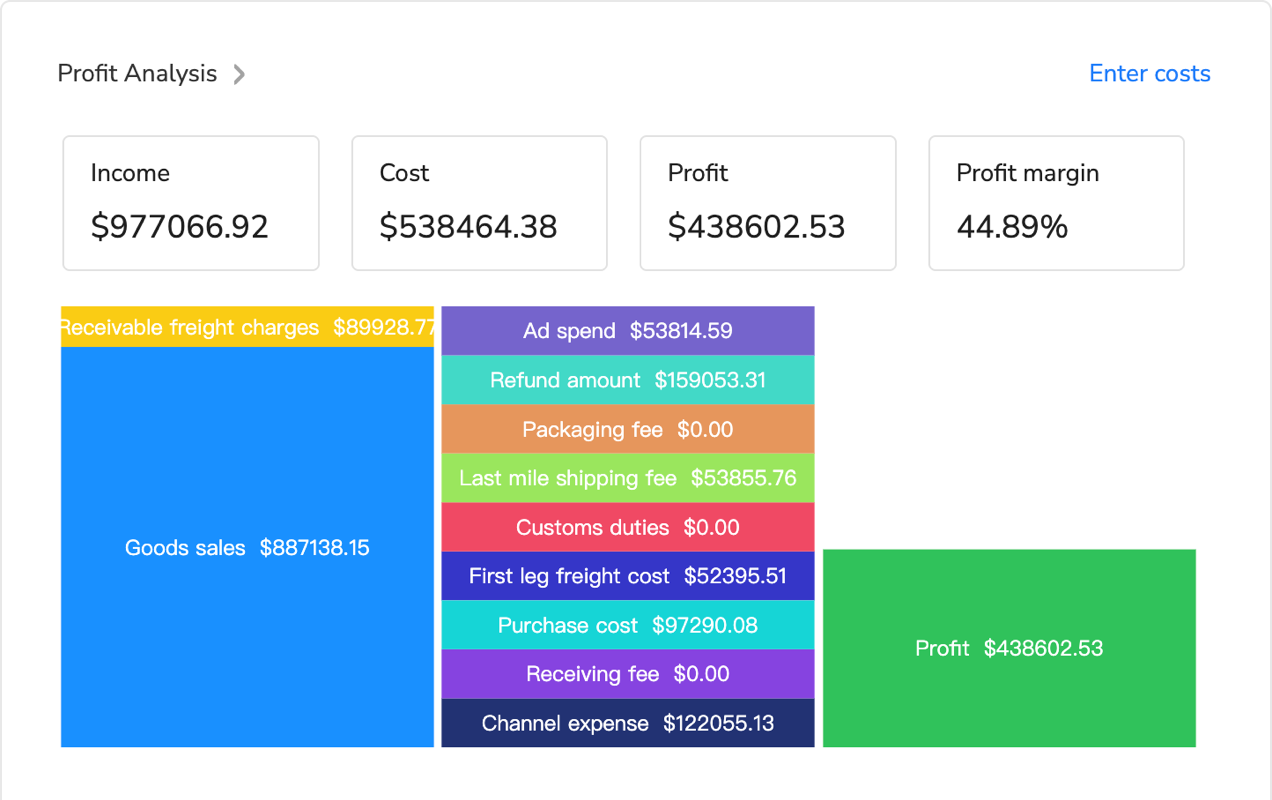
Accurate Amazon Profit Calculation Formula for 2025
Step-by-Step Profit Calculation Example
Let’s calculate true profit for a $39.99 kitchen gadget (large standard size tier):
- Selling Price: $39.99
- Product Cost: $15.00
- Referral Fee (15%): $6.00
- FBA Fulfillment: $5.42
- Inbound Placement: $0.48
- Storage: $0.75
- Shipping to Amazon: $2.00
- PPC per Unit: $1.50
- Return Reserve: $0.80
Total Costs: $31.95 | Net Profit: $8.04 | Margin: 20.1%
This 20.1% net margin is healthy for sustainable FBA business. However, Q4 peak surcharges add $0.65, reducing profit to $7.39 (18.5% margin).
| Margin Range | Business Health | Action |
|---|---|---|
| Below 10% | Unsustainable | Discontinue or optimize costs |
| 10-15% | Risky | Improve sourcing or increase pricing |
| 15-25% | Healthy | Maintain and scale |
| 25-35% | Strong | Invest in marketing |
| Above 35% | Exceptional | Monitor for competition |
7 Common Amazon Profit Calculator Mistakes That Cost Thousands
1. Forgetting Inbound Placement Fees
The most common 2025 mistake is omitting inbound placement fees ($0.27-$1.58/unit). A seller shipping 5,000 large standard units pays $2,400 in placement fees—reducing 22% margins to 19%, a $1,200 profit difference.
2. Ignoring Q4 Peak Surcharges
Many sellers calculate margins using standard fees without accounting for Q4 peak surcharges ($0.35-$1.50/unit). Products profitable off-peak become marginal during your highest revenue period when surcharges apply October-January.
3. Underestimating Return Costs
67% of sellers fail to account for return processing fees. Apparel with 20% return rates creates $160 in losses per 100 units ($1.60/unit), plus disposal costs for damaged returns ($0.15-$0.60/unit).
4. Using Wrong Size Tier Assumptions
Size tier misclassification causes errors—large standard ($5.42) versus small standard ($3.22) is a $2.20 difference. Optimizing packaging from 16x13x1″ to 14.5×11.5×0.75″ can save $22,000 annually on 10,000 units.
5. Omitting PPC Costs Per Unit
Calculate PPC per unit by dividing total ad spend by units sold. A product with 25% margin before advertising may yield only 15% after $3/unit PPC costs. Allocate 10-20% of selling price for PPC during launch, optimizing to 5-10% once ranked.
6. Not Accounting for Long-Term Storage
Long-term storage fees ($6.90/cubic foot) trigger at 271 days (not 365). A large product occupying 2 cubic feet incurs $13.80—potentially exceeding entire profit margins. Seasonal sellers must remove off-season inventory or calculate whether storage exceeds restocking costs.
7. Using Static Calculations
Static calculations become outdated as costs fluctuate. Real-time tracking systems continuously update margins based on actual performance, identifying margin erosion 2-3 weeks faster than monthly spreadsheet reviews.
Multi-Platform Profit Comparison: Amazon FBA vs eBay vs Walmart
| Platform | Referral Fees | Typical Margin | Best For |
|---|---|---|---|
| Amazon FBA | 8-15% | 15-25% | High-velocity products, brand-registered items |
| eBay | 12.35-12.9% | 20-30% | Unique items, collectibles, used goods |
| Walmart | 8-15% | 18-28% | Value-conscious buyers, consumables |
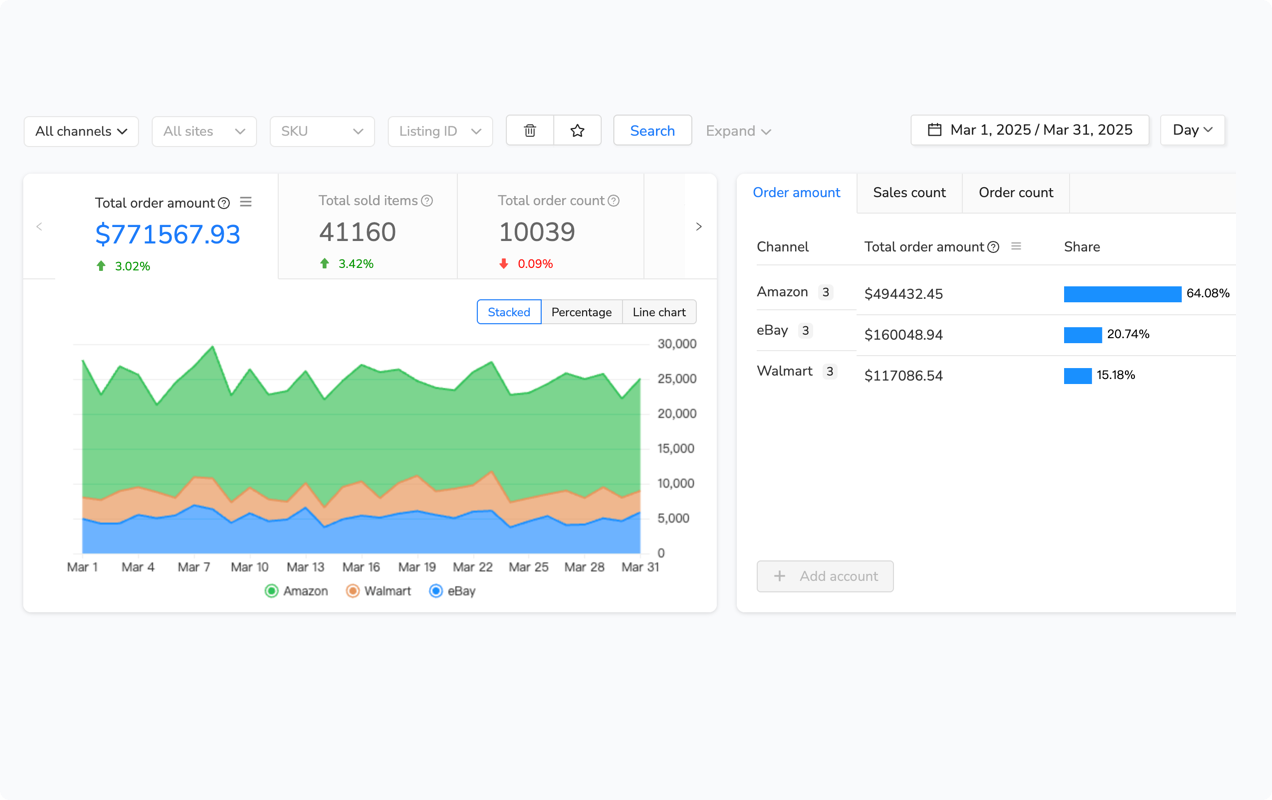
Amazon FBA excels for high-velocity products where Prime eligibility drives conversions. eBay offers higher margins (20-30%) for unique or collectible items with lower competitive pressure. Walmart provides middle ground with comparable fees but less competition in many categories. Advanced sellers use multi-channel analytics platforms to aggregate data and optimize inventory allocation based on margin and velocity.
Automated Profit Tracking vs Manual Spreadsheets
Limitations of Spreadsheets
Spreadsheet tracking requires manual data entry from multiple sources, creating stale data and human errors. Managing 200 SKUs requires 10-20 hours weekly—time better spent on strategic activities. Spreadsheets lack alerting capabilities; you won’t discover unprofitable products until your next review, potentially weeks later.
Benefits of Automated Systems
Automated systems sync with Seller Central to calculate margins continuously using current fees, actual return rates, and real PPC spend. They provide instant visibility into margin changes—flagging return rate spikes or fee increases before manual reviews catch them. Scenario modeling capabilities test pricing changes across your catalog in seconds versus hours with spreadsheets.
Maxmerce Profit Analyzer Features
The Maxmerce Profit Analyzer provides real-time profitability tracking designed to help FBA sellers understand true margins. Key features include comprehensive fee tracking (2025 inbound placement, peak surcharges, updated storage schedules), multi-channel comparison for Amazon/eBay/Walmart, and automated alerts when margins fall below thresholds or return rates spike.
Track Real-Time Amazon Profit Margins
Stop guessing at profitability with outdated spreadsheets. Maxmerce’s Profit Analyzer provides real-time margin tracking with all 2025 fees included.
Plans from $19/month with flexible options for growing sellers
Choosing the Right Amazon Profit Calculator for Your Business
Selecting an appropriate calculator depends on business size, product count, and operational complexity. Key criteria include fee accuracy with 2025 updates, real-time versus static calculation, multi-channel support, PPC cost integration, scenario modeling capability, and historical trend analysis.
New Sellers (1-20 Products): Use Amazon’s free FBA Revenue Calculator for product research, supplemented with spreadsheet templates. Growing Sellers (20-100 Products): Transition to automated tracking ($19-49/month) with Seller Central integration. Established Sellers (100-500 Products): Require comprehensive platforms ($99-199/month) with real-time tracking and multi-channel support. Enterprise Sellers (500+): Need sophisticated business intelligence with custom reporting and dedicated support.
Frequently Asked Questions
Conclusion: Master Your Amazon Profit Calculation for 2025 Success
Accurate Amazon profit calculation is the foundation of sustainable FBA success in 2025. True profitability requires accounting for 10-15 cost components including new inbound placement fees, peak surcharges, long-term storage, return processing, and PPC expenses. The seven common mistakes outlined above cost sellers thousands in unexpected fees.
Successful sellers maintain 15-25% net margins using comprehensive calculators with 2025 fee updates. They track profitability in real-time rather than using static spreadsheets, identifying margin erosion 2-3 weeks faster. Multi-channel sellers comparing profitability across Amazon, eBay, and Walmart optimize inventory allocation to maximize total profit.
Immediate Actions: Audit your calculation method to ensure it includes all 2025 fees. Recalculate margins for your top 10 products using the complete formula. Calculate both standard and Q4 margins accounting for peak surcharges. Implement automated tracking for 50+ SKUs or multi-channel operations. Set margin alerts for products falling below 15% net profit.
Automate Your Amazon Profit Tracking
Stop losing money to hidden fees and outdated calculations. Maxmerce’s Analytics platform provides real-time profit tracking designed to help you maintain healthy margins despite Amazon’s increasing fees.
Get instant visibility into true product profitability with automated tracking that includes all 2025 fee updates. Plans from $19/month with flexible options for growing sellers.
By mastering Amazon profit calculation in 2025, you gain the financial visibility necessary to make informed decisions about product selection, pricing strategy, and channel expansion. Accurate profit tracking enables you to identify optimization opportunities that competitors miss, creating sustainable competitive advantages through superior unit economics.