AI Product Listing Optimization Guide

Filling product attributes manually takes 15-30 minutes per listing. However, with AI product listing optimization, you can complete dozens of item specifics in under a minute—transforming what used to be hours of tedious data entry into an automated, accurate process. Additionally, this technology enables sellers with hundreds or thousands of products to maintain comprehensive attribute coverage across Amazon, eBay, and Walmart without proportionally increasing labor costs.
Key Takeaways
- Manual attribute filling takes 15-30 minutes per listing; AI can complete it in under a minute (Industry benchmarks, 2025)
- Listings with complete attributes can receive 35-50% more search impressions (Seller reports, 2025)
- AI listing generators fill 20-50+ item specifics automatically vs. manual entry (Platform requirements, 2025)
- Attribute completion rates can improve from 60% (manual) to 95%+ (AI-powered) (Industry estimates, 2025)
- Time savings: up to 90% reduction in listing creation time for catalogs over 100 products (Maxmerce operational data, 2025)
- Typical cost impact: $15-30/hour manual entry vs. automated solutions from $19/month (Market analysis, 2025)
This comprehensive guide explores how AI product listing optimization works, compares platform-specific requirements across major marketplaces, and provides actionable strategies for implementing attribute automation. Consequently, you’ll learn how to reduce listing creation time from hours to minutes while improving search visibility through complete, accurate attribute data.
What Is AI Product Listing Optimization? How Attributes Drive Search Visibility
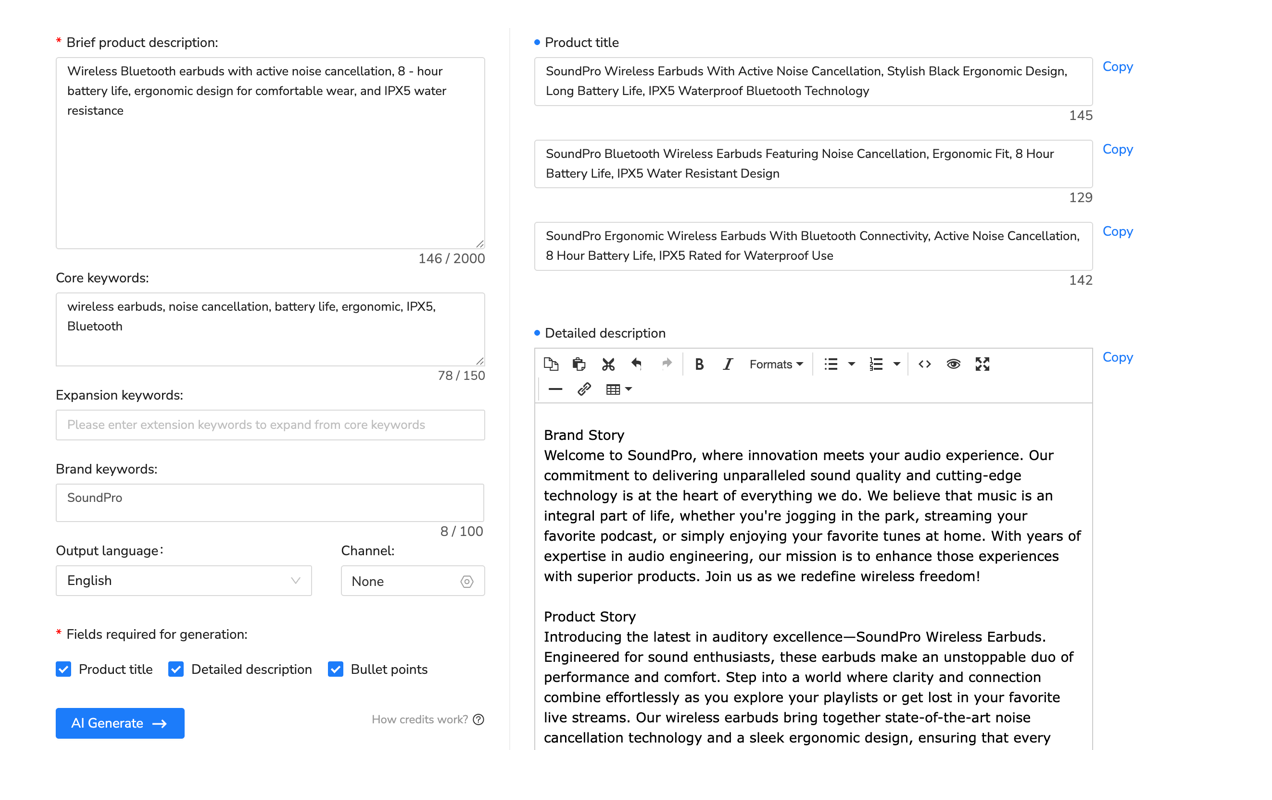
AI product listing optimization uses artificial intelligence to automatically generate optimized titles, descriptions, bullet points, and complete dozens of product attributes in seconds. Instead of manually filling 20-50 item specifics per listing, AI analyzes your product data and auto-populates required and recommended attributes across marketplaces. Furthermore, this automation maintains consistency, reduces errors, and enables scaling without proportional labor increases.
Understanding Product Attributes and Item Specifics
Product attributes are structured data fields that describe specific product characteristics—brand, size, color, material, dimensions, and dozens of other specifications. Meanwhile, each marketplace requires different attribute sets: Amazon typically requires 20-40 attributes per listing, eBay demands 15-30 item specifics, and Walmart expects 25-45 complete attributes for optimal Buy Box eligibility.
These attributes directly impact search algorithm ranking. For instance, when shoppers filter by “Size: Large” or “Material: Cotton,” only listings with those attributes populated appear in results. Therefore, incomplete attributes mean invisible products in filtered searches—potentially losing 35-50% of potential impressions.
How AI Listing Generators Work
AI listing generators use machine learning to analyze product information from multiple sources—titles, descriptions, images, supplier data, and successful competitor listings. Moreover, the technology recognizes patterns and automatically maps extracted data to platform-specific attribute requirements.
The process involves several sophisticated steps: image recognition identifies visual attributes like color and style, natural language processing extracts specifications from descriptions, and category-specific models understand which attributes matter most for different product types. Subsequently, the AI ensures platform compliance by checking prohibited words, trademark restrictions, and category-specific rules before publishing.
Why Manual Attribute Filling Fails at Scale
Manual attribute completion becomes unsustainable as catalogs grow. For example, a seller with 500 products spends 40-165 hours on manual attribute filling alone—that’s 1-4 weeks of full-time work just completing forms. Additionally, human data entry introduces inconsistency: similar products get different attribute values, recommended fields remain empty to save time, and categorization errors cause suppressed listings.
Platform policy violations multiply with manual processes. Sellers accidentally use prohibited words in custom attributes, misclassify products into wrong categories, or provide incompatible attribute combinations that trigger automatic suppressions. Meanwhile, AI listing optimization helps prevent these issues through automated compliance checking.
The Hidden Cost of Incomplete Product Attributes: Search Visibility Loss
Incomplete product attributes don’t just slow down listing creation—they directly reduce revenue through lost search visibility. Studies consistently show that listings with comprehensive attribute coverage significantly outperform minimal listings in organic search rankings. Let’s examine the business impact.
How Incomplete Attributes Kill Search Rankings
Amazon’s A9 algorithm prioritizes complete attribute data when determining search relevance. When two similar products compete for rankings, the listing with more complete attributes gains advantage—assuming comparable pricing and reviews. Similarly, eBay’s Best Match algorithm explicitly factors item specifics completeness into ranking calculations.
Walmart’s algorithm requires 90%+ attribute completion for optimal Buy Box eligibility. Products with incomplete attributes face reduced visibility and lose competitive positioning, even with better pricing. Seller reports indicate that listings improving from 60% to 95% attribute completion can see 35-50% visibility increases within weeks.
Furthermore, incomplete attributes eliminate your products from filtered searches entirely. If you don’t specify “Size: XL,” your product won’t appear when shoppers filter by that size—regardless of how good your title, price, or reviews are. This represents substantial lost traffic for every missing attribute.
Time Costs: Manual vs. Automated Attribute Filling
Time investment for manual attribute completion breaks down into several tasks. Initially, category selection takes 1-2 minutes as sellers navigate complex taxonomies. Then, required attributes demand 2-5 minutes of careful data entry. Additionally, recommended attributes—often ignored to save time—take another 2-10 minutes when completed properly. Finally, verification and compliance checking add 1-3 minutes per listing.
At scale, these minutes become weeks of work. Consider these scenarios:
| Catalog Size | Manual Time (15 min avg) | AI Time (45 sec avg) | Time Saved | Cost Saved ($20/hr) |
|---|---|---|---|---|
| 100 listings | 25 hours | 1.25 hours | 23.75 hours | $475 |
| 500 listings | 125 hours | 6.25 hours | 118.75 hours | $2,375 |
| 1,000 listings | 250 hours | 12.5 hours | 237.5 hours | $4,750 |
These calculations assume moderate 15-minute manual times and may vary by category complexity and seller experience. Complex categories with 40+ required attributes can take 20-30 minutes per listing, making the cost differential even more dramatic. Additionally, opportunity cost matters—hours spent on data entry can’t be spent sourcing products or optimizing marketing.
Accuracy and Compliance Issues
Manual attribute entry inevitably introduces errors. Typos in dimension fields cause listing suppressions. Wrong category selections make products invisible in relevant searches. Inconsistent attribute values across similar products confuse both shoppers and algorithms. Moreover, these errors compound over time as catalogs grow.
Platform policy violations from incorrect attributes damage account health. Amazon suppresses listings with incompatible attribute combinations. eBay penalizes sellers for missing required item specifics in their defect rate calculations. Walmart denies Buy Box eligibility to listings with incomplete attribute sets. Consequently, maintaining compliance manually becomes increasingly difficult as platforms add requirements and change policies.
How AI Product Listing Optimization Works: From Product Data to Complete Listings
Understanding the technical process behind AI listing optimization helps sellers maximize value from these tools. The automation involves four distinct phases, each leveraging different AI technologies.
Step 1: Product Data Analysis and Extraction
AI listing generators accept data from multiple input sources: product titles and descriptions, supplier catalogs, competitor listings, and product images. Advanced systems use computer vision to identify visual attributes—color, style, material texture—directly from photos. Natural language processing extracts specifications from unstructured text, recognizing patterns like “Made from 100% cotton” or “Dimensions: 12 x 8 x 3 inches.”
Input flexibility matters significantly. Some sellers provide detailed Excel files with pre-organized data. Others scrape supplier websites or copy competitor listings. The best AI systems handle all input types, extracting maximum information regardless of source quality. Additionally, bulk processing enables analyzing hundreds of products simultaneously.
Step 2: Smart Category and Attribute Mapping
After extracting product specifications, AI determines correct categories across different marketplaces. This proves challenging because platforms use completely different taxonomies—Amazon’s “Electronics > Computers & Accessories > Laptops” maps to eBay’s “Computers/Tablets & Networking > Laptops & Netbooks” and Walmart’s “Electronics > Computers > Laptops.” Smart mapping automates these translations.
Furthermore, attribute names vary dramatically. The specification “Material: Cotton” becomes “Fabric Type: Cotton” on Amazon, “Material: Cotton” on eBay, and “Material Family: Cotton” on Walmart. Advanced AI maintains mappings for thousands of attributes across categories and platforms, automatically translating your data to each marketplace’s requirements.
Machine learning improves accuracy over time. When sellers correct category or attribute mappings, the system learns from these corrections. Consequently, accuracy for similar products increases, creating a continuously improving automation system rather than static templates.
Step 3: Content Generation and Optimization
Beyond attributes, AI generates complete listing content. Titles incorporate high-traffic keywords while maintaining readability and platform character limits. Bullet points highlight key features and benefits in priority order. Descriptions balance SEO optimization with compelling copy that converts browsers into buyers.
Competitive analysis informs optimization. AI systems analyze top-performing listings in your category, identifying common keywords, attribute combinations, and content structures. This competitive intelligence gets incorporated into your listings automatically, helping new products achieve visibility faster.
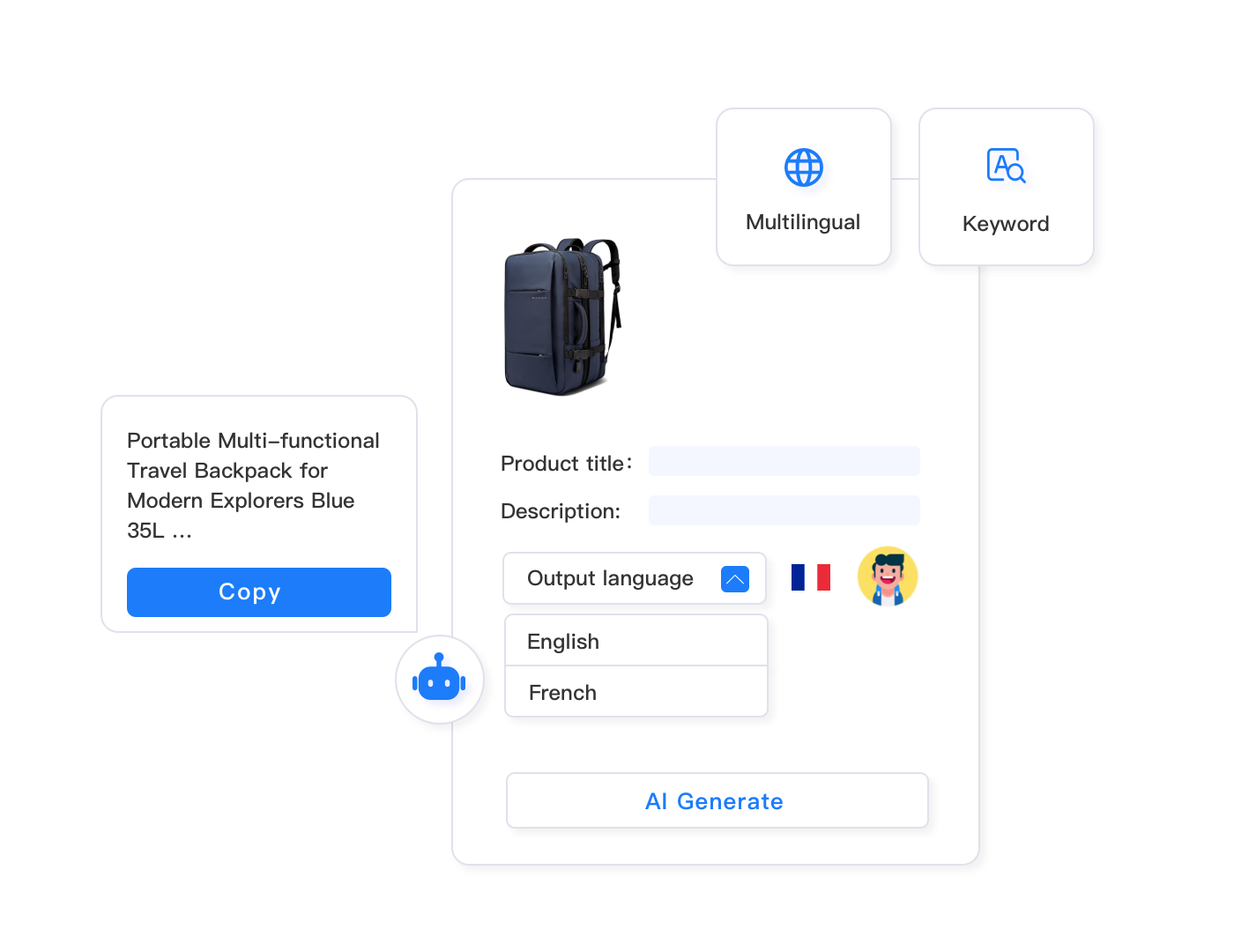
Multi-language support expands market reach. Advanced systems generate listings in multiple languages for international marketplaces, maintaining appropriate tone and cultural adaptations. This enables geographic expansion without hiring translators or international listing specialists.
Step 4: Compliance Checking and Validation
Before publishing, AI-powered listing management tools verify compliance across multiple dimensions. Prohibited words scanning detects terms that violate platform policies—medical claims on Amazon, superlatives like “best” on eBay, restricted brand mentions on Walmart. Trademark checking flags potential infringement issues before they cause account suspensions.
Attribute validation ensures logical consistency. The system confirms that size, color, and dimension combinations make sense. It verifies that category-specific required fields are populated. Error reporting identifies issues with suggested corrections, enabling sellers to fix problems before listings go live.
This automated compliance layer dramatically reduces policy violation rates. Instead of discovering errors after platform suppression or customer complaints, sellers catch issues at the creation stage. Therefore, account health metrics improve alongside operational efficiency.
AI Product Listing Optimization by Platform: Amazon, eBay & Walmart
Each marketplace has unique attribute requirements, algorithm priorities, and optimization strategies. Understanding platform-specific differences maximizes the value of AI listing automation.
Amazon: Attribute Requirements and AI Optimization
Amazon’s A9 algorithm heavily weights complete attribute data when determining search rankings and relevance. Required attributes vary dramatically by category—Electronics might demand 35+ fields while Apparel requires different sets for size matrices and material specifications. Recommended attributes, though optional, significantly impact visibility for competitive searches.
AI optimization for Amazon focuses on several key areas. The technology auto-fills both “Vital Info” sections visible to shoppers and technical “Product Details” that feed the algorithm. Backend search terms, limited to 250 bytes, get optimized with keyword research rather than random word stuffing. Brand Registry requirements—critical for brand protection—get validated automatically.
Variation listings pose particular challenges. Products with multiple size and color combinations require complex attribute structures where each variant has individual dimensions, weights, and SKUs. AI handles this complexity automatically, generating parent-child relationships with complete attribute sets for every variation. Time savings for variations prove especially dramatic—what might take 20+ minutes manually reduces to under a minute with automation.
eBay: Item Specifics Automation for Best Match
eBay’s Best Match algorithm explicitly prioritizes item specifics completion in ranking calculations. Listings with comprehensive specifics rank higher than similar listings with minimal data. Category-dependent requirements mean Electronics might need 25+ specifics while Jewelry requires different attribute sets focused on materials and measurements.
AI listing optimization for eBay excels at several tasks. First, it automatically populates all required specifics—those flagged as mandatory by eBay’s category requirements. Second, it suggests and fills recommended specifics that improve visibility even when not strictly required. Third, it creates custom item specifics for niche products where standard options don’t suffice.
Automotive fitment data presents unique challenges on eBay. Parts listings require compatibility tables showing which vehicle years, makes, and models work with each product. Manual fitment data entry can take 10-15 minutes per listing. AI systems either scrape this data from supplier sources or utilize vehicle databases to auto-generate compatibility tables.
The visibility impact proves substantial. eBay sellers report 35-50% impression increases when improving specifics from basic 8-10 fields to comprehensive 20-25+ fields. Since Best Match directly factors specifics into rankings, this optimization translates into measurable traffic and sales improvements within weeks.
Walmart: Rich Attribute Data for Buy Box Eligibility
Walmart’s Content Catalog system requires extensive attribute completion—often 25-45 fields depending on category. The platform’s quality scoring system, updated in 2025, makes 90%+ attribute completion critical for Buy Box eligibility. Products with incomplete attribute sets face visibility penalties regardless of competitive pricing.
AI optimization for Walmart addresses several platform-specific requirements. Item Spec 5.0 compliance gets validated automatically, ensuring attribute formats match Walmart’s strict standards. Enhanced content attributes—those that enable rich product pages—get populated to maximize conversion rates. Walmart’s unique taxonomy gets properly navigated through intelligent category mapping.
Measurement attributes prove particularly important on Walmart. The platform requires specific unit formats and precision levels for dimensions, weights, and volumes. Manual errors in measurement formatting cause validation failures and listing rejections. AI systems standardize these formats automatically, converting between imperial and metric units as needed.
Time savings on Walmart often exceed other platforms because attribute requirements are more extensive. A home goods listing meeting all 38+ required attributes might take 20-30 minutes manually. AI reduces this to 45-60 seconds while ensuring every field meets Walmart’s technical specifications.
| Platform | Required Attributes | Recommended Attributes | Manual Time | AI Time | Visibility Impact |
|---|---|---|---|---|---|
| Amazon | 8-15 | 20-40 | 15-20 min | 30 sec | Improved A9 ranking |
| eBay | 8-15 | 15-30 | 10-15 min | 25 sec | 35-50% visibility boost |
| Walmart | 15-25 | 25-45 | 20-30 min | 45 sec | Buy Box eligibility |
Best AI Listing Generator Tools: Features and ROI Comparison
Selecting the right AI listing optimization tool requires understanding essential features, platform support, and realistic ROI expectations. Not all AI listing generators offer equivalent capabilities or value.
Essential Features in AI Listing Optimization Tools
Multi-channel support stands as the most critical requirement. Tools should handle at minimum Amazon, eBay, and Walmart with platform-specific optimization for each marketplace. Additionally, automated attribute mapping must work intelligently across different taxonomies rather than using simple one-to-one conversions.
Bulk listing creation capabilities prove essential for sellers managing substantial catalogs. Look for tools that process hundreds or thousands of listings simultaneously through Excel upload or API integration. Rule-based editing enables targeted updates—for example, “update all Electronics listings with missing ‘Wattage’ attributes”—without republishing entire catalogs.
Compliance and policy checking should catch issues before publication. The best systems maintain updated prohibited word lists, trademark databases, and category-specific restriction knowledge across all supported platforms. Learning capabilities improve accuracy over time as the system processes corrections and identifies patterns in your specific product categories.
Maxmerce AI Listing Generator: Complete Automation
Maxmerce provides comprehensive multi-channel listing management with AI-powered automation across Amazon, eBay, and Walmart. The platform’s AI Listing Generator creates optimized content while automatically filling dozens of item specifics and attributes in seconds.
Core capabilities include intelligent listing creation with AI-powered titles, descriptions, and bullet points optimized for both search algorithms and shopper conversion. Smart category and attribute mapping works across platforms, translating your product data into marketplace-specific formats automatically. Prohibited words checking and compliance validation prevent policy violations before listings go live.
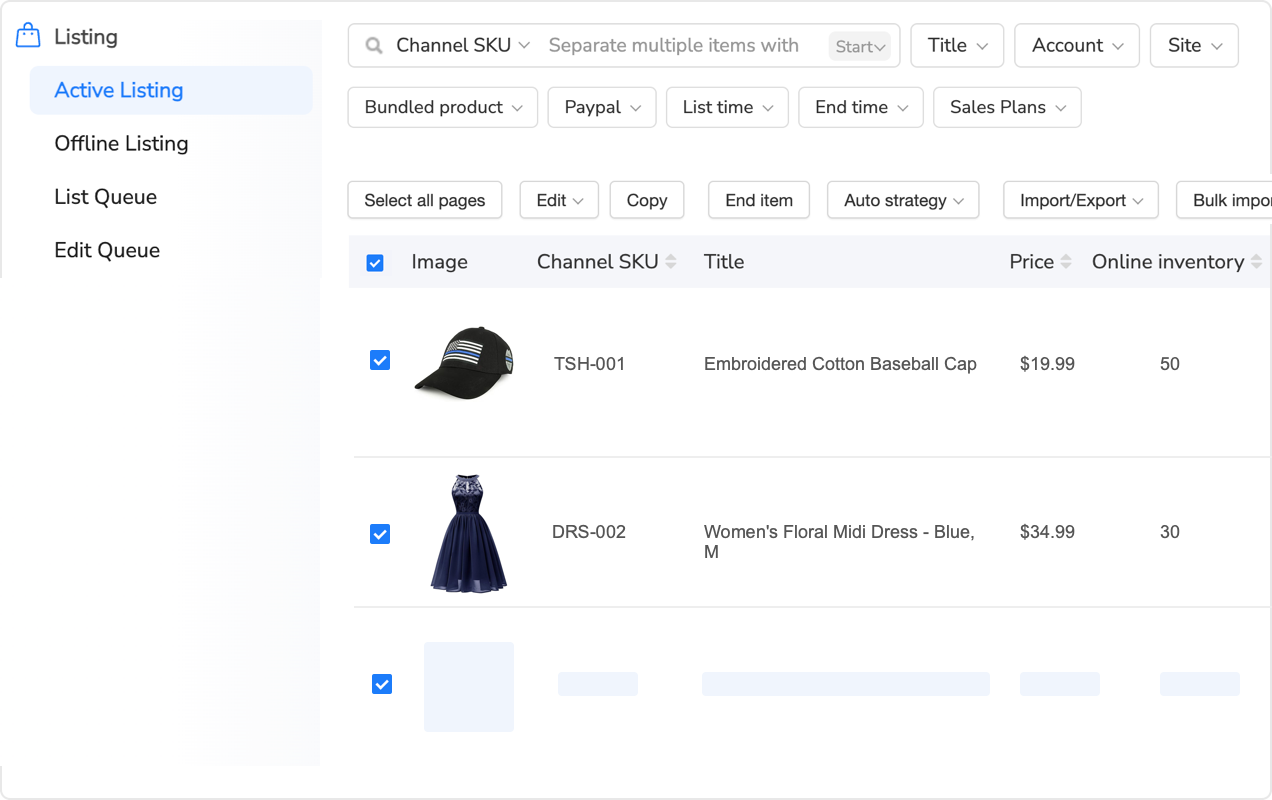
Bulk operations via Excel enable managing thousands of listings simultaneously. Rule-based editing targets specific segments—update prices for a category, add missing attributes to filtered products, or modify content based on performance data. Real-time inventory sync prevents overselling across channels while maintaining accurate stock levels everywhere.
Unique differentiators set Maxmerce apart. The system can fill 20-50+ attributes in seconds compared to 15-30 minutes manually—designed to help dramatically reduce listing creation time. Platform-specific optimization ensures Amazon listings leverage A9 algorithm factors, eBay listings maximize Best Match visibility, and Walmart listings meet Buy Box requirements. The learning system improves accuracy over time, getting smarter about your products and categories with use.
Integration with Maxmerce’s full suite amplifies value. Listing performance analytics track which attributes correlate with higher conversion rates. CRM features automate customer communications. Advertising tools optimize campaigns based on listing performance data. This integration creates a comprehensive ecosystem rather than isolated point solutions.
Pricing starts from $19/month with 20% discounts for annual subscriptions. Plans scale based on listing volumes and feature requirements, making the platform accessible to sellers ranging from small operations managing 100 SKUs to large enterprises with 10,000+ products across multiple brands. For detailed pricing and plan comparisons, visit the pricing page.
ROI Calculation: When AI Listing Tools Pay for Themselves
ROI analysis for AI listing tools involves straightforward calculations. Primary savings come from labor time reduction. If you create 100 listings monthly and AI saves 14 minutes per listing (reducing 15 minutes to 1 minute), that’s 1,400 minutes or 23.3 hours saved monthly. At $20/hour labor cost, monthly savings reach $466—significantly more than typical tool costs of $19-99/month.
Break-even happens quickly for most sellers. Even at low volumes of 50 listings per month, time savings typically exceed $200-300 in labor value. Additionally, the ability to scale without proportional cost increases provides strategic value beyond immediate ROI. Sellers can expand catalogs by 10x without needing additional staff for listing creation.
Secondary benefits amplify ROI further. Increased visibility from complete attributes drives revenue growth—if 35% more impressions yield even 10% more sales, that revenue increase often exceeds tool costs by 10-20x. Reduced listing errors prevent suppression-related lost sales. Faster time-to-market enables capturing trending opportunities competitors miss while building manual listings.
How to Implement AI Product Listing Optimization: Step-by-Step Setup
Successfully implementing AI listing automation requires systematic planning rather than diving in headfirst. Following a structured approach maximizes results while minimizing risks.
Phase 1: Audit Your Current Listing Process
Begin by documenting current performance. Track time spent per listing across different categories—Electronics might take 20 minutes while Apparel takes 12. Calculate attribute completion rates by exporting existing listings and analyzing how many required versus recommended fields you’re filling. Measure baseline search visibility and conversion rates for comparison after optimization.
Identify specific pain points. Which categories have highest error rates? Where do policy violations occur most frequently? What product types take longest to list? Which platforms cause most frustration? This analysis focuses optimization efforts on areas with highest impact potential.
Prioritize products strategically. Start with best-selling items or highest-margin products rather than entire catalogs. Focus on categories with most incomplete attributes for maximum visibility gains. Target products with upcoming seasonal demand where faster listing enables capturing market opportunities.
Phase 2: Choose and Configure Your AI Tool
Evaluate tools based on your specific platform mix and product categories. Verify that supported marketplaces match where you sell. Check category coverage—some tools handle certain product types better than others. Review compliance features for your specific categories, particularly regulated products with strict attribute requirements.
Configuration involves several steps. Connect marketplace accounts through API credentials or authorization workflows. Import existing product catalogs or configure data sources for new products. Create templates for common product types to streamline future listings. Set automation rules defining which tasks run automatically versus requiring review.
Initial setup takes 2-4 hours but pays dividends through ongoing efficiency. Take time to configure preferences, establish naming conventions, and set quality standards. Document your workflow so team members can maintain consistency.
Phase 3: Test with Small Batch
Start with 10-20 products in a single category rather than processing entire catalogs immediately. This pilot phase identifies issues while limiting exposure. Review AI-generated attributes carefully for accuracy—verify technical specifications, measurements, and compatibility data match reality.
Compare performance metrics. Monitor search visibility changes for optimized listings versus control groups. Track conversion rate shifts. Measure time savings accurately by timing both manual and AI-assisted processes. This data validates expected benefits and identifies optimization opportunities.
Make corrections to improve learning. When AI makes mistakes, correct them within the platform. Most systems feed these corrections back into their models, improving future accuracy for similar products. Document patterns in errors to adjust templates or data sources.
Phase 4: Scale and Optimize
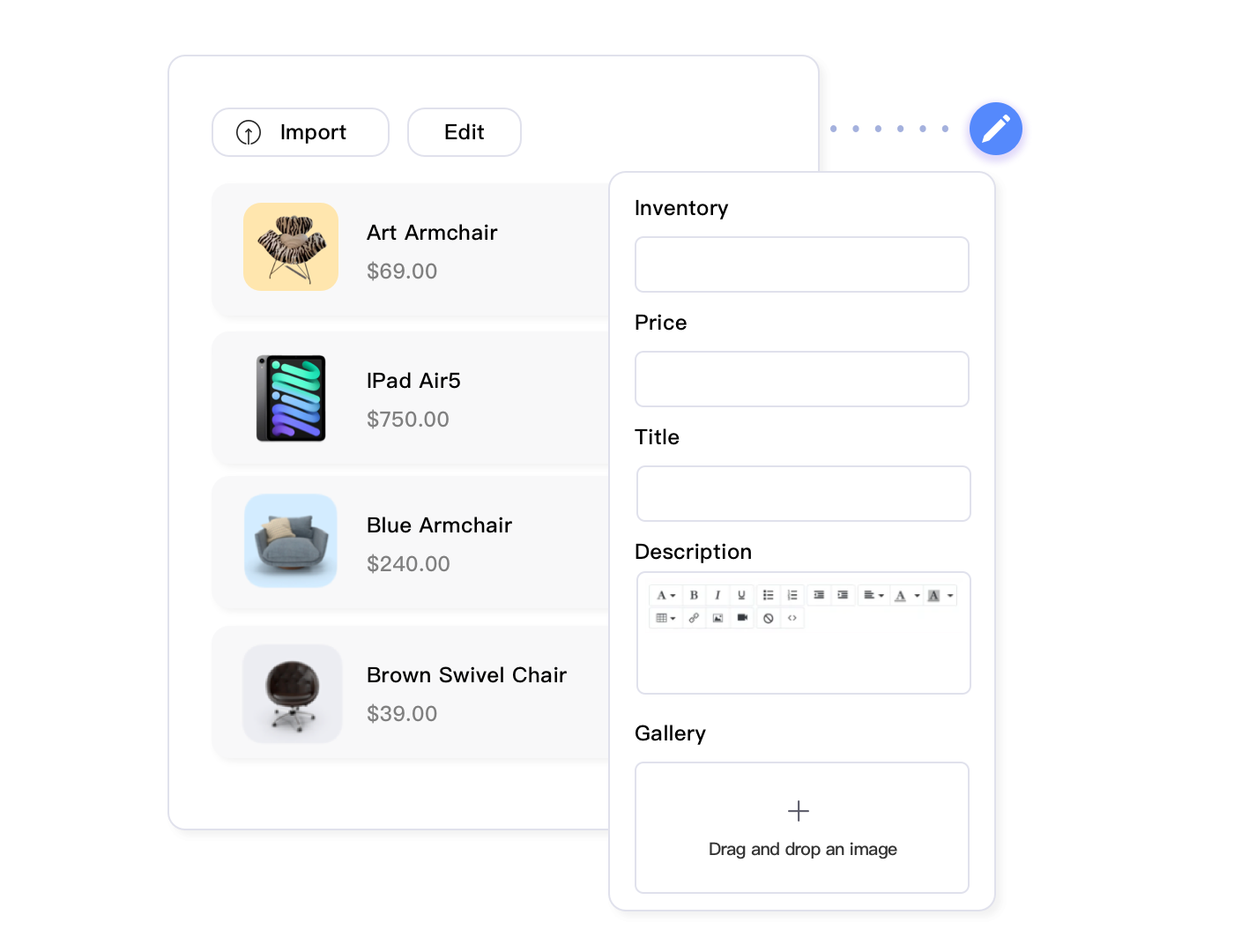
Expand to full catalog systematically after validating the pilot. Process products in category batches, applying learnings from each wave to subsequent groups. Use bulk operations to update existing listings rather than just creating new ones—retroactive optimization often yields substantial visibility improvements.
Monitor performance metrics continuously. Track category-level changes in impressions, clicks, and conversions. Identify which attribute additions correlate with biggest visibility boosts. Refine templates based on performance data rather than assumptions.
Train team members on AI tool usage. Create documentation for common workflows, troubleshooting procedures, and quality standards. Establish review checkpoints—especially for new product types or regulated categories. Set up automated workflows for recurring tasks like seasonal updates or promotional campaigns.
5 Common AI Listing Optimization Mistakes to Avoid
Even powerful AI tools can fail to deliver results when used incorrectly. Avoid these common pitfalls to maximize value from listing automation.
1. Trusting AI Without Verification
AI typically achieves 85-95% accuracy for standard attributes, which means 5-15% of outputs need correction. Always review AI-generated attributes for technical accuracy, especially measurements, specifications, and compatibility data. For example, AI might misinterpret “2L” as length instead of volume, or confuse metric versus imperial units.
Verification importance increases for regulated categories. Health, beauty, children’s products, and supplements face strict attribute requirements. Incorrect claims or missing safety warnings cause compliance issues beyond simple visibility problems. Therefore, establish review workflows where human experts validate AI output before publication.
2. Ignoring Platform-Specific Requirements
Each platform has unique attribute taxonomies and naming conventions. Simply copying Amazon attributes to eBay creates mismatches—”Fabric Type” on Amazon becomes “Material” on eBay. Category-specific requirements vary dramatically—Electronics needs different specifications than Apparel.
Understanding these nuances matters. For instance, eBay automotive parts require compatibility tables showing fitment data, while Amazon uses different compatibility attribute structures. Walmart demands specific measurement formats that differ from eBay standards. Platform-specific optimization ensures listings meet individual marketplace requirements rather than using lowest-common-denominator approaches.
3. Providing Incomplete Product Source Data
AI quality depends entirely on input quality. Providing minimal data like basic titles and prices yields minimal results. Comprehensive input—detailed descriptions, technical specifications, measurement data, material information—enables AI to generate complete, accurate attributes.
Best practice involves creating rich source data templates. Include all known specifications even if certain platforms don’t require them. Better inputs generate better outputs, reducing correction time and improving first-pass accuracy from 85% to 95%+.
4. Failing to Optimize for Search Keywords
Attributes shouldn’t just be technically accurate—they should include relevant search terms. For materials, use both technical terms and customer language: “Aluminum Alloy” and “Lightweight Metal” capture different search queries. Colors should include specific shades (“Navy Blue”) and general terms (“Blue”).
Competitor research identifies optimization opportunities. Analyze top-ranking listings in your categories to see which attribute keywords they use. Incorporate high-traffic terms while maintaining accuracy. Balance technical precision with discoverability.
5. Setting and Forgetting
Platform requirements change continuously. Amazon adds new category-specific attributes quarterly. eBay updates required item specifics lists. Walmart revises taxonomy structures. What was complete six months ago might be incomplete today.
Regular audits catch these changes. Schedule quarterly reviews of attribute completion rates, checking for new requirements in your categories. Monitor competitor listings for attributes you’re missing. Update templates when platforms release new specifications. This ongoing maintenance ensures sustained visibility rather than gradual decline.
Frequently Asked Questions: AI Product Listing Optimization
How accurate are AI listing generators for product attributes?
AI listing generators typically achieve 85-95% accuracy for standard attributes like brand, size, color, and material. The technology analyzes product titles, descriptions, images, and specifications to extract relevant data. Accuracy improves as the system learns from your corrections. However, you should always review technical specifications, measurements, and compatibility data to ensure 100% accuracy. Most platforms allow quick corrections that train the AI to improve future results for similar products.
Can AI listing tools handle variations like size and color?
Yes, advanced AI listing generators automatically identify and create variation listings with proper attribute structures. They can handle size matrices, color combinations, and multi-dimensional variations across Amazon, eBay, and Walmart. The AI assigns individual SKUs, manages variation-specific attributes like dimensions per size, and ensures each variant has complete attribute data. This proves especially valuable for apparel, shoes, and products with multiple configuration options.
How long does it take to generate a listing with AI vs. manually?
Manual listing creation with complete attributes takes 15-30 minutes per listing on average, including category selection, required and recommended attributes, content writing, and compliance checking. AI listing generators reduce this to 30-60 seconds for the same completeness level—a 90-95% time reduction. For sellers managing hundreds of listings, this translates to weeks of saved labor. The bulk creation feature can generate hundreds of optimized listings simultaneously.
Will AI listing optimization work for niche or specialized products?
Yes, but with some limitations. AI tools excel at standard attributes across any niche—brand, dimensions, materials, colors work consistently well. For highly specialized technical specifications or industry-specific terminology, you may need to provide more detailed source data or review the initial output. Many AI systems learn from your corrections, becoming more accurate for your specific niche over time. Custom templates and rules can be configured for recurring specialized requirements.
Does AI listing optimization help with Amazon A9 and eBay Best Match algorithms?
Absolutely. Both Amazon’s A9 and eBay’s Best Match algorithms prioritize listings with complete, accurate attribute data. AI optimization ensures you fill all required and recommended attributes, which directly impacts search visibility. Complete attributes mean your products appear in more filtered searches—for example, “Red Nike shoes size 10.” Studies show 35-50% visibility improvements with comprehensive attribute completion compared to minimal attributes. Therefore, AI listing optimization provides algorithmic advantages beyond time savings.
Can I use AI to update attributes on existing listings in bulk?
Yes, this represents one of the most powerful use cases. AI listing tools can analyze your existing catalog, identify missing or incomplete attributes, and bulk-fill them across hundreds or thousands of listings. You can use rule-based filters like “all products in Electronics category with less than 50% attribute completion” to target specific segments. This retroactive optimization significantly boosts visibility for your entire catalog without manual listing-by-listing updates. Moreover, the bulk approach enables catalog-wide improvements in hours rather than weeks.
How much does AI listing optimization software cost?
AI listing optimization tools typically range from $19-199/month depending on features, listing volume, and platform support. Entry-level plans start around $19/month for basic automation, while comprehensive solutions with multi-channel support, bulk operations, and advanced AI features range from $49-199/month. Most platforms offer 20% discounts for annual subscriptions. Given that average sellers save 10-20 hours per week, the ROI is typically achieved within the first month. Calculate your specific ROI by multiplying weekly time savings by your labor cost.
Will AI-generated listings get flagged for policy violations?
Reputable AI listing tools include built-in compliance checking to prevent policy violations. They scan for prohibited words, trademark infringement, restricted terms, and category-specific restrictions before publishing. However, you remain responsible for accuracy and compliance—platforms hold sellers accountable regardless of how listings were created. Always review AI-generated content, especially for regulated categories like health, beauty, and children’s products. Best practice involves using AI for efficiency while maintaining human oversight for final approval.
Can AI listing tools integrate with inventory management systems?
Yes, modern AI listing platforms offer API integrations with popular inventory management systems, ERPs, and e-commerce platforms. This enables automated workflows where new products from your inventory system automatically trigger AI listing creation across marketplaces. Real-time inventory syncing ensures attributes stay current when specifications change. Integration capabilities vary by platform, so verify compatibility with your existing tech stack before committing. Advanced integrations can even sync pricing changes, stock levels, and product updates bidirectionally.
What happens if the AI generates incorrect product attributes?
All AI listing tools provide easy correction mechanisms. You can manually edit any attribute before or after publishing. These corrections typically feed back into the AI’s learning model, improving accuracy for similar products in the future. Most platforms include preview modes and bulk review interfaces to catch errors before going live. Therefore, you should treat AI as a powerful assistant that requires human oversight rather than a fully autonomous system. The key is establishing review workflows that balance efficiency with quality control.
Transform Your Listing Process with AI Product Listing Optimization
AI product listing optimization has evolved from competitive advantage to operational necessity for sellers managing substantial catalogs across multiple marketplaces. The technology delivers tangible benefits: up to 90% time reduction in listing creation, potential 35-50% visibility improvements from complete attributes, dramatically reduced errors and compliance issues, and scalable solutions enabling catalog growth without proportional labor increases.
Sellers without AI optimization increasingly fall behind competitors who leverage automation. Complete attributes directly impact search rankings on every major platform. Time saved from automated attribute filling enables focus on high-value activities—product sourcing, marketing optimization, customer service excellence. Meanwhile, the consistency and accuracy of AI-generated attributes prevent costly policy violations and listing suppressions.
Take immediate action to capture these benefits. First, audit current listing attribute completion rates to establish baseline metrics. Second, calculate your specific time and cost savings potential based on catalog size and creation volumes. Third, test AI listing tools with a small product batch to validate expected results. Finally, scale to your full catalog after confirming performance improvements.
Get Started with Maxmerce AI Listing Optimization
Maxmerce provides comprehensive AI listing automation designed to help reduce your listing creation time by up to 90% while improving search visibility through complete attribute coverage. The platform handles Amazon, eBay, and Walmart with integrated compliance checking and optimization tailored to each marketplace’s requirements.
Explore Maxmerce AI listing features or view pricing plans to see how automation can transform your multi-channel selling operations.
AI product listing optimization represents more than efficiency gains—it enables strategic capabilities impossible with manual processes. Sellers can test new product lines rapidly, expand into international markets with localized listings, and maintain competitive attribute coverage across thousands of SKUs. As marketplace algorithms increasingly prioritize complete, accurate attribute data, automation becomes essential for sustained visibility and growth.